Saturday, August 15, 2009

Woodstocked


Why does the Woodstock music festival, held 40 years ago this weekend, still matter? Perhaps it's because it was "half a million strong"—mega-viral before flashmobs and the Web. "Woodstock had to have been one of the earliest examples of a viral event—long pre-dating blast faxes, mass emails, Web ads, the blogosphere, texting and tweeting," says Robert Goldstein, NPR's music librarian."Somehow, 40 years ago, word spread from person to person about a fabulous outdoor rock festival at a farm a few hours outside of New York City."

Woodstock also was a community of like-minded souls formed at the edges of the cultural mainstream. Today, there is no mainstream, and crowds are more apt to form digitally; in 1969, crowds were only physical—defined less by their collaborative networking potential than by their power to disrupt the status quo. Today, hundreds of thousands of communities are forming and communicating with each other, quickly, over the Web. Back in the summer of 1969, crowd-to-crowd communication did not exist and was beyond the realm of the imaginable. Woodstock was the original flashmob, shocking in both its size and its ability to rapidly self-organize. "This was a spontaneous, pre-Web community of the anti-Establishment, a kind of peaceful protest and celebration all wrapped into one," says Henry Diltz, a photographer who captured most of the festival in a series of iconic images.

Diltz also told the BBC in a recent interview that Woodstock's crowd-power gave the anti-Establishment a platform that signaled a change in the American spirit. One of Diltz's most vivid memories is of Jimi Hendrix playing the Star Spangled Banner:

"It was a Monday morning, there were only about 20,000 to 30,000 people left—most (concert-goers) had gone home already. It was very startling to hear (Hendrix play) the national anthem that morning; there had been such mixed feelings about it, our country, patriotism. The song in a way represented the (Vietnam) war machine, yet most of people who came to Woodstock were peace-and-love hippies who didn't want to kill anybody. But then to have Hendrix play that song? It was amazing. When you heard the sound effects of dive bombs and machine guns in Hendrix' playing, it reminded you that the (Vietnam) War was still going on...

...What was so amazing was that sound, in the still morning air, of the single string, the single instrument playing. The sound was so sharp and vibrant, and it went out and echoed against the mountains and came back again. And when you looked out onto the field—which had been a green alfalfa field five days earlier—now it was just a muddy hillside and looked very much like a battleground. Somebody had stuck a branch in the ground with an American flag flying and there it was, out there in that muddy field.
It was just a transfixing moment."

Here's Hendrix in that moment, below:


(Poster: Woodstock Music & Art Fair, 1969)

Labels: , , , , , , , , , , ,

Thursday, August 21, 2008

Collective wisdom


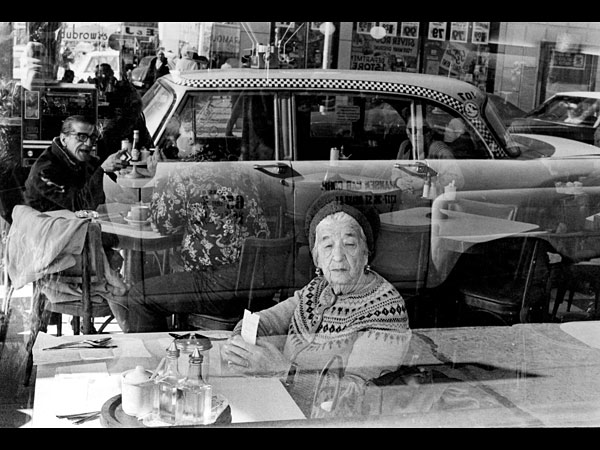
Like this photograph? Join the crowd. It is the top choice of some 3,344 people who answered an open call by the Brooklyn Museum of Art to curate 389 crowd-sourced photographs that best fit the theme, "The Changing Face of Brooklyn." (This photo was shot in 1979 by Marcia Bricker Halperin from a street in Brooklyn, through the front window of the legendary, long-gone Dubrow's Cafeteria.)

Halperin's photograph—the reflection of a Checker cab on Dubrow's window that appears to mingle with the patrons seated inside—joins nine others in the Top 10 "cut of the crowd" that comprise the museum's show, Click! A Crowd-Curated Exhibition. Entirely Web-sourced and Web-curated, the exhibit represents the first use of "crowd-sourcing" by a nonprofit in this way. The museum's goal: to build community, woo potential donors, and raise awareness of its work.

Organizer Shelley Bernstein, BMA's dynamic new manager of information systems, was inspired by the 2004 book, The Wisdom of Crowds. In it, New Yorker columnist James Surowiecki offered the world a simple but profound idea: a large, diverse group of people will make better judgments and smarter decisions than an elite few—no matter how individually brilliant.

Bernstein set out to test that theory in the context of visual art. First, she displayed the images anonymously on the museum's Web site, where anyone interested was invited to log on and rank them, one by one, on a sliding scale from "least effective" to "most effective" in fitting the theme. After a six-week rating period, Bernstein posted the top 20 percent of the images selected—78 photographs in total—on the site and they were pared down further by the crowd. Finally, Bernstein grouped them on the site into various lists, including "Most Discussed" and "Top 10 Compared."

"I wanted to build our community, expand it, and ask it to participate in what we do in some way," she says—critical for engaging new, cause-wired donors and patrons in advocacy today. Bernstein said she was "amazed" that many people who identified themselves as novices selected some of the same photographs as did the experts. (To hear more about what worked and what didn't in Bernstein's experiment, click here for the podcast of a June 28 discussion, which included Surowiecki and fellow crowdsourcing expert Jeff Howe.)

Here's another Top 10 photograph from Click! Called Just Girls, it was shot by photographer Donna Aceto last year at Coney Island:


For more on the wisdom of crowds, click on the video below, in which Howe talks about his new book, Crowdsourcing. It goes on sale next week in bookstores around the country:


Watch this site for more on the lessons of Click! I'll be moderating a September 23 panel on Web 2.0 technology and nonprofits that will include Bernstein and a discussion of her experiment at the Harvard Business School Club of New York's Social Enterprise Summit.

In the four years since Surowiecki's book, the phrases, "the hive mind" and "crowd-sourcing" have entered the lexicon: those inventing the next, "2.0" version of the Web are testing ways that companies, educators, and social change advocates can tap into their thousands of new and expanding social networks—on demand—for better ideas, more money, and greater influence.

Labels: , , , , , , , , ,