Saturday, February 19, 2011

TweetMobs

Next month marks the fifth anniversary of the first Tweet -- which Twitter creator Jack Dorsey sent at 9:50 p.m. PST on March 21, 2006. The tweet? Nothing special, actually. "Just setting up my twttr," Dorsey wrote.

The microblogging service has since wracked up an estimated 200 million users sending some 65 million tweets per day worldwide -- and, says NPR's Terry Gross, "it has been used by heads of state, astronauts in outer space and protesters in Iran, Egypt and Tunisia trying to disseminate information after news media crackdowns in their respective countries."

Earlier this week, Gross interviewed Twitter co-founder Biz Stone about the rapid growth of the social network, the short history of Twitter in activism and efforts by some governments to censor usage. "Twitter has managed to find its way into almost every political uprising around the world," Stone told Gross. "...The Internet and social media are making the world a smaller place," he added, helping to synchronize thought and action globally.

Here's an excerpt of that February 16th interview; the full podcast is below:

TERRY GROSS: What were the first indications you saw that Twitter was being used as an organizing tool in Egypt?

BIZ STONE: Well, actually, Twitter's use in Egypt goes back to something that happened in 2008 that we heard about after the fact and we were just sort of chilled by -- and that was this photojournalism student named James Buck, who had traveled from U.C.-Berkeley to Egypt specifically to photograph protests. And he wanted to get great photos in Egypt.

And so he went out there on his own, and he kept missing all of the protests that were organized. And so he asked some of his Egyptian friends that he met there: How is that you guys are, you know, suddenly organizing these protests so quickly and so efficiently? And they said: Oh, we're using this tool called Twitter.

And, you know, James was from the Bay Area, hadn't even heard of it, and he's hearing about it in Egypt. And so he gets on Twitter, and he's suddenly plugged into this network. And so he's able to make it to these protests, and there he is, taking these great photos.

And suddenly, he notices something is up. He told us later, a lot of Egyptian police have mustaches, and the mustache quotient in the crowd went up significantly, which got him worried. And he suddenly said something doesn't seem quite right.

And he was grabbed, arrested by Egyptian police, thrown in the back of a car, really starting to freak out. He's this young guy, realized they hadn't taken his mobile phone from him yet and that he was on Twitter.

And so he sent out a tweet, and it was a one-word tweet, and the word was "arrested." Within about three hours, what happened was his friends back home in California knew the situation that he was in, they had been following his other tweets. They knew it wasn't - that it was serious, that it wasn't a joke.

His friends called the dean. The dean called a lawyer. The lawyer called the consulate, and within a few hours, James sent out another tweet that was also one word, and that was simply "freed."

And when we heard about this story and that Twitter was being used in Egypt in 2008 to organize these protests, that was one of the early, eye-opening experiences for us, that made us realize this was not just something in the Bay Area for, you know, technical geeks to fool around with and to find out what each other's up to, but a global communications system that could be used for almost anything and everything.


(Photograph of Biz Stone, top, by Joi Ito)

Labels: , , , , , ,

Monday, February 7, 2011

Like Water


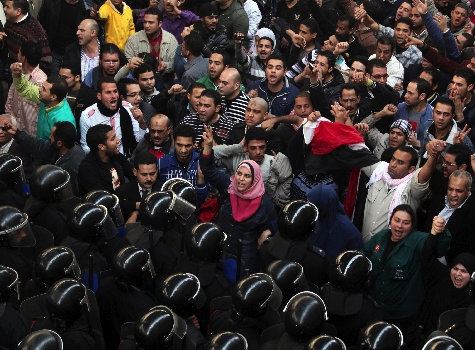
Just after the 1989 pro-democracy protests in Beijing's Tiananmen Square ended in a spray of live fire from government tanks that killed untold numbers of demonstrators, a Chinese journalist colleague of mine advised his fellow writers to "be like water." He was quoting a Chinese proverb commanding persistence in the face of towering obstacles: water, he explained, can seep through and around even the most imposing walls to get to the other side. I have been thinking of him recently, watching events unfold in Cairo's Tahrir Square.

Egyptian blogger and pro-democracy activist Mona Seif, when interviewed last week by National Public Radio's On the Media from Tahrir Square, affirmed that it was a challenge to organize anti-Mubarak demonstrators online after the Egyptian government had tried to shut down the Internet. But it wasn't impossible, she said. Seif, a post-graduate student in cancer research at Cairo University and the daughter of renowned human rights lawyer Ahmed Seif El-Islam Hamad, said the Web and social media not only helped to amass protesters but also to humanize them outside of Egypt. Additionally, she said, the government was unable to shut down all communication; information is still able to leak through.

Seif, via cell phone from the Square, told OTM that she and other activists are using a friend's wireless connection and her apartment as an online organizing hub. [Her friend's internet provider was not shut down due to its relationship with the country's financial exchanges, she explained. On the Media Host Bob Garfield quipped later that Seif's use of that wireless account was "like using a government tank to get behind enemy lines." Seif said she has another friend with a satellite connection "if things get worse."]

Here's a short excerpt from that interview:

NPR: When the (Egyptian) government shut off the Internet, did it have a backlash (effect), infuriating people who otherwise would not have mobilized?

SEIF: I think it had a backlash but not because of infuriating people. A lot of the people who would have normally been satisfied with just following the updates (of what was happening in the square) on Facebook and Twitter suddenly did not have this connection and so they found no way of being part of this movement except by going out into the streets. I think that cutting off the Internet actually helped the movement on the ground and in the street to become bigger.

NPR: We get lots of criticism here in the West about about Twitter; can you take this opportunity to explain what Twitter can mean?

SEIF: I understand this criticism because I've been getting it a lot from my friends. I think sometimes there needs to be an experience like the one we are in to really grasp just how powerful such a tool like Twitter is (and can be). The use of Twitter to engage different people in bits of your life is really what it makes it a powerful tool -- when there is a serious event and you want to engage people. If it is only used as a (personal) news feed, then it would be boring and it wouldn’t be as interactive as it should be.

Usually, I use Twitter for really personal things--to share moments from my work, or moments from my love life or I talk about my cats or my family. And it engages lots of different people, so that when these people are following you -- and suddenly you are talking about a torture case (for example) - some of them might not usually be exposed to such cases. But because they are following me and there is an ongoing conversation between us, they will suddenly be engaged in this as well. So it’s a really powerful tool in that sense.

NPR: The movement has coalesced a number of forces of anger at the (Mubarak) regime. There are trade unionists, there are Muslim Brotherhood elements, there are young people who have been facing hopelessness and despair and unemployment. How worried are you that what comes next may be worse than the status quo -- for example, an Islamic revolution?

SEIF: I really am not worried and I know that might sound strange to a lot of people. What I have seen these past nine days is making me really hopeful. I’m in Tahrir Square with thousands of people from completely different backgrounds and for once in my life, all of the big issues that we are usually encountering in the streets of Eygpt and are having to deal with, such as violence and tension and sexual harassment against girls, for example– all of these issues we keep on talking about now do not exist. I’m in Tahrir Square and feeling that I belong with those people and we are everyone -- there are Muslim Brotherhood (and) independent people who don’t belong to a political party. I really, really think this could (end up in) a much, much better scenario than what all of the outside world is expecting or feeling.

Here's hoping it will, long after (and through) the violence of the past few days -- though as of today, government forces have been moving in on protesters in the Square, attempting to minimize their numbers.

For the best ongoing coverage of the upheaval, watch Al-Jazeera's livestream, here.

To hear the OTM interview with Seif from February 3rd, click below:

For alternative views of what is happening on the ground, see this essay by Joshua Stacher, assistant professor of political science at Kent State University, which asserts in Foreign Affairs that "despite the tenacity, optimism, and blood of the protesters massed in Tahrir Square, Egypt's democratic window has probably already closed."

What do you think? Let us hear from you.

(Photo: Courtesy NPR; scene from street protests in Cairo's Tahrir Square February 3rd)


Labels: , , , , , , , ,

Saturday, October 17, 2009

Dolphin Hunting


The Cove, the award-winning documentary about covert dolphin hunting in Japan, makes its debut this week at the Tokyo International Film Festival. At a private screening I attended last night in Manhattan for Japanese filmakers, writers and environmental advocates (a gathering hosted by documentary film producer Kaoru Wang), one of the producers told us that she expects the film will trigger much controversy in Japan. Click here for the trailer.

Controversy over dolphin hunts in Japan is not new. Here's my story on the practice, "Uproar Over Dolphin Slaughter," which ran on Page One of the Hearst-owned San Francisco Examiner on Sunday, December 23, 1990. At the time, I was Hearst Newspapers' Asia bureau chief, based in Tokyo. [The Examiner is no longer owned by Hearst and stories published before 2005 are not accessible by link, so I've copied the article here from the tearsheet.] My piece, which I also produced for National Public Radio at the time, does not defend the practice but explains how villagers view the practices and why Japanese government subsidies had been encouraging the hunts. Here is that account, in full, with the original subtitles:

By Marcia Stepanek
MIIRAKU, Goto Islands — Time moves slowly here; traditions die hard.
For as long as most villagers can remember, fishermen have been butchering dolphins on the sprawling white sands of the harbor.
In 1949, on a grassy hilltop above the beach, four fishermen erected a chest-high marble stump, a Shinto shrine to the souls of the dolphins they had slaughtered below.
Last month, after 582 dolphins died on the beach, a small ceremony was held at the shrine. A burnt candle still rests against the side facing the harbor. "The dolphins cry, you know, when you kill them," says villager Ichiro Itaya. "But it is us or it is them."
That last time the dolphins came to this secluded fishing village off the southern tip of Japan, some were tied with rope to immobilize their fins before slaughter; others were clubbed, then butchered.
Dozens were hoisted onto car roofs and driven home by villagers. Those thought to be ill were buried in a yard-deep trench on the beach. Children were warned not to walk there in bare feet "because they might get cut on the bones," said villager Toshii Awaii. But that last time the dolphins came to Miiraku, they also brought international controversy, shattering what had been for generations a gentle obscurity.
Even now, more than a month after the beaching, sharp criticism by British, American and Japanese conservationists about the incident continues, prompting some Japanese leaders to complain of renewed Japan-bashing.
British tabloids, one of which renamed Miiraku's harbor "Blood Lust Bay," continue to write about the dolphins. One London weekly accused villagers of being "barbarians" and "killers" who "eat the animal's heart raw...and use its dorsal fin as a sex potion, despite worldwide protests."
And since the incident, an embarrassed Japanese government—which awards bounties for dolphins hunted here—has been scrambling to explain what happened amid growing accusations of a cover-up.
***
Matter of Survival
For generations of villagers, hunting dolphins has been a matter of survival.
During World War II and for years afterward, dolphins were food for Miiraku and other remote Goto Island villages on the East China Sea. "Food shortages from the war made it difficult," Itaya recalls. "Dolphins were our only source of protein." Now, Miiraku fishermen compete with the dolphins, and the mammals are no longer welcome. "No one hunts them anymore for food," says villager Awaii, 56, a fish buyer. "Now they are pests and will eat anything in sight. When dolphins come, you cannot fish if they are in the harbor." Even without the dolphins, fishing here is difficult. Before dawn at the local fish market, 65-year-old fish buyer Miyako Awanohara is bent over a pile of wriggling skipjack, wielding a bloody fish hook like a baton. She laments the village's shrinking supply of fish.
***
Dwindling Population
"The catch is half of what it used to be 20 years ago," she says, using her hook to separate fish by type into small piles. "The fish are smaller now, and thinner."
Awanohara blames the weather. Deputy Mayor Yoshishige Yokoyama says Miiraku's simple skiffs and handmade nets have become obsolete, no match for the high-tech trawlers that sweep coastal waters with sonar and drift nets. Strict rules limiting territory now keep Miiraku's fishermen close to the shore; some fish cannot reproduce as fast as they are caught by offshore trawlers. Yokoyama says Miiraku, too, is getting smaller. More than 15,000 people lived here 15 years ago. Now, more than half of the town's 4,973 people are older than 40, about twice the national average, and 99.3 percent of village revenue is provided by the government. "It is not longer honorable to be a fisherman here," says 25-year-old delivery truck driver Iwasaki Katsumore, one fisherman's son who stayed behind. Says Yokoyama, "No one here is optimistic about the future."
Miiraku fishermen suspected there would be trouble the night of November 1.
For days, their handmade nets, positioned at the mouth of the harbor, had come up empty. A typical morning catch included several dozen squid and skipjack. Now there was almost nothing. The next day, as they headed back to port, the fishermen saw the reason. Fins, hundreds of them, were plying the waves off the harbor.
Fishermen's Cooperative Union representative Yasuhiko Kamakura says word traveled fast. Some fishermen took their boats out to the harbor. On the beach, a "dolphin union" organized years ago to distribute dolphin meat to the villagers, gathered on the beach to start digging a trench in the sand for the dolphins they saw in the harbor.
"Fishermen were concerned about the damage to the nets," Kamakura recalled. "We tried to make them go away" from the area in the harbor where fishermen had set their nets. "Fishermen felt they must protect themselves," he said.
***
Scene of Slaughter
By morning, there were 582 dolphins on the beach—enough, Kamakura said, to make the mile-wide stretch of white sand look as if it were covered by black coats, laid arm-to-arm, as if out to dry. Over the next 24 hours, 90 dolphins were buried with earth-moving equipment, Kamakura said. Others were clubbed and slaughtered. Several hundred were sent home with villagers, some of whom transported whole dolphins tied to the roofs of their cars. "Some were still alive," Kamakura said. "If they cannot die themselves, we deal with them, and we may bury many of them."
Once inside the harbor, he said, dolphins cannot be chased back to the ocean. The shoal is shallow and the dolphins "lose their navigational ability there." In the harbor, Kamakura says, the dolphins are as good as dead. Says fish buyer Awaii: "It is local custom. Nothing unusual happened here."
***
The Mystery
But how the dolphins got from the bay into the shallow shoal area of the harbor remains a mystery. Miiraku fishermen tell conflicting stories. Some says the dolphins were chased onto the shoal. Others say fishermen sought to chase them back toward the ocean. Still others, like Kamakura, say the dolphins scattered in both directions.
For weeks, the Japanese government insisted the dolphins beached themselves, committing "mass suicide." Last week, Foreign Ministry spokesman Taizo Watanabe said some fishermen, in an effort to chase dolphins out of the bay, may have chased them into the harbor. Watanabe denies any "preconceived plot" to kill the dolphins.
***
Doubts Expressed
Many remain dubious. Japan's leading news service, Kyodo Tsushin, sent a reporter from its Nagasaki bureau to cover the beaching and stands by its account that some fishermen attempted to chase dolphins into the harbor. Naoko Kakuta of Greenpeace-Japan says natural strandings of dolphins are rare. A beaching of one to four dolphins would not be unusual, she said.
"Hundreds of stranded ones like the 582 in this case would be very rare if it happened naturally," she says, adding that in this case, people were in the harbor, in boats, "chasing the dolphins around, so it is very difficult to see the situation as a totally natural stranding."
Last week, Toru Ishihara, the former chief of the Goto Island Ocean Fisheries Control Committee, an arm of the Nagasaki prefectural government, said, "It is a fact that the fishermen drove the dolphins ashore...Unless we admit that and start explaining why hunting is necessary, we will be considered barbarians every time we hunt."
***
Dolphin Bounty
For the last three years, the Nagasaki prefectural government has been awarding Miiraku fishermen a bounty of $38 for each dolphin they hunt and slaughter. Masahiro Iwasaki, supervisor of the fisheries division of the Nagasaki prefectural government,s aid Miiraku fishermen seldom make claims. In 1989, the village received about $2,300 for hunting 60 dolphins. Before November's incident, authorities had awarded $923 dollars for 24 dolphins captured and killed in the village this year.
Watanabe says Nagasaki officials have been advised against paying bounties to Miiraku for the November beaching, for fear that foreign critics "misunderstand" the intent of the bounty system, which is unique to Nagasaki prefecture in southern Japan. Iwasaki says bounties are awarded "to help protect the local Miiraku fisheries industry." Watanabe says that "if there is a real need for a bounty, it should be paid. but this time, there was such an international outcry against the dolphins...that concern about the image of the prefecture was taken into account."Kamakura said villagers sought $20,300 for the time and effort it took to "clean up the beach." Last week, the bounties were denied.
***
Too Many Dead
At Isekiji's tavern, a sake and yakotori bar on a hill above the Miiraku harbor, patrons say they don't understand why the beaching caused such an uproar. "It is strange that (the dolphins) should become a topic of discussion like this," says Itaya, who runs the bar with his wife, Misako.

From the shrine above the harbor, Kamakura voices similar thoughts to an American visitor. "Take a look," Kamakura advises. Against an afternoon sky, Miiraku glows pink and orange against the clouds and is awash with sound—the faint squeals of sea gulls and school children, the muted hum of voices, boat engines and small cargo hoists. "I want people to come up here and see for themselves that we are not what they call us in the foreign press," he says, squinting against a cold wind. "Six hundred dolphins is too many dead. We want them to sleep now, eternally, in peace."

(Photo: A still from The Cove, courtesy Diamond Films)

Labels: , , , , , ,

Saturday, August 15, 2009

Woodstocked


Why does the Woodstock music festival, held 40 years ago this weekend, still matter? Perhaps it's because it was "half a million strong"—mega-viral before flashmobs and the Web. "Woodstock had to have been one of the earliest examples of a viral event—long pre-dating blast faxes, mass emails, Web ads, the blogosphere, texting and tweeting," says Robert Goldstein, NPR's music librarian."Somehow, 40 years ago, word spread from person to person about a fabulous outdoor rock festival at a farm a few hours outside of New York City."

Woodstock also was a community of like-minded souls formed at the edges of the cultural mainstream. Today, there is no mainstream, and crowds are more apt to form digitally; in 1969, crowds were only physical—defined less by their collaborative networking potential than by their power to disrupt the status quo. Today, hundreds of thousands of communities are forming and communicating with each other, quickly, over the Web. Back in the summer of 1969, crowd-to-crowd communication did not exist and was beyond the realm of the imaginable. Woodstock was the original flashmob, shocking in both its size and its ability to rapidly self-organize. "This was a spontaneous, pre-Web community of the anti-Establishment, a kind of peaceful protest and celebration all wrapped into one," says Henry Diltz, a photographer who captured most of the festival in a series of iconic images.

Diltz also told the BBC in a recent interview that Woodstock's crowd-power gave the anti-Establishment a platform that signaled a change in the American spirit. One of Diltz's most vivid memories is of Jimi Hendrix playing the Star Spangled Banner:

"It was a Monday morning, there were only about 20,000 to 30,000 people left—most (concert-goers) had gone home already. It was very startling to hear (Hendrix play) the national anthem that morning; there had been such mixed feelings about it, our country, patriotism. The song in a way represented the (Vietnam) war machine, yet most of people who came to Woodstock were peace-and-love hippies who didn't want to kill anybody. But then to have Hendrix play that song? It was amazing. When you heard the sound effects of dive bombs and machine guns in Hendrix' playing, it reminded you that the (Vietnam) War was still going on...

...What was so amazing was that sound, in the still morning air, of the single string, the single instrument playing. The sound was so sharp and vibrant, and it went out and echoed against the mountains and came back again. And when you looked out onto the field—which had been a green alfalfa field five days earlier—now it was just a muddy hillside and looked very much like a battleground. Somebody had stuck a branch in the ground with an American flag flying and there it was, out there in that muddy field.
It was just a transfixing moment."

Here's Hendrix in that moment, below:


(Poster: Woodstock Music & Art Fair, 1969)

Labels: , , , , , , , , , , ,

Monday, January 19, 2009

Inaug-o-rama!

Here are just some ways to use social media today and tomorrow to share your Inauguration Day experiences:

*Participate in "The Moment" project by CNNPolitics.com, which will use Microsoft's photosynth technology to create a massive, 3-D photo compilation of the precise moment Obama takes his oath of office. Email your photo of that moment to themoment@cnn.com and then, later, head to cnn.com/themoment to see the results.

*See Link Live's Inauguration tweetstream at http://twitter.com/linklive.

*Go to CNN's political ticker, http://twitter.com/politicalticker, for the network's tweet coverage

* National Public Radio has set up a way for people going to the Inaugural to tweet their experiences and impressions by using the hashtag #dctrip09 to describe their travel to Washington and #inaug09 on Inauguration Day to weigh in on what it's like to be in the middle of it all. Follow twitter.com/inauguration for the latest tweets.

*Current and Twitter are teaming up again to broadcast as many tweets as possible over the inauguration ceremony and also will be streaming the event live.

*Check out Inaugurationreport.com, a joint project of NPR, CBS, American University, and others. The site compiles input from on-the-street citizen reporters through Flickr, YouTube, Twitter and other mobile applications.

*For a similarly condensed view of online inaugural-mania, do a Big Buzz search on Icerocket. This search site gives near real-time results from the Web, blogs, Twitter, video sites, news sites, and other Web 2.0 tools and mashes it all onto one page.


(Illustration, Swiss Army Phone, by Russell Tate for istock.com)

Labels: , , , , , , , , , , ,