Friday, June 27, 2014

#LikeAGirl


Like many women I know, I was told repeatedly by my older brother growing up that I threw a softball "like a girl"— despite turning in an impressive season many years later as shortstop for a co-ed softball team I organized at the University of Hawaii, while there on an international reporting fellowship.

That phrase continues to catch my attention, and I heard it again the other night, after leaving a movie at NYC's Film Forum. There, on the street near the subway, I overheard two men accusing a third of "acting like a girl" during an argument that would soon turn into a fistfight. I stopped myself from shouting, to anyone in particular, "What's so bad about acting like a girl?"

Filmmaker Lauren Greenfield and her new three-minute cause video out this month, called #LikeAGirl, has saved me the trouble. Greenfield, who directed the 2012 documentary, Queen of Versailles, was commissioned by feminine hygiene brand, Always, to make the video as part of the company's CSR initiatives. Watched by more than 40 million people on YouTube since it launched last month, the video has sparked a new national conversation on female empowerment and self-esteem.

"Always was interested in looking into how girls deal with the confidence crisis that happens around puberty," Greenfield told CauseGlobal. "Everyone knows that 'crying like a girl' or 'running like a girl' isn't a compliment, but no one takes the off-the-cuff remark too seriously or considers its damage."  Greenfield said she came up with the idea of asking a handful of adults, for her camera, to imitate running, throwing and fighting "like a girl." The results are predictable, but the surprising part comes when Greenfield later asks young girls the same questions.

Have a look. When was the last time you used or heard the phrase? How did you feel when you said or heard it?


-- Marcia Stepanek


Labels: , , , , ,

Saturday, November 16, 2013

SxSW Bound

Workshop_Interactive
My workshop on Cause Video, to be co-presented with Jefferson Graham of USA Today, has been accepted on the program roster for the 2014 SxSW. The workshop, "Viteracy Now! Cause Video and the Proof Imperative," is slotted to run on March 11th. Modeled after my NYU Cause Video Lab (which I teach as part of my graduate class, The Wired Nonprofit: Social Media Strategy and Practice with Howard Greenstein and Tom Watson), this SxSW workshop will explore the latest trends and practices in the emergence of short-form video as a critical tool for conveying urgency, proof and relevancy in the social good sector.
Jeff and I also will discuss ways to measure video impact and build cross-sector, group-to-group support for specific causes that can endure from one campaign to the next. Attendees will gain working knowledge of the 10 types of cause videos being used successfully in the social commons and advocacy sector today, and discover which types are best for creating specific outcomes. Attendees also will learn how short-form video is better made in-house, with the best campaigns employing smart social/mobile strategies for maximum impact and continuous engagement.

Hope you'll be able to join us!

--Marcia Stepanek


Labels: , , , ,

Tuesday, June 11, 2013

Cause Video: A First-Ever Survey

YouTube, See3 and Edelman just released a first-of-its-kind survey on nonprofit sector use of Cause Video, asking 500 cause leaders and experts how the social good sector is using video stories to make an impact. [The report, Into Focus: Benchmarks for Video and A Guide for Creators can be found here.] Full disclosure: We here at Cause Global were among those experts polled, based on our work to create a cause video curriculum and lab at NYU's Heyman Center for Philanthropy and Fundraising to help the sector take video-making in-house.]

The survey's big takeaways? First, nearly all of those polled (91%) say video is important and will get more important over the next three years. Second, most nonprofit leaders (87%) say they intend to produce a lot more video. [No surprise so far: Cisco projects that by 2017, just five years from now, two-thirds of the world's global consumer data traffic will be video.]

But here's the rub. This video enthusiasm is not (yet) being reflected in nonprofit spending—and in a big way. Only 6% of the cause leaders queried say they anticipate a significant increase in their video budgets in the coming year, 24% said they expect only a slight increase, and the rest think allocation of funds will remain about the same as it is today, or even slide. "Only about a quarter of those polled expect some increase in their video budget and 70% do not," says Michael Hoffman, CEO of See3 and one of the founders of the survey. "That's a full two-thirds of organizations who won't be spending more than they do now, and maybe even less. There's definitely an underlying discomfort behind all that video enthusiasm."

So what's driving it? There are four top barriers:

* The biggest barrier cited, by far, are budget restrictions. Nonprofits would make more video if their budgets were bigger, 79% of respondents said. [Annual video expenditures for 66% of the organizations surveyed were $10,000 or less.] According to the survey, a full half of the respondents currently outsource what video projects they have to outside studios rather than try in-house projects which can be just as good, if not better. By tapping volunteers with special expertise or turning to lower-cost equipment, such as smartphones and free editing software, a rising number of organizations are starting to make short, high-quality videos themselves at very low cost. "The excuse that we nonprofits don't have the equipment has gone away," Hoffman says. "It's not just you who has a camera in your pocket. Your constituents do, too." Still, about 20% of organizations said they lack the skillsets needed to make their own videos.

* Staff resources aren't ideal. Slightly more than half of those polled (52%) said the staff lacked the time to focus on video production. People are already overworked and are reluctant to take on more, respondents said, especially if they won't be paid for their efforts. "Trouble is," says Hoffman, "video is here to stay. If you want to reach people with your message in this hyper-connected world, you need to incorporate video into your marketing and fundraising plans, and then assign the necessary personnel to take responsibility for producing it and overseeing it." Better yet? Start building internal capacity for video editing and storytelling with your very next hires in all departments. And meanwhile? Ask volunteers to film or photograph your on-the-ground programs as they occur. Sharing your organization's work in simple videos posted on YouTube is a good way to start.

* Internal departments don't collaborate very well. Nonprofit cultures still tend to be more hierarchical than collaborative. Cultural factors, such as a not-invented-here syndrome, and departmental silos, were cited by nearly 40% of respondents. In many organizations, both large and small, each department has its own budget and task list. "In some cases, we found that the communications department would have a video budget but the fundraising department down the hall didn't have access to that," Hoffman said. "Very few nonprofits are doing joint projects internally with shared budgets and goals—yet."

* Nobody knows how to measure the impact of a video. A large number of respondents said they don't know, and have no way of knowing, if a video works or not against nonprofit objectives. They don't have video metrics, and to be sure, most nonprofits are still struggling with measurement issues across the spectrum of their new media efforts. During the Philanthropy 3.0 Speaker Series  we curated and moderated at NYU this spring, both Hoffman and DoSomething.org's top data scientist, Bob Filbin, cited the frustration. "How many views from people does it take to consider a YouTube video a success? Try 1.5 million," Filbin said on one of our NYU panels on the use of Big Data in advocacy. "We got that many views on one of the videos we posted in 2011, and we all thought it was a success, right? But then came the data report. Only eight viewers had signed up to donate equipment, which was what the video was trying to get people to do." So what happened? "We were concerned with the wrong metric," Filbin and colleague Jeff Bladt wrote in the Harvard Business Review on March 13. "...As we learned, there is a difference between numbers and numbers that matter."

Hoffman and other survey founders caution that maybe the sector is looking too hard at conversion rates as a way to measure the impact of a good video. Maybe something is getting overlooked, Hoffman says, suggesting the biggest survey takeaway of all may be this: "Videos provide the emotional framework for the ask," he says. "People respond to a good story more than anything else. Emotion leads to attention leads to support."

Among other survey findings:

* Who's in charge of cause video production at most nonprofits? Not surprisingly, the communications department (58%), followed by digital/social media (32%), fundraising (20%), and volunteers (19%). Outside video producers are contracted for about half of the total videos, though the trend is moving toward more in-house production, says Hoffman.

* Shorter is better. Viewers of all stripes start tuning out after 10-15 seconds. According to Hoffman, if you don't put the ask within the first 15 seconds of your video, you will lose most of your audience.

* 'Thank-you' videos are gaining in popularity, mostly because they can be made in-house, at less expense and by volunteers using their smartphones. These types of short videos can be an important part of your donor relationship management strategy; donors love to see themselves in a video or to be personally and publicly thanked in one. Here's one made by charity:water.org.

* What are the top social media channels used to distribute cause video? YouTube ranked No. 1 with 81% of respondents, followed by Facebook (78%), Twitter (55%), Vimeo (16%), Google+ (10%) Pinterest (8%) and private social networks at 5%.

* What's the best way to get your videos viewed? Send your videos to known supporters of your cause and organization rather than to people who have shown no previous interest in your mission. "It is much more effective to get your video to 100 of your organization's most passionate supporters, who will share, promote, and engage with your content," Hoffman says. "These 100 are most likely to work for you, and their friends are more likely to view something that comes from someone they already know."

How is your organization using video? Are you experimenting with Vine? Our cause video news team here at Cause Global would love to hear from you.

-- Marcia Stepanek


Labels: , , , , , , , , , , ,

Thursday, April 11, 2013

Cause Video Awards


Here are this year's Do-Gooder Nonprofit Video Award-winners, announced last night at the 2013 NTEN conference. On Wednesday, Cause Global moderated a panel on cause video at NYU that included Do-Gooder co-founder Michael Hoffman, who joined us for a screening of two of the films—including the winner of the Best Nonprofit Video Award, Follow the Frog (Rain Forest Alliance), below:


The two other top cause videos to win awards (below), co-sponsored by YouTube and Cisco, were Pathfinder International's No Joke. Choice Matters, about the difficulties women across the global face when trying to access reproductive health care, and END 7's How to Shock a Celebrity, which was used to draw attention to seven neglected tropical diseases and raise funds to help end them by 2020.

Here's How to Shock a Celebrity, winner of the competiton's ImpactX Award, a new award given this year for measureable effectiveness in a video campaign:


Here's No Joke, winner of the competition's Funny for Good Award, which recognizes cause video campaigns that use humor effectively to draw awareness to a cause:


Hoffman told our panelists Wednesday night that the use of cause video by nonprofits to boost awareness and fundraise is on the rise. But according to a first-ever survey of nonprofit leaders, co-sponsored by See3, there's still a big shortfall in funding available for good video projects. One key reason, the survey says, is that the nonprofit sector's senior executive leadership doesn't yet fully appreciate the critical power of visual storytelling — chiefly across new social networks — to help generate credibility, engagement and support for a cause.  "Video is becoming a requirement for nonprofits to compete effectively for new donor dollars online," Hoffman says. He said he founded the Do-Gooder awards "to help encourage the creation of more good films to raise more good money for more terrific causes across the digital landscape."

For more on the winners and to see the runners-up, check out the Do-Gooder site.

Got a favorite? Share it with us here at Cause Global!

--Marcia Stepanek

Labels: , , , , ,

Friday, March 15, 2013

NYU Cause Video Lab


Part of the social media strategy class I teach this spring at NYU with co-profs Tom Watson and Howard Greenstein is a Saturday Video Lab, which I designed to help students become "viterate" and to help them visualize the missions of the nonprofit causes for which they either work or volunteer. (In class, each student must develop a social media strategy for a nonprofit of their choice, and also make a 60-second visual mission statement for that nonprofit, presenting both in front of the class in May for their final grade.)

To help me teach this mandatory Saturday lab segment of the class this year, I invited USA Today's Jefferson Graham. I'd met Graham at a video lab he taught last fall at the annual PDN/PhotoPlus Conference at New York's Jacob Javits Center, and his approach to teaching video editing — by crowdsourcing the exercise —was so inspired, I wanted Graham to help me and my co-profs, Watson and Greenstein, spread the magic among our students.

There were two rules: I'd insisted that each student use a smartphone to shoot their videos this year, so as to prove that not every good video required expensive equipment to produce. The second rule? Everyone had to participate.

We broke the class into three teams, each equipped with a tripod and a smartphone and a special microphone, and took them outside to Bryant Park, just across the street from our midtown Manhattan video lab classroom. Each team was assigned to find out how Mayor Michael Bloomberg's outdoor public smoking ban has been faring. (Answer? Not very well. The students found quite a few people still lighting up. To document this, we asked some students to conduct on-camera video introductions to the story; others to take turns interviewing smokers and non-smokers. Still others were asked to shoot behind-the-scenes footage and collect B-roll, which included footage of cast-off cigarette butts and anti-smoking signs placed prominently inside the park.)

Among those interviewed by the students was a homeless man who lost his mother and wife to cancer, yet who still smoked every day in the park; a non-smoking mother and her baby, who loved the ban, and a smoker from New Jersey who said he would quit if he lived in Manhattan, where cigarettes cost $2 more than at home.

Back in the classroom an hour later, we group-edited the main video into a 65-second rough cut. (This weekend, Graham and I will be putting together the "movie of the movie" that was shot by one of our three student teams.)

Besides being great fun, the point-and-shoot exercise was proof positive that it doesn't have to cost a lot of time and money to shoot a good nonprofit "cause video" that can have impact and visualize the importance of any organization. And, we proved to the students that it didn't take a lot of expertise to start making a decent citizen video. We used 2 iPhones and a Samsung point-and-shoot camera, and augmented each with IK Multimedia iRig microphones that Graham picked up for me at B&H for $45 each. Additionally, we brought along 3 tripods to help keep everything steady.

Our 14 students have since declared the day a hit; all 14 will be shooting their "for real" project videos over spring break at NYU, which begins in earnest this weekend. Before the lab, students were stressing out about their video assignments. After the lab? The shot lists, storyboards, and scripts I had assigned them were suddenly getting turned in or rewritten—a great indicator of renewed interest. Just this afternoon, three of our students borrowed microphones from my studio.

Thanks, Jefferson, for co-conspiring with me to co-develop this exercise for our class — and thanks, Howard and Tom, for working with us to create a dream team for Video Lab Weekend that has inspired 14 students to embark on citizen video projects now and in the future.

Can't wait to see what the students produce on their own!

(For more on the class, here's Graham's blog post on the experience.)

-- Marcia Stepanek

[PHOTO courtesy of NYU and The Wired Nonprofit: Social Media Strategy and Practice class co-taught by Marcia Stepanek, Howard Greenstein and Tom Watson. Those pictured comprise the #wnpnyu class: Samantha Brody, Jacqueline Wolfson, Nirmal Patel, Aaron Green, Ann Chandler, Tom Watson, Dolapo Ojo, Mrinali Vaswani, Samantha Collidge, Elizabeth Cotter, Regina Weichert, Molly Lukash, Marina Spindler, Jefferson Graham (front center), Howard Green, and Steven Galeazzi]

Labels: , , , , , ,

Saturday, February 23, 2013

Cause Film Oscars

Oscar night is here, and once again this year, there are five short cause documentaries up for an award. The 2013 nominees profile a range of courageous people, from an artistically gifted homeless teen in San Diego to can collectors on the streets of New York, to women cancer survivors. Most of the films reference specific social good initiatives and the work of some largely unsung nonprofits. [It's still not too late to see these important, deeply moving films about the challenges of everyday life across the country and the globe. If you're in New York, the Independent Film Center in Greenwich Village is screening them today and tomorrow.]

And the nominees are:

1. Inocente profiles a 15-year-old girl from San Diego who has been homeless most of her life but who finds "a safe place to go" spiritually in her art and her paintings. "We were looking for a story to do about homelessness, especially about homeless kids," filmmaker Sean Fine told WNYC Radio's Audie Cornish in a February 21, 2013 interview. "We found a nonprofit art program in San Diego called Reason to Survive, and we were invited to go out there and meet Inocente, who had been homeless almost her whole life. Her father was deported for domestic abuse. She has an alcoholic mother who, at one point, threatens suicide. Inocente represents a kind of homelessness that is overlooked in society, that doesn't mean you wake up on the street but are always moving between shelters and friend's houses and apartments, where nothing ever feels like home."

Yet Inocente is anything but a victim. "Here's this girl who, on paper, I would expect to be in a gang or maybe be doing drugs or something horrible because she has had everything in life thrown at her before the age of 15," says Fine, who made the film with his wife, Andrea Nix Fine. "And yet she paints these beautiful, colorful, rich and vibrant paintings and is throwing her soul onto canvas in this beautiful way, and I think it's the way she sees the world." The film was produced by our friend Susan MacLaury, the executive director of Shine Global, a New York-based nonprofit dedicated to ending the abuse and exploitation of children worldwide.

Here's the trailer:


[For more on the filmmakers, see this profile of Andrea Nix Fine for Contribute Magazine.]


2. Kings Point  is a heartbreaking documentary about a complex of modest retirement condos in Delray Beach, Florida, where director/producer Sari Gilman's grandmother lived for many years.  Filmed over a 10-year period, the film shows the lonely and raw lives of the seniors who live there and offers a glimpse at how illness and advancing age can shape the social lives of people in the last years of their lives.  "I wanted to show the clash of that sunny promise we all have of retirement and what happens when you do live maybe 20 years longer than you thought you were going to live," Gilman told WNYC Radio in a February 19, 2013 interview. It is a cautionary tale for the millions of Baby Boomers on the cusp of retirement.

Here's the trailer:

Kings Point trailer from Sari Gilman on Vimeo.


3. Mondays at Racine is a documentary about how some women are coping with the physical and emotional scars from cancer. The 39-minute exploration of cancer patients in their most vulnerable moments is anchored in a Long Island beauty salon, Racine Salon de Beaute & Spa, run by two women who lost their mother to breast cancer, and who, every third Monday of the month, give free makeovers, facials and massages to the cancer patients who walk through their doors. "It is a safe place to cry and laugh and connect with each other," says Director Cynthia Wade. Wade followed the women in her film for 2.5 years, from the time they were diagnosed through the path of their illness and their fight against cancer. "It is not a medical film but a film about their emotional lives," Wade told WNYC Radio in a February 22, 2013 interview. Wade will be taking one of the women in her film, Cambria, to the Oscars; the other women she profiled, all survivors, will be watching from home with their husbands.

Here's the trailer:


4. Open Heart is the story of eight Rwandan children who need life-saving cardiac surgery from rheumatic heart disease (stemming from untreated strep throat) and the Salam Center, the one hospital in Sudan that can save them. Filmmaker Kief Davidson made the film to raise awareness of the massive spread of rheumatic heart disease in Sub-Saharan Africa due, in part, to the lack of availability of basic antibiotics among the very poor. The film focuses on the work of Dr. Emmanuel Rusingiza, Rwanda's long-overworked public cardiologist, and Dr. Gino Strada, an Italian war surgeon and also the Salam Center's chief surgeon. The Salam Center is a $15 million hospital run and managed by the Italian NGO Emergency, founded in 1994 to help civilian victims of war. The hospital is Africa's only free-of-charge, state-of-the-art cardiac hospital and it performs high-risk open-heart surgery. "Emergency (the NPO) chose to build this hospital in Sudan, because it is the only country in Africa surrounded by nine neighbors, and it is the most easily accessible to patients who need to get there in a hurry," Davidson told WNYC Radio in a February 21, 2013 interview. "...There is sadness and anger because rheumatic heart disease is such a preventable disease. In America, 100 years ago, rheumatic heart disease was the No. 1 killer in the United States, and it is now virtually zero. But in Africa, it is estimated that there are 18 million people suffering from this today."

Here's the trailer:

Open Heart - trailer from Zak Mulligan on Vimeo.


5. Redemption, by filmmakers Jon Alpert and Matthew O'Neill, is the story of New York City's "canners"—the thousands of jobless or fixed-income New Yorkers who comb through garbage to find empty bottles and cans so they can trade them in for money (five cents each) at the local redemption center. "We wanted to change our neighborhood and make it better," Alpert told documentary.org. "My wife and I were doing community organizing in Chinatown and the Lower East Side of New York in the 1970s, and failing to make a dent. But when we took one of the early, primitive, black-and-white porta-pak cameras and made short films that documented the horrific conditions of our local schools, factories and hospitals, things began to change." That passion for short cause film and video, coupled with HBO Documentary chief Sheila Nevins's curiosity about these can-collectors in her Manhattan neighborhood, resulted in Redemption, a film about these canners struggling at the edge of society. It was shot between 2010 and 2012 on Manhattan's Lower East Side and Chinatown. "I can usually collect enough cans in a day to redeem for $25, and on Sundays I get more, depending on where I go to get the cans, and the numbers of canners on the streets is increasing," one of the canners in the film told The Leonard Lopate Show on WNYC Radio in a February 8, 2013 interview. Added O'Neill: "This is the invisible work force in this city."

The link for the trailer is here (click past the ad).

Let us at CauseGlobal know which is your favorite!

-- Marcia Stepanek

(Top photo: One of the cancer patients who patronizes the Long Island beauty salon, Racine's, courtesy Mondays at Racine's)

Labels: , , , , , , , ,

Monday, February 11, 2013

Philanthropy 3.0

Once again this year, I'm curating a Speaker Series for NYU on disruptive innovation in the advocacy sector. Called Philanthropy 3.0, the series, which I founded in 2010, is aligned with the graduate class on social media strategy that I teach with Howard Greenstein and Tom Watson for the Heyman Center for Philanthropy and Fundraising. It's all about the influence of emerging/social media on advocacy for social good.

This year's segments focus on Crowdfunding, women-led digital activism, Cause Video and big data partnerships between nonprofits and the nation's new crop of data hackers/analysts for good. All panels will be held from 6-8p at the NYU Welcome Center Auditorium at 50 West 4th Street, on the NYU campus just east of Washington Square Park in Greenwich Village.

Wednesday, February 20tha Social Media Week panel on crowdfunding for causes. Among the panelists are Shaun King, founder and CEO of Hope Mob. King, 28, is the pastor of Courageous Church in Atlanta. he founded Hope Mob in 2012 as a social media platform that asks strangers to vote on which lives to help — "lives that would otherwise fall through the philanthropic cracks of society," King told Fast Company magazine last year. Also on that panel will be: Robert Wolfe, the co-founder of Crowdrise, a cause-focused platform he founded with actor/philanthropist Edward Norton; Stephanie Pereiera of Kickstarter; Veronica Liu of Word Up, an NYC nonprofit that used Indiegogo to raise more than $65,000 to keep the doors open at this community bookstore in Washington Heights, and Geoff Livingston, the social media strategist and author of The Fifth Estate: How to Create and Sustain a Winning Social Media Strategy. Howard Greenstein will be moderating.

Wednesday, March 6th — we'll be talking about the rise of women-led social networks in advocacy, in honor of Women's Philanthropy Month. The panel, "Women and Philanthropy: Networked Activism for a Changing Landscape," will include Jennifer James of Mom Bloggers for Social Good and Allison Fine, co-author of The Wired Nonprofit. Tom Watson will be moderating this one.

Then, on Wednesday, April 10th — same time, same place — I'll be moderating a panel on the latest trends in the use of cause video and social media in fundraising. It will feature the formerly homeless activist Mark Horvath, founder and CEO of InvisiblePeople.tv; Lee Hirsch, the filmmaker behind Bully, the acclaimed 2011 cause film on bullying, and Susan MacLaury, the chief of Shine Global and producer of Inocente, one of this year's Oscar-nominated short subject documentaries. Michael Hoffman, the CEO of See3 Communications, also will participate. See3 is a co-sponsor with YouTube, Cisco, NTEN and the Case Foundation of the national Do-Gooder Nonprofit Video Awards, and Hoffman will preview this year's finalists.

The last event in the series will be held on Wednesday, May 1st, on Big Data and "hackers for good" in the social advocacy sector. I'll be moderating a demo of a couple of nonprofit projects that are using "deep-data" analysis of government/public information and corporate data in the public sphere to more accurately pinpoint the source and nature of social problems over time — and, in the process, are reshaping these causes' missions and fundraising/action strategies.

Here's the registration link to the program; watch this space for the Series site link. Hope you can join us this year. All panels are free and open to the public.

-- Marcia Stepanek

(Photo, above: 15-year-old Inocente, the subject of the Oscar-nominated short documentary of the same name, courtesy of Shine Global)


Labels: , , , , , , , , , , ,

Tuesday, March 13, 2012

The Slacktivism Card


I was invited to weigh in this morning on WNYC's The Takeaway about the ongoing backlash against KONY2012, the cause video from San Diego-based Invisible Children that went crazy-viral this past week. The 30-minute video, about African warlord Joseph Kony and his crimes against children, has been watched and shared by more than 100 million people worldwide in just six days and set a Web record for speed-sharing. Directed and narrated by IC cofounder Jason Russell, the video is many things, but chiefly a call to arms for a new generation of would-be activists, and an experiment in social media strategy aimed at raising global awareness of Kony and bringing him to justice.

As a cause marketing video, KONY2012 is really, really good. (There. I said it.) It has been deeply engaging for the viewers it targets. And it's an emotionally captivating piece of personalized storytelling, well-written and clear in focus. Its effort to bring a global story home and make it personal, for its donors, is laudable. (We don't see enough of that in the aid sector.) And the KONY2012 campaign makes it easy for anyone, anywhere to participate.

Yet unlike most other cause videos being shared on the Web these days, the KONY2012 campaign has deeply riled the nation's aid sector establishment, which is both envious of IC's global reach, and, among other things, is alarmed by its chutzpah. Critics also have serious problems with the content. Included on the aid establishment's elongating list of Kony2012 criticisms are assertions that the video oversimplifies the story of its central figure, Joseph Kony (it does, but it is a cause primer for teens, not foreign policy journalism); that its young-white-San-Diego-filmmaker-pursues-black-bad-guy-in-Africa conceit smacks of American paternalism (among other things), and that the nonprofit funding the film, Invisible Children, has spent too much money on social media and technology (including high-quality video production) to track Kony's movements -- and not nearly enough to help the victims of Kony's terrorist army. There are more criticisms --some valid, and others not so much.

And now, as the blowback against this media-savvy, cutting-edge cause campaign enters its second week, critics have leveled their biggest salvo yet. They're calling KONY2012 an example of slacktivism -- suggesting that the KONY2012 video, the public protest of Kony's movements inside and outside Uganda planned for April 20th in cities around the globe, the fundraising "action" kits and celebrity-policymaker "influencer" networks curated to help galvanize the viral campaign are not important and ultimately, won't likely lead to much. The assertion is that the people supporting and leading KONY2012 are uncommitted actors who won't do much, ultimately, beyond frenzied video-sharing, to help IC achieve its mission.

Slacktivism? Really? It sounds oh-so-2008. Our world's communication landscape in 2012 has become denser, more complex and more participatory, with more opportunities to engage in public speech and undertake collective action. Isn't it time the establishment aid sector stop crying "slacktivism" each time a tech-savvy nonprofit starts making waves across the Internet? Might it be wiser to ask, instead, how our maturing social networks -- serving us, increasingly, as forums for collective action -- are providing new actors an important way to participate in civic action and politics, and, in many ways, are forcing a much-needed reshaping of the advocacy sector at large?

Here are some other points about slacktivism, from WNYC's Is Slacktivism the New Activism? segment this morning. (Disclosure: I teach social media strategy at NYU and am the author of a forthcoming book, Swarms: The Rise of the Digital Anti-Establishment, about the increasing use of social networks as tools of civic engagement):

* The concept of slacktivism is outdated, misinformed and condescending. It is a term that many in the establishment aid sector have started to use to dismiss the importance of new actors in the sector -- people not previously allowed in before the Internet and before social media lowered the barriers to participation. The youth targeted in the KONY2012 campaign are new actors. They are not slacking, nor are they philanthropy's traditional target group of High Net Worth individuals looking for a meaningful tax writeoff. Invisible Children's stakeholders are mostly young people, born digital. Like most of us, they don't want simply to watch videos about awful things. They want a world in which there is a way to engage, and social media give them that opportunity to get involved, signal disagreement, and advocate for behavioral and social norms.

* The concept of slacktivism dismisses the role of social networks as important signals of public preference and intent. People who are barely committed to a cause will never be able to click their way to a better world. But that does not mean that committed people cannot use social media effectively. As we've seen with recent, ad-hoc groups forming quickly on line to protest the Komen Foundation's attempt to cut off funds to Planned Parenthood, or to speak out against Rush Limbaugh's incendiary comments about a Georgetown University student, or to support the Stop SOPA movement to preserve Internet freedom, committed actors -- everyday people with access to influential social networks -- can use social media effectively, not as a replacement for real-world action but as a way to coordinate it.

* Online groups that use social media to achieve a goal can be effective. An Internet firestorm, in just three days, was able to force Limbaugh to apologize -- twice -- to the woman he'd called "a slut" during his incendiary broadcast and he has lost nearly 100 advertisers. The anti-Komen protest swarm that was organized online to protest the breast cancer charity's decision to cut off funds to Planned Parenthood forced a reversal of that decision and led the woman behind the brouhaha to resign. The Stop SOPA campaign was able to delay a vote on legislation to diminish Internet freedom, at least for now. This isn't Slacktivism. This is new form of activism that has used social media to coordinate swift action around a specific goal.

* Organized social networks don't need permission to act. Invisible Children has been launching videos and mass demonstrations around its mission to stop Kony since 2006. Russell and cofounders Laren Poole and Bobby Bailey made Invisible Children, a 2004 documentary film about Kony and his child soldiers that first screened in June 2004 in San Diego. The following year, the trio founded Invisible Children as a nonprofit and on April 28, 2006, it staged a massive demonstration called Global Night Commute across 126 U.S. cities, in which more than 80,000 people walked to their city centers and slept in the streets to make a visual call to end night commuting in northern Uganda. The following year, in April 2007, IC hosted its second nationwide event, during which more than 68,000 people gathered in 15 U.S. cities to experience, for one night, what it was like to be displaced. Last April, 91,355 supporters went silent for 24 hours and in doing so raised close to $2 million to help Invisible Children build radio towers to help protect remote villages inside and outside Uganda from Kony-led violence. There is little to suggest that KONY2012 will fail to again mobilize young people in April and raise more funds for the African victims of Kony's army. With KONY2012, IC is seeking to globally scale its social media strategy for organizing public demonstrations and broad-scale fundraising drives.

The bottom line here? Thanks to social media, the aid sector establishment is no longer able to control the conversation, nor say who gets to be at the table. What really makes KONY2012 so provocative and, frankly, so unsettling to so many, has less to do with Invisible Children and its latest video and much more to do with the ability of new players in the advocacy sector to work collectively -- and successfully -- outside the sector's long-established structures to identify alternative goals.

The Internet is rebalancing power and reshaping the status quo throughout society, and the transformation within the cause sector is just getting started. That is the big story to watch. KONY2012 is just another wake-up call.

-- Marcia Stepanek


(Illustration, above: Invisible Children's Facebook page)

Labels: , , , , , ,

Saturday, February 25, 2012

Conflict Calling


Livestreaming, the act of broadcasting a video to the Internet in near-real time, is fast becoming the weapon of choice for increasing numbers of citizen activists worldwide, from supporters of Occupy Wall Street to protesters in Cairo and Moscow, to civilians targeted for assault in Syria's civil unrest.

Increasingly, cell phones are being used to document events as they happen, and to broadcast them, simultaneously.

Because of a spike in the number of citizen livestreams coming out of Russia, Egypt and Syria in recent weeks and months, here are some quick takeaways on mobile/video activism -- especially significant this past week, amid Syria's failure to completely block all livestreams of authoritarian abuse leaking out of Homs, the epicenter of the 2011-2012 Syrian uprising.

* Bambuser, a mobile app out of Sweden, has become one of the most popular livestreaming platforms, chiefly because of its ability to stream video over poor mobile connections and because it supports more than 200 different mobile devices, from inexpensive Nokias to the latest iPhone. About 90 to 95 percent of live video coming out of Syria in recent days and weeks has been streamed via Bambuser. The Syrian government blocked 3G and desktop Web access to the service on February 17th, yet some streams documenting the government's attacks on civilians as well as horrific conditions in Syrian hospitals caring for the wounded are still getting through. Here's another stream out of Russia today, by citizen journalist Vova Moska, documenting the large crowds that converged in Moscow's Red Square to protest government corruption in advance of next week's expected victory of Vladimir Putin at the polls.

* Livestreams are becoming one of the most potent forms of cause activism and citizen journalism. Thanks to recent improvements in Facebook's newsfeed, it is now easier to broadcast a live feed to target audiences via a smartphone or tablet device. One of the more facile stream-casters to date is Tim Pool, who became Web-famous last fall for his day-long, live videostream on Ustream of the tense, second-month anniversary of Occupy Wall Street last November 17th, which he engineered via a Samsung Galaxy S II cellphone operating on Sprint's 4G network. Pool's continous livecasting, which he hosted, narrated and produced on the spot for nearly 22 hours that day, drew more than 20,000 simultaneous viewers and 250,000 unique visitors. His feeds were also picked up by Al Jazeera English and other more mainstream news outlets.

* Livestreams are proving to be effective inhibitors. According to Bambuser Founder Mans Adler, in an interview last December with NPR's Brooke Gladstone, livestreams have evolved over the past five years from content produced by "soccer moms streaming live from soccer games" to live action shots of conflict produced by citizen activists covering civil unrest. When picked up by traditional media channels, livestreams can serve as near-instant documentation of authoritarian abuses as they occur -- and under the right circumstances, help to stop them. "Livestreaming provides (activists) with the opportunity to not be afraid of losing their content because when you're protesting, the police may confiscate your phone," Adler told NPR. "Doing a livestream isn't so risky. Once livestreamed, the content is already out there on the Web." Adler cites the case of Tarek Shalaby in Egypt, who was livestreaming a protest outside the Israeli Embassy in Cairo last June and got arrested along with 12 other people. "He kept streaming while the police arrested him and the others and you can hear everything they're saying," Adler told NPR. "The police were collaborating with the Egyptian Army, which was the first time anybody had heard that. The livestream was picked up by Al-Jazeera and it was such a huge thing on the news -- even before the police had managed to get those 13 people to the police station. The head of the police station was afraid of all the media attacking him, so he ended up letting them go."

In case you missed it the first time, here's an edited transcript of that interview:

NPR: A lot of people think livestreaming is a paragon of objectivity. Is that really the case?
ADLER: No, but it's definitely much harder to fake. I mean, it has the potential of validating things that a lot of other tools have a hard time of validating. Since Twitter is only text, it's very hard for a news editor to validate if someone writes that there are 100,000 people on Tahrir Square at the moment. However, if they are livestreaming, then a news editor will be able to send a real time chat saying, can you broadcast to the right? And they will validate that this is going on right here, right now.

You founded Bambuser in 2007. What motivated you then?
ADLER: The vision was to democratize the technology of broadcasting. The traditional business model for broadcast video costs several dollars a second. Now, all of a sudden, you had everything on your phone; you had a camera, you had an Internet connection. And boom, all of a sudden, you can do the same with your mobile phone.

How was the technology first applied?
ADLER: There were soccer moms streaming live from soccer games. There were people handing out real time live lectures so that students away from the university could ask questions and interact. A lot of nonprofit organizations picked up the tool here in Sweden. A lot of the political parties started to do livestreamed press conferences. Then, it sort of moved over during the last couple of years to more activists. Livestreaming provides them the opportunity to not be afraid of losing their content, because in scenarios where you're protesting and the police may confiscate your phone, doing a livestream is not so risky. Once livestreamed, the content is already out there on the Web.

Have you seen any of the livestreaming translate into tangible results?
ADLER: We have several scenarios of this. For example, a guy that we actually met in Egypt, Tarek Shalaby, he was livestreaming a protest outside the Israeli Embassy in the beginning of June. He got arrested, together with 12 people. He kept streaming while the police were arresting them. He even managed to get his phone into his pocket before they took it away from him. You can hear everything they say. And they were actually collaborating with the Egyptian Army, which was the first time anybody had heard that.

In Egypt, there is loyalty toward the army and a great deal of hostility toward the police, so this would seem like betrayal.
ADLER: Exactly. And so this livestream was picked up by Al-Jazeera and it was such a huge thing on the news -- even before the police had managed to get those 13 people to the police station. The head of the police station was afraid of all the media attacking him and ended up letting them go. ... And then when a bomb exploded in Oslo on July 22nd (2011), there was a person starting a live broadcast and that video was directly picked up by the Danish national broadcaster. It took four minutes from when he started his broadcast until that broadcast was live on mainstream television.

Are you seeing a trend among the people who download Bambuser?
ADLER: We're receiving a lot of videos from Russia, Syria, from the Emirates and, of course, a lot of Occupy Wall Street movements, still.

So in a way, this live streaming provides a portrait of protest.
ADLER: Absolutely. It's sort of like taking the temperature on a political level of what's going on, on our planet right here, right now.

For more on livestreaming in activism, check out Global Revolution, Livestream's citizen media channel, and this ehow.com on how to convert your camera cellphone into a wireless Webcam. Here's another "how-to" on livestreaming from Livestream.

-- Marcia Stepanek

(Photos: (Top) A screenshot of a Bambuser-generated video out of Homs, Syria, on February 17th documenting the bombing of a pipeline by government authorities; (middle) a photo, courtesy Fotorater, of Mans Adler, the co-founder of Bambuser, and (bottom) photo of Tim Pool, a chief livestreamer of last fall's Occupy Wall Street protests in NYC. (All photos published here with permission.)

Labels: , , , , , , , , , , , ,

Monday, February 20, 2012

Cause Video Checklist


Our friend Andrew Rasiej, founder of the Personal Democracy Forum, has often referred to the importance of “viteracy” — a word he coined to mean “video literacy” — in the current social media climate. I and my NYU faculty colleagues Howard Greenstein and Tom Watson couldn’t agree more, which is why we’ve added a video lab to the social media strategy class we're team-teaching this term in the Master's program at NYU. (We’ve also just added Andrew as a guest speaker for that March 3 lab, along with some other thinkers and co-practioners.)

Here is Cause Global's list of "10 things to think about before you start shooting" a cause video:

1. Consider your video an “argument for” something — a donation, a better explanation, greater awareness, a solution, a bigger pool of volunteers, a cause. You can make it highly personal, from your own experience. Or you can approach it as a citizen journalist. In either case, you want to showcase a need.

2. Keep it strategic. Remember, you’re making this video to help advance one or all of your organization’s strategic goals as stipulated in your social media strategy papers. Good videos show versus “tell.” What does your organization most need to show? Does it need to clarify its “reason for being?” Promote a lesser-known initiative? Kick off a new campaign? Prove impact? Be clear about the purpose of your video before you start shooting. Just telling a story isn’t enough.

3. Remember “the ask.” Consider your video a visual “ask” aimed at getting individual viewers to act in some way. What will your video be asking them to do, and where can they go to do it? Will you need to configure an extra page on your organization’s Website that will take micro-donations? To text in $15? To tweet your video?

4. Choose a single, simple message. Make your video short, maybe 60-90 seconds, max. Once you’ve determined your video’s “argument” and strategic purpose and ask, then you’re ready to select the message. Boil it down to a sentence. What is the single message this video needs to convey? The American Jewish World Service, in its prize-winning, 2010 video last year, was making an argument for more cross-sector engagement. Its strategic purpose was to boost awareness of AJWS, both inside and outside the organization. The ask? To go to its Website to give money, time, ideas. And the message? Says Judd Apatow, the filmmaker: “They were saying, ‘We are a Jewish organization but we serve and support all people in need, and we need more donations and new members to help us to keep doing this well.’”

5. Choose your audience. It is important to select who you really want and need as an audience so you can target your message. AJWS was facing an erosion of younger members. Its target audience was Millennials.

6. Choose the “voice.” Is your intent to make your message heart-wrenching, clever, provocative or funny? All of the above? At a panel in which I participated during Social Media Week last week, Buzzfeed President Jon Steinberg told attendees that digital content shouldn’t simply be about conveying “information.” It should also be the kind of content that gives people an excuse to connect (again) with their friends. Therefore, the content has to be fun or weild unusual emotional impact. “The stuff that goes viral is the kind of stuff that people can feel important or cool or relevant about, just by being associated with it,” Steinberg said. AJWS filmmakers chose humor as their “voice” because they knew humor was effective in messaging Millennials.

7. Think multimedia. Sure, you’re making a video. But don’t forget to think about the music and the still images and interviews you also might want to use. Does your organization have archival photographs you could use? Can you use illustrations if you can’t get much original footage? How about a simple animation? A podcast for narration? AJWS chose to do a series of short interviews with well-known people and edit them together. But you also can use still photographs and narration, Ken Burns-style -- or mix both stills and video.

8. Don't oversweat the equipment. For organizations operating on a shoestring, it's okay to keep it very simple. Nothing elaborate is required. Check out the video and camera functions of your phone. [Here are some smartphone video tips, to get you thinking about that option.] Or, borrow a Flipcam or dust off your old one. The Kodak zi8 pocket cam, the Sanyo Xacti VPC-CG10 or the lineup of Sony Bloggie Touch cams also offer acceptable options. [We especially like the audio features on the Samson Q3.] See if you can borrow something from your organization.

9. Map your scenes. Learn a bit about “storyboarding” — how to make a visual map of each shot. Where you want to “locate” your video? In your yard? Times Square? A studio? At your organization’s next fundraiser? At an environmental dump? An animal shelter? A performance space? What will this video need to show?

10. And finally, don’t agonize over the “putting-it-all-together” phase of things. Editing is a skill but one that you will be able to get the hang of in no time. Most software programs like iMovie and Movie Maker have simple editing tools, and there are some good Webinars offered by TechSoup and other organizations to walk you through some basic editing.


Go ahead. Involve your organization. Tell them it's time to visualize the mission statement, and get ready for a fascinating ride.

-- Marcia Stepanek


Labels: , , ,

Friday, October 14, 2011

Connected (the movie)


From Cairo to Wall Street, social media are changing the way people come together. Connected, a new documentary film that opens this weekend in Manhattan, explores some of those changes, for better and worse. "For centuries, we have declared our independence but maybe it's time to declare our inter-dependence," says director Tiffany Shlain, also the founder of the Webby Awards. The film, which previewed at this year's Sundance Film Festival, has been shown mostly to California audiences until now. Here's the trailer:


Seen the film? Let us know what you think.

[Illustration by S. Fox for istock.com)

Labels: , , , ,

Monday, February 7, 2011

Like Water


Just after the 1989 pro-democracy protests in Beijing's Tiananmen Square ended in a spray of live fire from government tanks that killed untold numbers of demonstrators, a Chinese journalist colleague of mine advised his fellow writers to "be like water." He was quoting a Chinese proverb commanding persistence in the face of towering obstacles: water, he explained, can seep through and around even the most imposing walls to get to the other side. I have been thinking of him recently, watching events unfold in Cairo's Tahrir Square.

Egyptian blogger and pro-democracy activist Mona Seif, when interviewed last week by National Public Radio's On the Media from Tahrir Square, affirmed that it was a challenge to organize anti-Mubarak demonstrators online after the Egyptian government had tried to shut down the Internet. But it wasn't impossible, she said. Seif, a post-graduate student in cancer research at Cairo University and the daughter of renowned human rights lawyer Ahmed Seif El-Islam Hamad, said the Web and social media not only helped to amass protesters but also to humanize them outside of Egypt. Additionally, she said, the government was unable to shut down all communication; information is still able to leak through.

Seif, via cell phone from the Square, told OTM that she and other activists are using a friend's wireless connection and her apartment as an online organizing hub. [Her friend's internet provider was not shut down due to its relationship with the country's financial exchanges, she explained. On the Media Host Bob Garfield quipped later that Seif's use of that wireless account was "like using a government tank to get behind enemy lines." Seif said she has another friend with a satellite connection "if things get worse."]

Here's a short excerpt from that interview:

NPR: When the (Egyptian) government shut off the Internet, did it have a backlash (effect), infuriating people who otherwise would not have mobilized?

SEIF: I think it had a backlash but not because of infuriating people. A lot of the people who would have normally been satisfied with just following the updates (of what was happening in the square) on Facebook and Twitter suddenly did not have this connection and so they found no way of being part of this movement except by going out into the streets. I think that cutting off the Internet actually helped the movement on the ground and in the street to become bigger.

NPR: We get lots of criticism here in the West about about Twitter; can you take this opportunity to explain what Twitter can mean?

SEIF: I understand this criticism because I've been getting it a lot from my friends. I think sometimes there needs to be an experience like the one we are in to really grasp just how powerful such a tool like Twitter is (and can be). The use of Twitter to engage different people in bits of your life is really what it makes it a powerful tool -- when there is a serious event and you want to engage people. If it is only used as a (personal) news feed, then it would be boring and it wouldn’t be as interactive as it should be.

Usually, I use Twitter for really personal things--to share moments from my work, or moments from my love life or I talk about my cats or my family. And it engages lots of different people, so that when these people are following you -- and suddenly you are talking about a torture case (for example) - some of them might not usually be exposed to such cases. But because they are following me and there is an ongoing conversation between us, they will suddenly be engaged in this as well. So it’s a really powerful tool in that sense.

NPR: The movement has coalesced a number of forces of anger at the (Mubarak) regime. There are trade unionists, there are Muslim Brotherhood elements, there are young people who have been facing hopelessness and despair and unemployment. How worried are you that what comes next may be worse than the status quo -- for example, an Islamic revolution?

SEIF: I really am not worried and I know that might sound strange to a lot of people. What I have seen these past nine days is making me really hopeful. I’m in Tahrir Square with thousands of people from completely different backgrounds and for once in my life, all of the big issues that we are usually encountering in the streets of Eygpt and are having to deal with, such as violence and tension and sexual harassment against girls, for example– all of these issues we keep on talking about now do not exist. I’m in Tahrir Square and feeling that I belong with those people and we are everyone -- there are Muslim Brotherhood (and) independent people who don’t belong to a political party. I really, really think this could (end up in) a much, much better scenario than what all of the outside world is expecting or feeling.

Here's hoping it will, long after (and through) the violence of the past few days -- though as of today, government forces have been moving in on protesters in the Square, attempting to minimize their numbers.

For the best ongoing coverage of the upheaval, watch Al-Jazeera's livestream, here.

To hear the OTM interview with Seif from February 3rd, click below:

For alternative views of what is happening on the ground, see this essay by Joshua Stacher, assistant professor of political science at Kent State University, which asserts in Foreign Affairs that "despite the tenacity, optimism, and blood of the protesters massed in Tahrir Square, Egypt's democratic window has probably already closed."

What do you think? Let us hear from you.

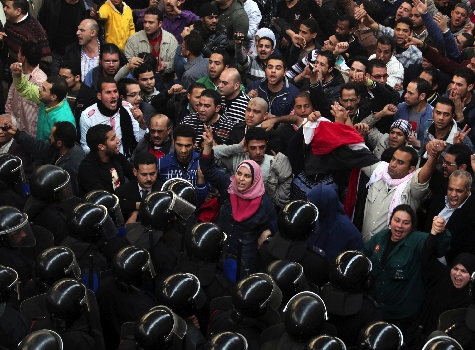
(Photo: Courtesy NPR; scene from street protests in Cairo's Tahrir Square February 3rd)


Labels: , , , , , , , ,

Tuesday, September 21, 2010

"Girl Effect" 2


The groundbreaking cause video, The Girl Effect, now has a sequel. It's called "The Girl Effect: The Clock is Ticking" and it had its world premiere today at the Clinton Global Initiative.

The original animated video -- which won awards for impact -- makes the point that improving the lives of women and girls will boost the economic health of everyone on the planet. The sequel elaborates on that theme, but focuses on the impact of intervention in the life of a girl at age 12.

Have a look, and let us know what you think. (To view the original, click here):

Labels: , , , , ,