Thursday, March 3, 2011

Al-Jazeera's Wadah Khanfar


Al-Jazeera Chief Wadah Khanfar addressed this year's TED conference about the civic uprisings sweeping the Arab world and gave his take on where the unrest might be leading. He said he believes that social media are helping to make the Middle East and northern Africa more democratic.

"The future we were dreaming for has arrived," Khanfar told conferees (see the video of Khanfar's talk, below, made public yesterday). "A new generation, well-connected and inspired by universal values and global understanding, has created a new reality for us. We've found a new way for us to express our feelings and dreams. ...The regimes who invested billions of dollars in security systems collapsed and disappeared because of the voices of the people. They (the regime) tried to kill (the people), but the young people found something called Facebook and Twitter...and we found that all of these people in the streets are our reporters now."

Here's Khanfar:


(Photo of Khanfar, top, courtesy TED Conferences)

Labels: , , , , ,

Tuesday, February 22, 2011

Anatomy of a Facebook Revolution


Tonight, Frontline airs Revolution in Cairo, a behind-the-scenes look at Egypt's April 6 Youth Movement as it plots strategy and then heads out into Cairo's Tahrir Square, hoping to bring down President Hosni Mubarak. "The film traces these young Egyptian activists' long road to revolution, as they made increasingly bold use of the Internet in their underground resistance over the last few years," Frontline's Executive Producer David Fanning recounts. "Through sites like Facebook, Twitter and YouTube, the members of April 6 and related groups helped organize a political movement that the secret police did not understand and could not stop, despite the arrest and torture of some of the movement's key members."

The piece includes soundbites from David Wolman, the WIRED writer who has been reporting inside the April 6 movement and Mona Eltahawy, a popular blogger on Arab issues.

Here's the PBS promotion trailer:


Here's the fuller video; the story begins after a 30-second advertisement:


What do you think of this story? Let us hear from you.

(Photo, top, is of April 6 Youth Movement headquarters in Cairo.)

Labels: , , , , , , ,

Monday, February 14, 2011

Cross-border Swarming


Cairo youth didn't act alone in using social media to depose Egyptian President Hosni Mubarak, the New York Times says today in a front-page story. Their Facebook and YouTube activism was part of a sophisticated, two-year, online collaboration with Tunisian youth activists that used social media to reach across national borders to commiserate about torture, trade tips on evading tear gas, and plot how to use technology to duck surveillance.

"They fused their secular expertise in social networks with a discipline culled from religious movements and combined the energy of soccer fans with the sophistication of surgeons," Times correspondents David Kirkpatrick and David Sanger wrote, describing the anatomy of the movement that led to protesters' successful face-off in Tahrir Square against less tech-savvy Egyptian authorities.

"What we discovered in reporting this story was that what's happening in the Middle East now is more than just a contagion in which one group inspires the next," Sanger told WNYC Radio this morning on The Brian Lehrer Show. "There was, thanks to Facebook and other social networking elements, a lot of communication back and forth across borders, but of course there are no borders (on the Internet). ...Imagine what a shock that was to Egyptian authorities -- to discover that the entire security system they had spent billions to build and focus on the inside never even considered this other (cross-border technological) threat."

[Wael Ghonim -- the Egyptian Google executive whose Facebook page is credited with helping to catalyze the crowds in Tahrir Square -- told CBS 60 Minutes last night that "Without Facebook, without Twitter, without Google and without YouTube, this (revolution) would never have happened." CBS Correspondent Harry Smith, in this blog post today, quotes Ghonim as saying that the revolution "is like Wikipedia, okay?" Social media enabled everyone to be contributing content, Ghonim told Smith. "Everyone was contributing small pieces. No one was the hero but everyone was the hero."]

Sanger agrees that social media were critical to Cairo's youth revolution, which used online social networks to help destabilize the regime of former President Hosni Mubarak, forcing him to resign from his 30-year reign on February 11th. "But what was really remarkable" about the Egyptian youth movement, Sanger told WNYC, is that it used both high and low tech to organize support:

"While social media were used to organize ringleaders, once they got going, they also used some of the oldest forms of communications -- putting up leaflets and fliers and walking through some of the poorest sections to reach people without Net connections. They shouted their message in the streets and picked up a following, liked the Pied Piper. This was a combination of extremly high tech organization and extraordinarily low-tech organization."

And now the young leaders are looking beyond Egypt, Sanger says. He and Kirkpatrick quote Walid Rachid, 27, one of the members of the April 6 movement in Cairo -- an Egyptian Facebook group -- as saying that "Tunis is the force that pushed Egypt, but what Egypt did will be the force that will push the world." At a meeting of youth movement leaders last night in Cairo, Rachid told Kirkpatrick: "...If a small group of people in every Arab country went out and persevered as we did, then that would be the end of all the regimes." According to the Times story, the members of the Tunis and Cairo youth movements are talking about sharing their experiences with similar youth movements in Libya, Algeria, Morocco and Iran.

But Sanger cautions that the movement's success in Cairo doesn't insure its success elsewhere, especially in countries where authorities are far more sophisticated in the use of the Internet to organize protest. Sanger told WNYC: "I'd love to say Facebook was protection against the military, but had the military decided it was going to open fire on protesters and round people up, this could have looked more like Tiananmen Square, then I think we would have had something very different here." Sanger added: "...Just because social networks can be organized doesn't necessarily mean they will be successful at overcoming a regime." Sanger said that some regimes, like China, "are extraordinarily adept at using the Internet and social media to follow dissidents and punish them." Mubarak's regime, he says, "was clueless" about the power of social media and the Web -- but not every regime is, nor will be in the wake of what happened to Mubarak.

Meanwhile today, The Associated Press is reporting that the U.S. State Department has begun sending Twitter messages in Farsi to reach social media users in Iran, with some of the Tweets accusing Iran's government of "illegalizing dissent" while at the same time praising Egyptian protesters. The State Department's Farsi Twitter account had 60 followers within two hours of its launch, the AP was reporting. The AP also is reporting today that the State Department launched an Arabic Twitter feed last week in an effort to communicate with the Egyptian protesters and signal its support.

For more on the role of social media in political activism in the Middle East, see Cairo's Facebook Flat, below:


(Photo of Egyptian Facebook activist Wael Ghonim by Getty Images)

Labels: , , , , , , , , , ,

Monday, February 7, 2011

Wake-Up Call


Efforts by authorities last week to shut down the Internet in Egypt should serve as a "wake-up call" to citizens everywhere that social media are not free from government and corporate control, Web and foreign policy experts warned today at two separate Social Media Week gatherings in Manhattan.

"I don't worry about social media so much as I do about corporate and government attempts to shut them down," Micah Sifry, Executive Editor of the Personal Democracy Forum, told a mid-day panel hosted by Wired magazine at Google's New York science hub. Social media companies, he said, will do what is in their best interests -- and not always what's best for free speech, privacy and the security of citizen activists.

"...I'm terrified that we are relying on corporate entities to enable" citizen organizing over Facebook, Twitter, email and cellphones in one country after another, Sifry said. "I think it's very dangerous, as there's really no reason that social media companies have to be socially responsible at all. Their responsibility is to the bottom line." [See Portable Propaganda in CauseGlobal, about Vodaphone's Feb. 3 accusation that Egyptian authorities were secretly using its network to send anonymous, pro-government propaganda to protesters.]

Sifry, author of the recent book, Wikileaks and The Age of Transparency, also said he worries about a lack of transparency by social media companies when it comes to their policies governing user privacy and security. He said social media platforms "have become ubiquitous ... yet we as users have less rights on them than we do walking into a shopping mall." Sifry added: "I don't think that these [social media] companies will be good global citizens" in the years ahead. Typically, "the government asks for your data and companies hand it over," he said. "...This is a great wakeup call for citizens to fight for something better, and to ask themselves, What are our rights? How do we enforce them in this space?"

Later in the day, author Evgeny Morozov told a panel hosted by the Open Society Institute that "governments everywhere are looking for an Internet kill switch" now that social media are making it easier for activists to organize faster and in higher numbers than ever before. Morozov, the author of The Net Delusion: The Dark Side of Internet Freedom, said the Utopian vision of the Net that most people shared a decade ago -- the notion that dictatorships would collapse under the onslaught of social media -- doesn't square with today's world. The Internet, Morozov argues, "is an uncontrollable and inherently political medium that will frustrate those who believe democracy can be promoted with the push of a button."

He said he wrote his book to help people understand that while social media can accelerate social movements -- these movements will not occur the same way across the globe, nor have the same outcomes, due to differences in local cultures and aspirations. Case in point: the failure of a Facebook campaign in Syria last week and separately, the recent use of blogs and other forms of social media by Sudanese authorities to disseminate false information in an effort to ferret out and arrest anti-government protesters.

For more on the subject, see the February 5 CNN Opinion article, "Internet is easy prey for governments" by Douglas Rushkoff, and "Caught in the net" -- a review of Morozov's book by The Economist magazine. See also "Voicing Opposition" by Sarah A. Topol in Slate.

Do you agree or disagree? Let us hear from you.

-- Marcia Stepanek

(Illustration: Miroslaw Pieprzyk)

Labels: , , , , , , , , ,

Like Water


Just after the 1989 pro-democracy protests in Beijing's Tiananmen Square ended in a spray of live fire from government tanks that killed untold numbers of demonstrators, a Chinese journalist colleague of mine advised his fellow writers to "be like water." He was quoting a Chinese proverb commanding persistence in the face of towering obstacles: water, he explained, can seep through and around even the most imposing walls to get to the other side. I have been thinking of him recently, watching events unfold in Cairo's Tahrir Square.

Egyptian blogger and pro-democracy activist Mona Seif, when interviewed last week by National Public Radio's On the Media from Tahrir Square, affirmed that it was a challenge to organize anti-Mubarak demonstrators online after the Egyptian government had tried to shut down the Internet. But it wasn't impossible, she said. Seif, a post-graduate student in cancer research at Cairo University and the daughter of renowned human rights lawyer Ahmed Seif El-Islam Hamad, said the Web and social media not only helped to amass protesters but also to humanize them outside of Egypt. Additionally, she said, the government was unable to shut down all communication; information is still able to leak through.

Seif, via cell phone from the Square, told OTM that she and other activists are using a friend's wireless connection and her apartment as an online organizing hub. [Her friend's internet provider was not shut down due to its relationship with the country's financial exchanges, she explained. On the Media Host Bob Garfield quipped later that Seif's use of that wireless account was "like using a government tank to get behind enemy lines." Seif said she has another friend with a satellite connection "if things get worse."]

Here's a short excerpt from that interview:

NPR: When the (Egyptian) government shut off the Internet, did it have a backlash (effect), infuriating people who otherwise would not have mobilized?

SEIF: I think it had a backlash but not because of infuriating people. A lot of the people who would have normally been satisfied with just following the updates (of what was happening in the square) on Facebook and Twitter suddenly did not have this connection and so they found no way of being part of this movement except by going out into the streets. I think that cutting off the Internet actually helped the movement on the ground and in the street to become bigger.

NPR: We get lots of criticism here in the West about about Twitter; can you take this opportunity to explain what Twitter can mean?

SEIF: I understand this criticism because I've been getting it a lot from my friends. I think sometimes there needs to be an experience like the one we are in to really grasp just how powerful such a tool like Twitter is (and can be). The use of Twitter to engage different people in bits of your life is really what it makes it a powerful tool -- when there is a serious event and you want to engage people. If it is only used as a (personal) news feed, then it would be boring and it wouldn’t be as interactive as it should be.

Usually, I use Twitter for really personal things--to share moments from my work, or moments from my love life or I talk about my cats or my family. And it engages lots of different people, so that when these people are following you -- and suddenly you are talking about a torture case (for example) - some of them might not usually be exposed to such cases. But because they are following me and there is an ongoing conversation between us, they will suddenly be engaged in this as well. So it’s a really powerful tool in that sense.

NPR: The movement has coalesced a number of forces of anger at the (Mubarak) regime. There are trade unionists, there are Muslim Brotherhood elements, there are young people who have been facing hopelessness and despair and unemployment. How worried are you that what comes next may be worse than the status quo -- for example, an Islamic revolution?

SEIF: I really am not worried and I know that might sound strange to a lot of people. What I have seen these past nine days is making me really hopeful. I’m in Tahrir Square with thousands of people from completely different backgrounds and for once in my life, all of the big issues that we are usually encountering in the streets of Eygpt and are having to deal with, such as violence and tension and sexual harassment against girls, for example– all of these issues we keep on talking about now do not exist. I’m in Tahrir Square and feeling that I belong with those people and we are everyone -- there are Muslim Brotherhood (and) independent people who don’t belong to a political party. I really, really think this could (end up in) a much, much better scenario than what all of the outside world is expecting or feeling.

Here's hoping it will, long after (and through) the violence of the past few days -- though as of today, government forces have been moving in on protesters in the Square, attempting to minimize their numbers.

For the best ongoing coverage of the upheaval, watch Al-Jazeera's livestream, here.

To hear the OTM interview with Seif from February 3rd, click below:

For alternative views of what is happening on the ground, see this essay by Joshua Stacher, assistant professor of political science at Kent State University, which asserts in Foreign Affairs that "despite the tenacity, optimism, and blood of the protesters massed in Tahrir Square, Egypt's democratic window has probably already closed."

What do you think? Let us hear from you.

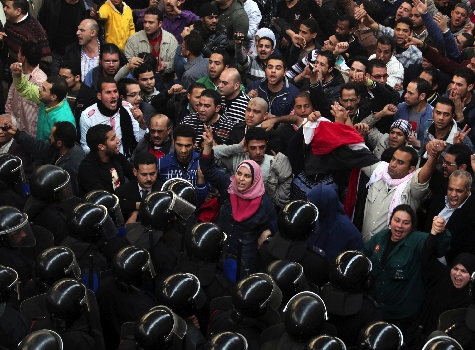
(Photo: Courtesy NPR; scene from street protests in Cairo's Tahrir Square February 3rd)


Labels: , , , , , , , ,

Saturday, October 23, 2010

Twitter Babble

Every year at PopTech, organizers show a selection of short viral videos to mark segment breaks or pull people back into the Camden Opera House auditorium for a new session. Here's one of them, shown today at PopTech2010, that spoofs the official trailer for the film, The Social Network, and skewers Twitter:


What do you think?

Labels: , , , , ,

Wednesday, June 30, 2010

Fear Factor

Corporate social media? If that's not an oxymoron at your company or social enterprise, then social media can be scary, difficult stuff -- requiring a ton of courage and patience to deploy effectively, according to corporate social media strategists for Target, PepsiCo, Gap and Facebook.

"It's very, very scary," Claire Lyons, Pepsico's corporate brand program manager, told a packed room of nonprofit and CSR activists attending a panel at today's 2010 National Conference on Volunteering and Service. Social media represent "a huge shift in the way companies operate," she said, "because they [social media] shift the locus of control of a brand, which was always controlled by brand managers, and blows it up. ...It is changing the whole way that brand architecture is considered."

Lyons, one of the lead architects of the company's Pepsi Refresh campaign, said she finds social media "exciting." But using social media to engage employees and stakeholders is "very different. We really don't have control" of the conversation, she said. "This [social media] is a total quality management feedback loop par excellence."

Target also has discovered some uncomfortable moments moving to social media. Jill Pete, a member of Target's national community relations team, said it was hard at first to simply "step back, listen and not react to what was being said" on the company's Facebook page. "We were hesitant to step into this realm, especially Facebook, because Facebook's power is dialogue," Pete said. But the risk has paid off, she said. Target's decision to stay quiet and listen has been "a huge step for us because we'd been seeing some stuff on there that was inaccurate and we really wanted to correct it right away." Turns out, said Pete, the company didn't have to. "all inaccuracies so far, all of them, are usually corrected no more than two or three days after it has been asserted," she said -- by people Target doesn't know but who follow the company on Facebook. "It's testing our strength as a brand," said Pete. "If you're strong as a brand, you listen -- and you learn."

Joshua Rahn, New York Director of Facebook, shared an anecdote of how early Pepsi traffic on Facebook included one comment that simply made the statement: "I hate Pepsi but I love Coke." This triggered a swirl of internal communication at Pepsi, he said -- "the lawyers had a field day" -- but before the company could respond, one of its Facebook "friends" quietly posted a short note telling the detractor that if he didn't like Pepsi, to go to Coke's Facebook page, instead. It worked. End of story. "Before Facebook and Twitter," Rahn said, "people still bad-mouthed products. They always will. You will never be able to control for that. Never. But now, you have the opportunity to shape the responses."

In other highlights, panelists agreed that companies and organizations should:

* Get clear on "who owns social media" inside the organization. "Don't make the person who owns social a second-class citizen," Rahn said. "Your social media person shouldn't be a person who sits in on every third meeting andhas no authority and no independent power. This should be a person who has a voice. Where should the person sit? In your marketing team but they have to be able to make decisions." Rahn cited Starbucks as a good example of a company that "gets it" about social media's internal role, putting its social media team in marketing but giving it autonomy "and the same amount of say as its TV team."

* Consider setting up a private, branded employee social network. Abby Frost, manager of employee engagement and community partnerships at Gap, said the company has launched Sketchbook ["our employee Facebook," Frost explains]. On that social network, she said, employees share the highs and lows of the workplace expeirence, share team projects and communicate socially. Recently, Frost organized an "Ultimate Happy Hour" on Sketchbook, which included a video content among employees to celebrate the company's 48th anniversary. She said prizes were given out to the best employee stories and participation on the network remains high. So do employee retention rates. Said Facebook's Rahn: "As much as companies think of using social media to raise awareness, they also need to be thinking of creating engagement around it."

* Remember that ROI rules. But don't look for magic. Facebook's Rahn said that far too many companies, in their efforts to create a social media strategy, waste too much time trying to get something ready for release. "These are companies that need to consider their 'return on energy' instead," Rahn said. Gap's Frost agrees. "You need to move fast, not perfect," she said.

* Be clear that social media are a must for employee retention. If companies have hired someone to craft their social media strategy but won't let them use the tools on the job, then don't be surprised if you can't hire anyone good -- or keep them once they're on board. Target's Pete said Millennials expect to be able to use social media on the job "If you encourage your employees to engage online, they will engage in your favor; if employees see how you're connecting online and see how effective it is, they will become your biggest ambassadors," she said. "But if you don't let them engage, you may lose them." Rahn called it "social retention."

Erik Darby, vice president of business development for The Experience Project, which just launched TwitCause -- a new offering that helps companies engage Twitter users in their pet causes -- offered attendees "5 Things Your Corporation Needs to Know About Social Media." Here they are, briefly:

1. Know why you're going into social media. "Just going for fans on Facebook and followers on Twitter is not going to cut it," Darby says.

2. Know what ROI metrics you're measuring.

3. Be consistent with your social media engagement. "Don't expect to see results if you send out a tweet once a week," Darby says.

4. Be human. "Don't exploit your audience. Care about them. Ask their input on things."

5. Go where your audience is. "'Build it and they will come' isn't true anymore," Darby says. "If you're a pet company, for example, don't just do Facebook. Go where your customers are. Go on Dogster."

Okay, readers. It's your turn. Got any pointers to add?

-- Marcia Stepanek

(Illustration: istock.com)


Labels: , , , , , , , ,

Friday, June 25, 2010

Google Oogled


In May, Google announced that, for more than three years -- in more than 30 countries -- it had been "mistakenly collecting" personal data from open WiFi networks as its vehicles roamed the streets taking photos for its Street View mapping service. That data could include people's email messages, their passwords and even the logs of their Web site visits.

This week, more than 30 state attorneys general announced they will begin examining the lawfulness of Google's actions, though it still isn't clear whether Google committed any legal wrongdoing. "At the very least, Google acknowledges that intercepting and gathering people's data was wrong," Connecticut AG Richard Blumenthal told WIRED. "But there may be a need to strengthen and enhance federal and state laws." Meanwhile, the chief of the Consumer and Governmental Affairs Bureau of the Federal Communications Commission has issued a warning to consumers that Google's "behavior" raises important privacy concerns, adding that the collection of WiFi data, "whether intentional or not ... clearly infringes on consumer privacy."

The Google disclosures have triggered one of the biggest public probes of online privacy so far in the digital era. Google, in response to government inquiries and lawsuits, has claimed that it is lawful to use packet-sniffing tools readily available on the Internet to spy on and download payload data from others using the same open Wi-Fi access points. But two months ago, in May, shortly after the FCC and U.S. Justice Department began looking into the Street Maps issue, Google co-founder Sergey Brin told a Google developer conference his company "screwed up" by improperly collecting the WiFi data. "We screwed up, and I'm not making excuses about it," Brin said. "Trust is very important to us and we're going to do everything we can to preserve it." Brin said the company is "putting more internal controls into place and bringing in third parties to work on this issue, as well." Google also has begun destroying some of the Wi-Fi data it collected for Street View -- in some cases, at the request of governments, including Britain's. But privacy advocates now say Google should preserve the data and turn it over to governments.

"The problem here is that there are criminal laws at issue, and there is a real question as to whether Google violated these laws," says Marc Rotenberg, executive director of the Electronic Privacy Information Center (EPIC), a nonprofit privacy rights group in Washington. "If it did, the evidence is in the information Google collected. Google has tried to minimize the data it collected, calling it snippets or fragments. But that's a determination that needs to be made by a third party, possibly a prosecutor."

For one of the most comprehensive overviews of the Street Map issue -- including a timeline of the Street View program from its launch in 2007 to Germany's announcement last month that Street View vehicles have been collecting data from WiFi networks -- see EPIC's Web page on the brouhaha.

Street View isn't the only Google product that has been drawing recent privacy concerns. In February, EPIC filed a complaint against the company with the FTC, seeking constraints on Google Buzz, the company's new social networking service. The complaint describes an attempt by Google "to convert the private, personal information of Gmail subscribers into public information" for the Buzz service. "This change in business practices and service terms violated user privacy expectations, diminished user privacy, contradicted Google's own privacy policy, and may have also violated federal wiretap laws." [Facebook also has come under fire from privacy advocates for ongoing problems with its privacy settings, chiefly the lack of control users have over personal information that others have made public about them, including photographs. Another sore spot: Facebook's decision to push users into using its "instant personalization" feature, the company's link to third-party Web sites such as Yelp and Pandora that share users' opinons on shops and tunes.]

What do you think? As the Web becomes more "social," should consumers have more of a say in how their personal data is distributed across social networks? [See Radical Shock, a Q&A by Cause Global with privacy scholar Helen Nissenbaum about the need for new privacy protections that don't care so much about whether data is shared "but whether it's being shared appropriately."] Let us hear from you.

-- Marcia Stepanek

(Photo: istock.com)

Labels: , , , , , , , , ,

Monday, June 21, 2010

Networkers' Bill of Rights

An influential group of Silicon Valley tech activists are circulating a petition across the Web that calls for a Social Network Users Bill of Rights. As reported here earlier, the group met last week at the 2010 Computers, Freedom and Privacy conference in San Jose to hammer out the document, a response to the ongoing Facebook privacy uproar and concern over Goggle Buzz's recent release of users' top email contacts.

Here's what emerged:

We, the users, expect social network sites to provide us the following rights in their Terms of Service, Privacy Policies and implementations of their system:

1. Honesty: Honor your privacy policy and terms of service

2. Clarity: Make sure that policies, terms of service, and settings are easy to find and understand

3. Freedom of speech: Do not delete or modify my data without a clear policy and justification

4. Empowerment: Support assistive technologies and universal accessibility

5. Self-protection: Support privacy-enhancing technologies

6. Data minimization: Minimize the information I am required to provide and share with others.

7. Control: Let me control my data, and don't facilitate sharing it unless I agree first.

8. Predictability: Obtain my prior consent before significantly changing who can see my data.

9. Data portability: Make it easy for me to obtain a copy of my data.

10. Protection: Treat my data as securely as your own confidential data unless I choose to share it, and notify me if it is compromised.

11. Right to know: Show me how you are using my data and allow me to see who and what has access to it.

12. Right to self-define: Let me create more than one identity and use pseudonyms. Do not link them without my permission.

13. Right to appeal: Allow me to appeal punitive actions.

14. Right to withdraw: Allow me to delete my account, and remove my data.


What do you think? Google and Twitter have, so far, declined to comment; a Google spokesperson said the company already has its own set of posted privacy standards. Facebook, when asked to comment on the principles by the San Jose Mercury News, issued a prepared statement, which said that while Facebook shares the goal of ensuring "a safe and trusted environment" for its users, "we don't agree with all of the proposed elements" of the Bill of Rights, including any provision that would let people use pseudonyms.

Petition organizers are hoping to get widespread support for the document, regardless. "A networking Bill of Rights is a tool that users can use for education and empowerment," said Jack Lerner, director of the USC Intellectual Property and Technology Law Clinic and one of the drafters. Jon Pincus, a co-chairman of the conference, added that "Facebook, with its 400 million users, likes to describe itself as equivalent to the third-largest country in the world. But what rights do the citizens of that country have? Users of social networks need to know about how some of their rights are being subverted and need to know how to protect themselves."

What do you think? Noble pipe dream, or the start of something big? Go here to vote in favor of the petition; go here to vote against it.

-- Marcia Stepanek

(Illustration: istock.com)

Labels: , , , , , ,

Wednesday, June 16, 2010

Bill of Rights for Social Networks?


Reacting to the Facebook privacy uproar and Google Buzz's recent release of users' top email contacts, an influential group of social media activists is meeting this week in Silicon Valley to hammer out a Web-wide Bill of Rights for social network users.

The goal: to catalyze a user movement that will compel social network owners and operators to give users more say over their personal information -- including a right that lets users quit a site (leave it) and take every trace of their data with them.

The group, meeting through Friday at the 2010 Computers, Freedom & Privacy conference in San Jose, is livestreaming and posting its deliberations, as well as conducting some of its conversations on Facebook and Twitter so as to involve as many interested users and viewpoints as possible. (Those interested may follow the deliberations at #BillofRights and #cfpconf.)

"We're not the first people to have the idea of a social network users' bill of rights," said conference chair Jon Pincus. "In fact, we decided to make the creation of a user Bill of Rights a main focus of our gathering because people all across the country are starting to push for a set of principles to define best practices for social networks. We thought it was time to combine inputs and produce one such document that embodied the sentiments of as many social network users as possible."

Being used as a basis for the discussion is the Electronic Frontier Foundation's recent framework, which proposes that any rights manifesto should contain three broad categories of rights: the right to informed decision-making (compel social network owners to tell users what they are doing with user data); the right to control (giving users ownership of their information and control over who can view that information), and the right to leave (letting people quit Facebook or any other social networking service with the ability to take their personal information with them.)

"A networking Bill of Rights is a tool that users can use for education and empowerment," Jack Lerner, director of the USC Intellectual Property and Technology Law Clinic, told conferees yesterday. Lerner added:

"Facebook is the 800-pound gorilla right now but that won't necessarily be the case forever. Our purpose this week is to galvanize users of all social networking sites and educate them, not just on what they ought to be looking for in a social network but about how some of their rights are being subverted. Some networking companies have been reckless and irresponsible and not a lot of people yet realize what all is at stake here. There are complaints now from people who say their Facebook pages are disappearing if they're critical of the company. I think it's time for clear guidelines about what is acceptable company behavior and what is not. This is not just about privacy and social media but whether users are being treated fairly by the companies that depend on their information."

What do you think? What rights should users of social networks have? Are user rights a value that social media entrepreneurs can build new businesses around?

-- Marcia Stepanek

(Illustration: istock.com)

Labels: , , , , , ,

Wednesday, June 2, 2010

Diaspora, Crowdfunded


Diaspora, the pro-privacy social network being built as an alternative to Facebook by four NYU classmates, announced today that it was able to crowdsource its first round of funding on Kickstarter -- and then some.

The group announced its project on April 24 and gave itself 39 days to raise $10,000 using the online fundraising site. The group reached its $10,000 goal in 12 days, and today, the group announced that it has been able to raise all of the money it sought -- some $200,000, plus an additional $642 -- from 6,479 people (including Facebook CEO Mark Zuckerberg), each kicking in $5 or more to the project.

The group, inspired by a desire to build a social network that wouldn't force people (involuntarily or otherwise) to surrender their privacy to commercial interests, says it will distribute the software it is developing for free and will make the code openly available so other programmers can build on it. [Diaspora software will let users set up their own personal servers, called seeds, so they can control who-sees-what about their private data. Diaspora will aim to provide the same functionality as Facebook but won't rely on centralized servers.]

According to Max Salzberg, 22, one of the four co-founders, says the group began its work on the project in April, after hearing Eben Moglen, a Columbia University law professor, describe social networks as a form of "(corporate) spying for free." Diaspora has received much attention in the mainstream media in recent weeks amid Facebook's privacy woes. Diaspora also has been a buzz magnet across the social Web: there are now nearly 29,000 followers of "@joindiapsora" on Twitter.

"We're making Diaspora because we want to use it," says Salzburg.

Diaspora isn't the only "un-Facebook" social network that is being developed amid privacy concerns. Appleseed and OneSocialWeb also have been working on alternatives.

For more on the Diaspora project, see the four explain their objectives, below:


(Photo (from left to right) Diaspora Co-founders Rafael Sofaer, 19; Ilya Zhitomirskiy, 20; Dan Grippi, 21, and Max Salzberg, 22)

Labels: , , , , , , ,

Wednesday, May 19, 2010

Swarms Rising


Facebook isn't the first company to be targeted by online swarms, nor will it be the last: cause-wired consumers are just starting to flex their digital organizing muscles. [Due to prevailing privacy concerns, almost two-thirds of Facebook users say they are considering leaving the site, according to the IT security firm, Sophos, with 16 percent of those surveyed already claiming to have boycotted the site.]

I've been tracking this trend and others for my upcoming book, Swarms, about the rise of self-organized groups online, which is due out later this year. What's new is that increasing numbers of self-organized pressure groups, collaborating digitally, are finding they they're able to wield more influence than ever -- changing how a particular airline treats its customers and employees to influencing how a financial services company runs its national charity contest. [There's even a swarm that got a San Francisco liquor store owner to install more eco-friendly lighting; once he did, the swarm brought him some $9,200 worth of extra business one Saturday afternoon.]

And that's just for starters. In the social enterprise sector so far this year, swarms temporarily sidelined the Chase Community Challenge contest, pushed Nestle into a nasty confrontation over its use of palm oil in its KitKat chocolate bars, and forced Pepsi's Refresh contest administrators into a quick apology for bending its own contest rules earlier this spring.

Will the recent swarms of rattled Facebook users be as successful in forcing change in the site's privacy policies? So far, so good: The Wall Street Journal is reporting that Facebook's swarms have become so riled that Chief Executive Mark Zuckerberg is thinking about scaling back his push to get users to share more about themselves in public.

"Activists are starting to see the power that consumers have online (using social media) to put pressure on brands, and to hijack conversations that brands are attempting to have with consumers," Seventh Generation's Chris Miller told a Milken Global Conference panel I moderated last month on the rising power of swarms. Corporate public relations veteran Jack Leslie, the CEO of Weber Shandwick, agreed, adding that "the speed with which something can happen and the size of the damage that can be done (by swarms) is so much greater now ... that the whole name of the game (for companies on the receiving end) is not to push a message so much as to engage in conversations that lead to new opportunities." [Justmeans cofounder Kevin Long, also a panelist, agreed.]

Brent Schulkin, the founder of Carrotmob, a Berkeley, Calif.-based Web action group that has organized 60 consumer swarms from Helsinki to San Francisco in the past few years, says the most powerful swarms are those which push for a win-win for both companies and consumers. "Today, we all know that every company does stuff we don't like," Schulkin says. "Now, if companies say, 'We don't do anything bad,' nobody believes them. The Carrotmob premise is that every business can do something better."

Schulkin is forming a new nonprofit this summer to expand the reach of Carrotmobs to include national brands. Consumer swarms, he says, should "look at what companies can do to improve -- and then judge these companies by the level of their improvements, rewarding those which improve the most with their purchasing power. It's about win-win. It's kind of a reverse boycott."

What do you think? What swarms are you currently tracking and which swarms have you joined? Are you boycotting Facebook? Let us hear from you.

-- Marcia Stepanek

[Illustration: istock.com]

Labels: , , , , , , ,

Saturday, March 13, 2010

After Slacktivism


Who says social advocates can't raise big money and forge lasting donor relationships online for their causes? Today's South by Southwest (SxSW) panel on slacktivism -- more elegantly and formally called Debunking the Myth of Social Media Fundraising -- offered a rousing antidote to the notion of ineffectual, click-and-give philanthropy. Urban Dictionary defines slacktivism -- a portmanteau of the words "slacker" and "activism" -- as "a way of pretending to care while sitting ... in front of a computer playing WoW." Such detachment, the panelists asserted, is becoming less of a factor in today's cause-wired, text-aided giving arena: the outpouring of mobile contributions to victims of Haiti's January 12 earthquake and donor retention strategies being crafted to hang on to many of those donors over time should be proof positive that online giving has, at last, begun to evolve and inform even the most traditional philanthropy circles.

[Evgeny Morozov, one of the critics of slacktivism, wrote in a Foreign Policy Magazine article last fall entitled "From Slacktivism to Activism" that he is skeptical of numerous digital activism campaigns "that attempt to change the world through Facebook and Twitter." He said the desire to instantly connect with others online around ever-new causes poses a threat to more productive uses of time, such as brainstorming solutions to the world's ongoing problems.]

Combining research data with personal anecdotes, panelists Stacey Monk (Epic Change); Brooke McMillan (the Lance Armstrong Foundation); Donna Wilkins (Charity Dynamics), and Frank Barry (with Blackbaud, the fundraising software firm) made a strong case for the potential of social media sites like Twitter, Facebook, and YouTube to raise money and awareness -- not simply as tools in one-off fundraising campaigns but also in efforts to build richer and more sustainable donor relationships across the socioeconomic spectrum.

There are dozens of commonly-held misperceptions about the use of social media in advocacy, the panelists said, and here are five of them:

Myth One: Social Media Aren't Very Effective. Not true, said the panelists. Social media can be effective in breaking down geographic boundaries, building communities of donors who otherwise would not be able to connect, and bringing in contributions from many more people than before. Monk says her nonprofit has raised nearly all of its money via Twitter, to build classrooms in Tanzania, buy school supplies for the students there and provide skills training inside and outside the classroom -- including social media skills aimed at helping them to learn more about other people from around the world. While the panelists agreed that using social media to fund-raise can take time, as it's all about relationship-building and not simply a matter of learning the technology.

Myth Two: Major Donors Do Not Exist in Social Media. Not true, said McMillan, and cited the example of @fatcyclist, the Twitter handle for a man who blogged and Tweeted to raise some $800,000 over the course of a year for Livestrong, Lance Armstrong's cancer research foundation. With social media, Barry said, "major donors" are no longer just wealthy individuals. Now they include individuals of all income levels adept at using their social influence online and off to engage others around giving to a cause.

Myth Three: No one Raises Money on Twitter. Guess again, said the panelists. For one, look at Twestival, the regional, national, and global fund-raising campaigns staged on Twitter to benefit a variety of causes. Then look at TweetsGiving. Both micro-blogging fundraisers have increased donations year over year, suggesting such campaigns are sustainable. To be sure, Monk said, "when you first get on Twitter you don't know what you're doing there." But soon, she added, you discover that "Twitter engineers serendipity" -- all sorts of connections that can be leveraged to raise money and awareness over time.

Myth Four: Building Community Does Not Help You Raise Money.
Also not true, the panelists said. Social media campaigns allow nonprofits to reach new donors and build the relationships required to raise funds from previously untapped sources. Nonprofits, said Monk, "shoot themselves in the foot" when they put a "give" button on their Web sites. Causes need, instead, to humanize fund-raising by using social media to engage donors in the cause. "Authentic connections between humans create movements, and movements raise funds," Monk said. "...Social media should humanize the process of giving, not automate it." Storytelling, the act of humanizing your cause to engage donors, is critical, she added. "If the word 'donate' is in your Tweet, you're doing it wrong," said Monk. To emphasize the point, Monk says she writes the Twitter handles of donors on the walls of the classrooms they're helping her to build as a way of showing them both her gratitude and their impact, and it works.

Myth Five: Social Media Cannibalize Other Fundraising Channels. Au contraire, said Monk. "Social media are just additional tools. Donors want to be able to choose" the way they give money to a cause, she said, and sites like Facebook and Twitter give them the option to give in new ways. Besides, the panelists agreed, social media offer an effective way for causes to reach the hearts and pocketbooks of Baby Boomers, the largest-growing demographic using Facebook, Twitter, and other social networking sites. Both Wilkins and Barry said multi-channel fund-raising strategies proved most effective, citing a recent Blackbaud/Charity Dynamics study. One finding: organizations that use email effectively to fund-raise also tend to use social media more effectively, as well. "My job didn't exist a year ago," said McMillan, the social media evangelist at Livestrong.

For more on the subject, check out the study on social media in fund-raising released last month by Charity Dynamics and Blackbaud.

Still not convinced? Come to the NTEN annual conference in Atlanta in April to hear some opposing views on the subject and a debate over the challenges to online giving that exist. My panel on Slacktivism will feature Nancy Lublin, CEO of dosomething.org; Jacob Colker, Cofounder of The Extraordinaries; Wendy Harman, social media director of the American Red Cross, and Aaron Smith, of Pew Research Center's Internet & American Life Project, which is conducting ground-breaking research on the use of social media by Generation Y. Hope to see you there!

--By Marcia Stepanek

(Illustration by Jumpingsack for istock.com)

Labels: , , , , , , , ,

Thursday, January 28, 2010

Privacy, Revisited


Today is Data Privacy Day; Congress voted quietly last year to have the United States join Europe in designating January 28 as an annual, international holiday to raise awareness about the importance of data privacy protection.

Make no mistake: the privacy debate is hotter (and louder) than ever. The recent uproar over Facebook's new Terms of Service—and then, even more recently, Twitter's new service terms—"is all about privacy," says Georgetown University law professor Marc Rotenberg. "It's not the old-fashioned parchment scroll, carried by courier on horseback from the castle to the king's army notion of privacy," says Rotenberg, the director of the Electronic Privacy Information Center, a nonprofit he founded in 1994 to address the Internet's impact on society's traditional notions of privacy. "This is "modern-day privacy, about digital identity, the control of personal information, and the brewing battle between what we post and its commercial value." [For more on Rotenberg's views, see his essay that ran recently in The Huffington Post, suggesting that "we give up personal information all the time but that doesn't (nor should) end the discussion over privacy." That, says Rotenberg, is where the discussion begins.]

Just don't tell the social media executives meeting in Davos this week. There, halfway 'round the world from Rotenberg's Washington, D.C., office—and while Rotenberg was commemorating Data Privacy Day in press briefings and other talks elsewhere—the chiefs of Twitter, Facebook, MySpace, Ning and LinkedIn squeezed into a small, packed anteroom at the World Economic Forum to share their predictions for social networks, discuss their impact on society (for better or worse) and ponder why their companies hadn't yet figured out a way to make big money off their subscriber's digital social connections.

Tim Berners-Lee, the British physicist who invented the World Wide Web, told the Davos gathering that "little changes in how your treat privacy can dramatically affect the way a social network works." He said that in eBay's case, for example, the site has increased privacy in some areas as the online auction site has matured. The site now hides the identity of people bidding against each other. Younger users, though, seem far more open to revealing personal details about themselves.

Then it was Reid Hoffman's turn. The executive chairman and founder of LinkedIn told the group: "All these concerns about privacy tend to be old people's issues." Transparency and accessibility are two reasons, he said, that so many younger users—teenagers and young adults—put their mobile phones on Facebook or MySpace. "The value of being connected and transparent is so great," Hoffman said, that privacy is not a concern but a hindrance.

Rotenberg wasn't present. But Don Tapscott, author of books on the so-called Net Generation and the need for corporate transparency in the Digital Age, took Hoffman on. Social networking, Tapscott said, would become what "we want it to be" over time, meaning that if we wish to build civic values into social network sites, we will—and should. "[The Internet] has an awesome neutrality and we need to build into it basic human values," Tapscott said. "...And one of those values is the right to informational privacy and the right to be left alone. I completely reject this view that privacy is dead. It's in deep trouble, it needs to be saved and everyone needs to get involved to protect their own information."

Indeed. [Says Rotenberg: "I smile every time someone says privacy is dead or the Facebook generation doesn't care about privacy. If there is one issue that people feel passioantely about today, that literally unites everyone who goes on line, it is the interest in privacy. And the battle is just beginning."]

What do you think? Is privacy an "old people's issue" or more about civil liberties in the 21st century? Let us hear from you.

—Marcia Stepanek

(Illustration: istock.com)

Labels: , , , , , , , , , , ,

Tuesday, January 26, 2010

Social Trafficking

According to the latest Nielsen survey, social media traffic is exploding. Global consumers spent over five and half hours on social networks in December, Nielsen says, up 82 percent from the same period last year. (A year ago, users were spending just over three hours a day on social sites like Facebook, blogs, and Twitter.)

In the United States, the time spent on social media sites has increased even more, the survey says. Total time spent on network and blog sites has increased 210 percent in the last year, with the average person spending 143 percent more time on these sites than they did a year ago. The U.S. is second only to Australia in time spent on social media, the Nielsen survey says.

Social media activity ranks as the most popular, the pollsters said, with gaming and instant messaging the next most popular. Facebook emerged as the leading destination in the category, with 209.8 million unique users, or 67 percent of the world's Internet population. And that's not all: Twitter continues to grow at a faster pace than any other social media destination, with 579 percent more unique users in December 2009 than in the same month in 2008.

But social media site-runners, beware. Nielsen says there is reason to suspect that Twittering has peaked, in that traffic to the site actually declined 5 percent in December. Meanwhile, social networks Classmates and LinkedIn also showed a December decline, year-over-year.

So what does this mean? According to the Online Publisher's Association, the share of overall Web time spent on content has been in decline consistently over the past year. (In November 2008, 44.5 percent of online time was spent at content destinations compared to 9.7 percent at community sites like Facebook. In November 2009, however, the share of time spent on content had declined sharply to 37 percent, with community spiking to 24 percent.)

Says Nielsen: "This is an impressive an undeniable shift in user mindshare that no publisher can ignore. It underscores the importance of media brands learning the language of social media and having an active presence in the social networking places that users are now treating like their Internet portals."


Labels: , , , , ,

Monday, January 25, 2010

Gates 3.0


Bill Gates released—no, make that tweeted—his second annual letter from the Bill & Melinda Gates Foundation earlier today. [That's right. Bill Gates, starting his second year of life post-Microsoft, now has an account on Twitter. Finally. It's @BillGates, he opened it on January 19th, and as of today—after 19 tweets—he's already got 343,218 followers. His Twitter bio: "Sharing cool things I'm learning through my foundation work and other interests..."]

So far, the billionaire philanthropist is following 42 people, including Vinod Khosla, the venture capitalist, celebrity Ryan Seacrest, commentator George Stephanopoulos, New York Times columnist Nicholas Kristof, President Barack Obama, and dynamic data whiz and public health professor Hans Rosling, for starters.

Gates also just opened a Facebook page [60,000-plus followers so far] and launched a personal Web site, called "The Gates Notes: An Inside Look at Global Matters." (He returns to Facebook after quitting the site last year, saying he was getting too many friend requests and had trouble determining who were his friends and who were strangers.) The Gates Notes, meanwhile, devotes sections to "What I'm thinking about" and "What I am learning" along with "My Travels", "Conversations" and "Curious classroom"—a page he devotes to answering questions from students around the world. [One question, from a high school student in Mexico, prompts Gates to sympathize with the sentiment that people don't always take very young entrepreneurs seriously, explaining that he got his start "young"—at the age of 19.] A sixth page, called "Infrequently Asked Questions" features one of the more frequently-asked of Gates in public forums, "Why not focus on global warming?" (Gates answers the question by saying energy issues are perfect for the marketplace to address but not something any foundation should try to do, and elaborates elsewhere on the site.)

Gates's move to social media, like Microsoft's move to the Web, comes late in the game. But Gates-watchers are taking a better-late-than-never stand, saying his conversion will undoubtedly lend his foundation more of a "cool factor" as well as help to further soften Gates's anti-social image.

Oh yeah, and Gates's 2010 annual letter? This year's note to the social innovation world, as last year's (both inspired by mentor and fellow billionaire Warren Buffett's annual letter to shareholders) is nearly 20 pages long, looks at the state of his $34 billion foundation and pledges to continue to give out record amounts of money this year, even though the global economy has hurt its endowment. Here are just a few highlights, below:

* Gates restated that he sees his foundation's key role as investing in innovations that would not otherwise be funded, and cited the need for new uses of technology, to measure impact more effectiveley so that what works can be replicated globally. (He said the foundation is backing about 30 innovations currently, including vaccines for malaria, AIDS, and tuberculosis.)

* Gates cited the San Francisco startup, Academic Earth, as among new education sites that will "revolutionize education" by offering students personalized learning experiences. Academic Earth, called by TechCrunch a "sort of Hulu for education videos," provides a user-friendly platform for educational video that offers courses and lectures from Yale, MIT, Harvard, Stanford, UC Berkeley, Princeton and others. Gates says his foundation will be investing in online courses that are able to provide interactive applications for children; he says he's also working to ensure that all libraries have computers with Internet access.

* Endorsed President Obama's push to double foreign aid giving, to make sure "the United States will get up into a very respectable range" of giving compared with other wealthy nations. He admonished Italy, specifically, for lowering its foreign-aid budget, saying that in June, he met personally with Prime Minister Berlusconi to make the case for more support, "but I was unsuccessful," Gates wrote. "This is a huge disappointment since I still think the Italian public wants to be as generous as people in other countries."

* Praised the new documentary film about education now airing at Sundance called Waiting for Superman, the story of a several kids trying to get into schools with high-quality teaching. [For more on Gates and his trip to Sundance to support the film, see Bill Gates: Party Animal, in the New York Times blogs today.]

(Photo: From Bill Gates' Facebook page)

Labels: , , , , ,

Tuesday, December 22, 2009

Transparency Bites


There's a firestorm that's erupting over how JPMorgan Chase & Company has fumbled its online contest to award millions of dollars to 100 charities this holiday season, and the incident is sending a stark reminder to socially-conscious companies trying to raise their "good" profile.

The message? Transparency matters (a lot) to today's cause-wired consumers. But that's not all. There's another lesson here that bears repeating, and it is this: don't invite Web-savvy crowds to participate in a "do-good" project without giving them control over the outcome - regardless of what the CEO thinks of it. Online fans and networks, it's clear, cannot be shut down nor controlled once you energize them around open initiatives they care about. Try micromanaging or censoring the people you invite to an online gathering, and you risk being accused of "cause-washing" — or worse.

The Chase brouhaha, in case you missed it over the weekend, first came to light on Saturday, in a New York Times story by reporter Stephanie Strom about how Chase is keeping its customers and Facebook "fans" in the dark about the outcome of a recent online contest it organized to give supporters a chance to vote for their favorite charities. Three nonprofit groups among the candidates for aid — Students for Sensible Drug Policy, the Marijuana Policy Project, and an anti-abortion group, Justice for All — told Strom they think Chase disqualified them as they began to amass votes because the company "didn't wish to associate its name with their missions" if they won, Strom reported. Strom also wrote that until Chase made changes to its contest in its final days, "these groups appeared to be among the top 100 vote-getters."

But what really has social media advocates miffed is Chase's failure so far to publish the final vote tallies, and to clear up whether it had, indeed, disqualified any of the charities that had participated. Over the weekend, a number of bloggers began criticizing Chase for the allegations, as well as taking the company to task for failing to create a public leader board showing a ranking of the charities based on the votes each charity had received from the more than 1 million people who joined Chase's Facebook fan page to vote.

One blogger, Nathaniel Whittemore of change.org, was especially critical, writing Saturday what he called "an open letter to Chase about their big charity transparency fail." In that post, Whittemore took Chase to task for failing to run the contest in a more transparent way. "You had the potential to build an incredible amount of social oomph with this contest," Whittemore wrote in his "Dear JP Morgan & Chase" letter. "...Now, [most nonprofits I know] think you're just one more system to game. And me? Well, I think it's pretty clear how I feel." Whittemore said that failing to provide a public leader board made Chase executives "look like jerks."

Another blogger, nonprofit social media consultant Beth Kanter, also weighed in, choosing the advent of Pepsi's own online charity contest to write a post a day later entitled, "What Lessons Will Pepsi Learn About Crowdsourcing for Social Change from Chase Bank Contest Fail?" Kanter's post yesterday, about the new Pepsi Refresh Project — another crowdsourced cause marketing project aimed at recognizing influential changemakers in society — also questioned Chase's handling of the contest. "Let's hope [Pepsi] learns from the recent Chase Bank's Online Contest Fail," she wrote. "I hope they avoid going to the dark side and waste (sic) money on projects and processes that don't have impact as well as many nonprofits' most valuable resource: their time." Kanter asked her readers, "What can Pepsi learn so its contest can truly make a difference in local communities, help them sell more soda, and avoid having its brand get tarnished?"

While Chase's official contest rules state clearly that the company "reserves the right to disqualify any charity for any reason whatsoever" — its apparent decision to exercise that right has struck social media advocates as being unacceptable, including the followers and creators of ad-hoc Twitter groups called #chasesucks and #ChaseDoesntCare. Wrote Kanter: "There are some things to think about with a completely open contest, one where anyone can submit an idea and the crowd votes on the best idea and the one with the most votes wins. The sponsor needs to ask if they are truly committed to the idea that gets the most votes, no matter who suggests it."

She has a point. As social media expert Clay Shirky told me earlier this year for a post I wrote for CauseGlobal, social media are starting to require companies and institutions to invent new ways to manage their organizations. Said Shirky in that interview:

"People managing these newly interactive organizations need to start explaining why it is that what they're doing and asking is important. They need to start articulating how people's input is helping the organization and its cause. It really does involve a degree of openness on the part of existing organizations that we haven't seen before. In fact, if you're a manager of a traditional organization looking for control, you will have trouble in this Web 2.0 environment. It's a little bit like the relationship between a trellis and a vine. You can shape it, but the organic growth and the ultimate structure is really going to be produced by the people who come there, and especially by the people you invite."

Okay, now it's your turn. What do you think? How much damage do you think this incident caused to the Chase brand? What do you think are the key lessons about corporate activism and social media to be gleaned from this incident? What would you have done differently if you were running the Chase social media campaign? Let us hear from you

—Marcia Stepanek

(Illustration, Gossip, by Malombra76 for istock.com)

[This post first appeared on Justmeans.com and reposts here with permission]

Labels: , , , , , , , , ,