Thursday, September 26, 2013

#CGI2013: Bill Gates on 'Rich Dogs' and Risk


The philanthropist Bill Gates, speaking on a panel at the Clinton Global Initiative, which ends today, urged nonprofit leaders to work harder and better at collaborating with business on social good projects. "It's interesting that nonprofits think the for-profit guys are evil," Gates told some of the world's most influential philanthropists and CEOs, NGO executives and government delegates to Bill Clinton's annual confab. "That attitude has blocked cooperation in many areas of the global food and drug sectors." And, Gates said, that attitude is blocking aid to the many of the world's hungry and dying.

The Microsoft co-founder and former CEO, in a candid assessment of philanthropy's role in global social innovation, also urged fellow philanthropists to start funding riskier projects "that nobody else wants to touch." Said Gates: "If you're a philanthropist, you don't want to go into an area that is already well-covered." Philanthropy, he said, "has more leeway to experiment. It should fund the higher-risk projects and let businesses and governments do the easier stuff."

What follows is an edited transcript of an interview with Gates that The Economist's Matthew Bishop moderated from the CGI stage this past week. Bishop is author of the book, Philanthrocapitalism, about the rise of for-profit/nonprofit partnerships for collaborative social impact.

Q/ BISHOP:  The world is having a discussion right now about what follows the Millennium Development Goals for 2015. How do we set targets (for global social good) for the next 15 years that are big bets—that are achievable bets but not too hard or too easy to achieve?

GATES: The Millennium Development goals are a phenomenal thing. They are the eight priorities that were adopted by the (UN) General Assembly (in 2000) as a report card for the world. They're very focused on  inequity—in health, in education, and in economics. It's quite amazing that several of them will be fully achieved, even though they were set quite ambitiously. The poverty goal [to halve the rate of extreme poverty by 2015] was achieved. And in fact, in the next round—the goals for 2030—we could get to extremely low levels of poverty around the world. In the health area, we had 12 million children dying every year from a starting point of 1990; we're now down to 6.6 million, so we'll be, by 2015, down to close to a 50 percent reduction. The Millennium Goals have been wonderful because they allow us to look at the countries that are doing it the best, and to go in and talk to the leaders of the countries that aren't and make it a priority. I think the world has come around to the idea that you really need amazing partnerships to make these big things happen. For child mortality, you have to break it down and say, okay there's malaria.  What can the drug companies do? What can UNICEF/World Health Organization do? What can the local governments do? There's diarrhea, there's pneumonia, there's the first 30 days. And so it's all become really quite concrete. And even philanthropy, which is a smaller percentage of the dollars here compared with, say, the private sector, rich world donations, and local governments, it can get involved in some of the riskier things. For example, the actual vaccine development teams (are funded) mostly by philanthropy. Philanthropy is the major player in that part of it. So it's amazing to see how all of that has come together.

Q: But when you think of the next set of goals, the next 15 years, how far should we stretch to accomplish even more?

GATES: The inequity today, that a child under 5 has 30 times chance of dying than a child in a middle income country, gives us a chance in the next 15 years to to largely eliminate inequity. We won't get it down to zero. There will still be a differential there.  But  we can make a very dramatic change. So the fact that these Millennium goals are unfinished goals, and that if we keep them as unique as they've been—and keep up these (for-profit/nonprofit) partnerships—we will be largely complete by 2030. To me, that says that these goals should be the centerpiece of what gets adopted as the world's next report card. Now, because Millennial Development Goals have been successful and every cause in the world would like to have an MDG, there will need to be some tough choices made in terms of measurability and prioritization.

Q: As you think about how to put your money and Warren Buffett's money to work to achieve social good, how do you determine how to get maximum bang for the buck?

GATES: Well, obviously, you don't want to go into an area that is already well covered. And because philanthropy is small, even compared to aid budgets, you have to pick something that is probably risky and therefore not likely to be taken up by aid budgets. Take inventing new vaccines. Governments other than U.S. really don't get into that kind of upstream R&D.  And that's a global public good. As Africa develops, it's not going to get organized to finance the malaria vaccine for itself any time soon. So philanthropy can be very complimentary. I totally agree with the private sector that we need those roads and electricity in a big way in Africa, but we need to realize that five or six magical new vaccines are needed, too, so that's a great place (for philanthropy) to specialize. Now, that kind of philanthropy is very risky. You need to have to have a lot of oars in the water. And you're going to need partnerships, working with universities and the NIH and the pharmaceutical companies, where there's a lot of expertise that only exists with them, so crafting exactly how you work with them is important. We do a report card called the Access to Medicine Index, that rates all the pharma companies on how much they do to help poor people. And it's been great because every year, the bar has gone up. The drug companies at the top want to do more and stay at the top; the ones on the bottom definitely see that, their employees see that, and so they push forward on it.

And further on risky philanthropy, consider polio eradication. It can only work if every country in the world manages to get  those polio drops out to over 90 percent of the kids that need them, around the world. And so now, we're down to northern Nigeria, northern Pakistan, and there's been a big outbreak in Somalia recently. In these places, getting access to those kids is very tough because of rumors that these are people from the West coming in with vaccines, they're from the U.S. and the rumors that the U.S. uses vaccination campaigns for bad things. And that has really overwhelmed the trust and knowledge you want to have on the ground to allow those vaccines to come in. We could fail.  We raised a little over $4 billion at a (polio) summit earlier this year and everyone endorsed a plan (for polio eradication) that runs through 2018. It's the kind of thing the world should take on because if you take it on, it will save millions of lives. But it's not an easy thing. It's not like building a wing of a museum, where probably it will get done. This one? Polio? It should get done.

"Polio eradication? It's not an easy thing. It's not like building a wing of a museum, where it probably will get done."

Q: Is it really worth the effort, to take the last few steps that could mean complete eradication?

GATES: That's sort of a math test. The only reason we have so few cases now is because we are spending so much money. If you stop spending the money before (the death rate from polio) gets to zero, then it goes back and hundreds of thousands of kids get sick or die every year, and the problem gets worse. But if you wait to stop spending the money until after you get to zero, it gets kind of nice because then, you can spend the money on other things—pneumonia, diarrhea, neo-natal, and whatever those other causes are. So you really have to judge, can it be done? The whole credibility of the global endeavor is very much tied up in this (the fight to eradicate polio). Will those hold-out countries allow us access to those kids? That's what this whole thing rests on. There are days I worry we won't get it. But overall, I'm quite optimistic.

Q:  Let's consider, for a moment, the "f word" of failure. In the business world, failures can often be taken as a badge of honor: you tried something, and you learned from it. But in the philanthropic world, failure really is a swear word. People don't talk about it and there is a sense that people don't take enough risks.

GATES: Well, people don't take enough risk, that's fair. And they try to do too many things. If you really want to take on big risk, you really have to be willing and able to develop deep technocratic understanding of the science, the tools, and the social science factors that weigh into the delivery (of the aid you're giving). Philanthropy should be taking much bigger risks than business. If these are easy problems, business and government can come in and solve them. Probably the most risky thing (the Bill&Melinda Gates Foundation) is doing involves the money we spend in the United States, where our top priority is changing the teacher personnel system in K-12 eduction so that teachers get feedback, so we learn from teachers who teach extremely well, and so we have a professional assessment system to really understand how to do things better and get the average teachers into the top quartile. But that has become subjected to all sorts of controversies—with the school board system, with some people who love the status quo and amid controversy over just how it would get done. This project has a very high high chance of failure, whereas our malaria work is just a question of when. I'll be disappointed if it takes too long. Malaria deaths will come down. We will discover drugs and vaccines and we'll get more bed nets out. Malaria is just (a matter of) impatience and cleverness. There is no mode of total and utter failure on that path, whereas K-12? All the money we spend on that could end up being wasted.

"Malaria deaths will come down. We will discover drugs and vaccines and we'll get more bed nets out. Malaria is just (a matter of) impatience and cleverness. There is no mode of total and utter failure on that path, whereas K-12 education? All the money we spend on that in the U.S. could end up being wasted."

Q: Throughout your philanthropy, you've been partnering with business. You just announced a partnership with JP Morgan on health innovation. Do you think the business world is finally escaping the Milton Freidman narrow view of a company's role in society and is now more willing to engage in some of these big bets to improve the world? 

GATES: The private sector is the biggest force in terms of dollars and innovation and often, that takes a form of trickle down, where, for example, a medicine will be invented for rich customers and then it's made available over time, as the patent expires and as manufacturing becomes more efficient. Now, that  has done an amazing amount of good. Unfortunately, that model doesn't work for everything because rich people don't get malaria. One truly ironic thing is that a drug was developed for rich dogs. These dogs had a real problem. They had worms and people wanted to pay to get rid of their dogs' worms, and so there was a great market for it. Ivermectin was developed for that. And then somebody said let's try it on humans in Africa. They have worms, too. And in fact it worked very well and the companies were extremely generous in donating all of that. But that's a strange form of trickle-down from rich dogs to poor people. A lot of things we can't do that way. I will say that in terms of some of these for-profit/nonprofit partnerships, it's sometimes interesting that the nonprofit guys think the for-profit guys are evil...and that's blocked cooperation between some of food companies and some of nonprofit actors in (various countries). ...Bridging the gap between the way the private sector thinks about things and what's reasonable to ask them to do—and the nonprofit people, who know how to deliver aid and are devoting their lives to it—trying to get the best of both worlds out of that often takes a middleman listening to both points.

 "It's sometimes interesting that the nonprofit guys think the for-profit guys are evil..."

Q: What could the private sector do better in these partnerships?

GATES: The most classic example is the Clinton Foundation. We went from suing the South African government for off-patent use of drugs to now getting all the poor countries to get their AIDs drugs at the lowest possible price and there's no intellectual property involved in that at all. That model has been very successful.

Q: We need to measure progress carefully, but when is measurement taken too far?

GATES: You need to do things that are hard to measure but there are some things you really can't measure very well. Consider the child mortality area. We are trying to ensure that kids survive malnutrition but many are damaged mentally by malnutrition, and there's a danger that if we don't understand that, we won't focus on the right interventions. There's a huge hidden cost in health care that goes beyond death. They do IQ studies in Africa, and the numbers in some parts are unbelievably low because kids that have gone through early malnutrition are never developed fully mentally. Anything you can measure is great but you want to make sure you're measuring the right things.

Q: And then there is, in much philanthropy today, a push for social innovation. You, for example, have decided to innovate the toilet. Why have you done that, how is your project going and are there similar, less-trodden areas where philanthropists might bring innovation?

GATES: It's a fantastic example where trickle-down doesn't work. (laughter). The rich world toilets are built on a Rube Goldberg kind of scheme, where you bring all sorts of water in, you make it dirty, you send it to very complex plant to clean it up. Just the piping system alone, if you were going to do this in the slums of India, you could never afford it. And so we need something with the smell- and disease-prevention characteristics that are as good as the gold standard, which is the flush toilet, but do not require a completely unaffordable infrastructure. And so you have to get the best people in smell, and in taking the disease out of the waste and getting rid of it. We had a big contest recently at Caltech, and gave out prizes, and now we're working on what does the engineering for those ideas look like.

It's easier at the community level to create a low-cost toilet. You want to go into the individual households so women don't have to go out at night, facing some insecurity or harassment. But that would not have happened without philanthropy coming in. Scientists will say, 'Oh, we know how to do smell, but nobody ever asked us to solve this problem with toilets.' So it's taking high IQ scientists who were not thinking much about toilets in the developing world, and drawing them into the partnership to try and help solve these very real and pervasive global challenges.

There are a lot of universities that have programs to come up with tools for poor countries, and you have crowd-sourcing, where someone will put out something and get back amazing results. There was this one thing, a call for a power light that someone suggested be made by pulling up a weight on a pulley to generate the power needed, and that got funded in, like, 10 days. So there's lot of neat things out there.

So, in you're a philanthropist, fund innovation. Pick what you're passionate about and think about what are the innovative tools. It will probably be risky. Are you willing to wait 5-10 years (for results)? Are you willing to figure which universities have the science to connect that area you want to fund? What you want to fund is often not something government does well, like education or even health. government can often miss some great opportunities. But philanthropy can help where others can't, and it's needed and a very important piece in these partnerships to make the world a better place.


-- Marcia Stepanek

[Photograph: Bill Gates on stage at CGI on Tuesday, September 24th]

Labels: , , , , , , , ,

Wednesday, September 25, 2013

#CGI2013: Brokering for Good


Once again this year, Bill Clinton is hosting his annual power-philanthropy conference in New York. His annual Clinton Global Initiative this week marks its ninth year of channeling mega-wealth to social innovation projects around the world. Cool, exclusive, wonky and celebrity-studded, this year's gathering, like others, is also ferreting out new strains of global injustice and dousing them with nonpartisan outpourings of media, money, PowerPoints, and hard work from truly committed people on the ground.

But it is Bill Clinton’s social capital – his remarkable, ongoing ability to forge unlikely alliances among corporate executives, NGO leaders, celebrities, and government officials -- that distinguishes CGI as a game-changer in its own right. "The world's problems are so big, philanthropy cannot do it alone," Clinton said again this year in opening remarks. "We need everyone at the table." Indeed, CGI has done much over the past decade to help erode some of the traditional cultural barriers to business collaboration within the American philanthropy establishment, and has helped to focus it more acutely on social impact. Before CGI, there were no other high-profile, independent forums devoted to channeling philanthropic resources into specific, cross-sector giving projects tied to measurable results. Today? According to the Clinton Foundation's website, CGI members have so far made more than 2,300 philanthropic commitments which have improved the lives of over 400 million people in more than 180 countries. When fully funded and implemented, Clinton says, these commitments will be valued at more than $73.1 billion. 

To be sure, not all of the projects spawned at CGI have succeeded; not everyone gets invited back. [CGI rules require philanthropic commitments that can prove impact from one year to the next.] "Solutions are only effective if they are implemented," Clinton told Time this week. And not everyone thinks CGI is inclusive enough, saying it's still mostly centered around the 1% and not the 99% who are innovating the Internet and digital social networks to create mass philanthropy models capable of channeling more funds directly (and more quickly) to those in need.

Still, more than 1,000 large companies, celebrities, governments and big NGOs are represented here, roaming the halls and small ballrooms of the Midtown Sheraton with an enthusiasm for proving the nonprofit/for-profit collaboration model can work to more efficiently and quickly get money to those in need. During opening day talks, Bono talked about how, when he took his fight against AIDS in Africa to American and European consumers with his One (RED) campaign, he was able to raise $200 million for the cause, while Sheryl Sandberg of Facebook touted the recent launch of Internet.org, a Facebook-led initiative to bring connectivity to billions of women in poverty living without it.

["U.S. lawmakers would tell us we're not feeling the (AIDs) issue at home," Bono told CGI attendees, sharing that his Global Fund to fight AIDS was flagging until he harnessed it to consumer market forces. "So we went straight to the people, to the shopping malls and Gap stores, and through the marketplace, RED started to turn up the heat on the issue. The marketplace is where the real money lies. Do you want a blue iPod or a red one? Kids started choosing red because they knew that purchase would count."]

Philanthropist Bill Gates, meanwhile, named again by Forbes last week as the wealthiest man in America, urged the nonprofit community to work even harder at nonprofit/for-profit collaboration. "It's interesting that nonprofits think the for-profit guys are evil," Gates told attendees. "That attitude has blocked cooperation in the global food and drug-health sectors" and it's slowing aid to the world's hungry and dying. On the other hand, Gates said, philanthropy has a unique role in the social good sector because it is more easily able to fund the smaller, risker projects, the kind "nobody else wants to touch," Gates said.  "You don't want (as a philanthropist) to go into an area that is already well-covered." 

Cause Global has attended seven out of the nine CGI meetings in New York. This year, attendees have started to refer to themselves as being in "the social commons." As the designer, Eileen Fisher, told Cause Global today: "These are exciting times for philanthropy because the tent is expanding, big-time, and now, it seems, everyone can play." 

Among other first-day highlights:

     *Bono did a good impression of Bill Clinton, to help fill time for the former President when he ducked back stage to get his glasses prior to starting a morning panel. The video of Bono’s impression got more than 6,000 hits by day's end.  Clinton, returning to the stage with his notes, quipped that “it must be real easy to make fun of me; anybody can make fun of me.”

   Sheryl Sandberg joined the International Monetary Fund’s Christine Lagarde and 24-year-old Khalida Brohi, founder of Sughar Women Program in Pakistan, to talk about the need to do more to empower the world’s women in poverty. “We’re going to invest in women and recognize that women need to lead,” Sandberg said of Facebook, her employer. Brohi, whose organization aims to mobilize a million women in the next 10 years, shared a phrase her father would tell her to encourage her to translate her tears into action. “Don’t cry, strategize,” Brohi said. Sandberg, meanwhile, gave a nod to Hillary Clinton, saying few have done as much for women’s empowerment as she has, stressing the double standard women face around the world with a quick poll of how many female leaders in the audience have been called “bossy.” “We teach ourselves from very young age that men should lead and women shouldn’t,” Sandberg said. “When this changes, we will have a society more productive, more peaceful and families will be happier.” Lagarde encouraged women to get into politics, citing countries like Rwanda, with a Parliament composed of two-thirds women. “In every crisis you see women rising,” Lagarde said. “When it’s messy you get the women in but when the mess is sorted, you need to keep the women in.”

   Mo Ibrahim, the Sudanese-British mobile communications billionaire and founder of the Mo Ibrahim Foundation, blasted the West for neglecting investment in Africa, chiding Google for investing only relatively small sums and criticizing U.S.-based Internet giants for being “totally absent” from the push to provide broadband data access to some 3 billion in Africa who still don’t have it. He also rebuked stereotypes about Africa on corruption, saying that “for every corrupt leader, there are 50 corrupt business people, half of them sitting here.”  

*    Barack Obama joined Bill Clinton on stage to promote Obamacare as part of the Administration's two-week blitz to build public support for the new health insurance law. The GOP Congress is waging an effort to defund the law ahead of October 1, when new health-care exchanges will begin to enroll people for health insurance coverage that will take effect in January. “Let's face it," Obama quipped, "It's been a little political, this Obama-care thing." But Clinton was far more pointed. “What you’ve had is an unprecedented effort that you’ve seen ramp up over the last month or so in which those who have opposed the idea of universal health care in the first place have fought this thing tooth and nail through Congress and through the courts and so forth," he said. "They’re trying to scare and discourage people from getting a good deal.” Obama said those who need health insurance should tune out the naysayers. “Make your own decision about whether it’s good for you,” Obama said. “What we are confident about is that when people look and see they can get high quality, affordable health care for less than their cell phone bill, they’re going to sign up.”

   Cherie Blair, the wife of former British Prime Minister Tony Blair and founder of the Cherie Blair Foundation of Women, conferees worked on ways to get more smartphones into people’s hands to create new opportunities for women. “Without access to mobile, so many poor have been cut out of the global economy,” Blair said. According to statistics, she said, countries that boost mobile phone access by 10 percent experience a 1.2 percent economic bump. But even the $20 needed to buy a phone is too much for the billions earning less than $2 a day, Blair said, and for women living in extreme poverty, there are often cultural barriers, too. Women in Africa and the Middle East are 23 percent less likely than men to have mobile access, she said. All told, Blair said, some 300 million women across the world could have access to mobile phones but don’t, due to cost, cultural attitudes that give men first preferences, fear of technology and environmental limitations such as a lack of electricity. Literacy creates another barrier, Blair said. 

CGI runs through Thursday. Watch this space for further highlights.

-- Marcia Stepanek

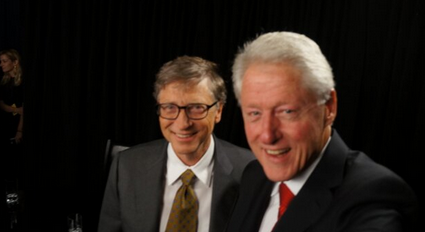
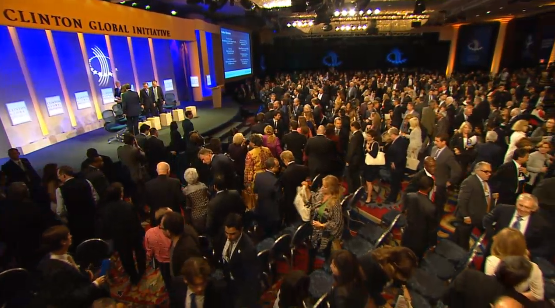
[Photography: courtesy CGI; Bill Gates and Bill Clinton, top; Bill Clinton on the CGI stage with Barack Obama, middle, and Sheryl Sandberg of Facebook, bottom]

Labels: , , , , , , , , , ,

Friday, June 7, 2013

Funders: R U (Really) There?


When Nancy Lublin's social media team at DoSomething.org began texting teens a couple of years ago to get more of them to focus their extraordinary energy on issues they care passionately about, what Lublin found was surprising. Mixed in with teens' texts about the need to help the homeless and rescue abused animals were many other texts that had nothing, at all, to do with DoSomething's social good campaigns at the time. "We started getting texts like, 'Help, I'm being bullied and I don't know what to do' and texts on eating disorders," Lublin said.

And then, Lublin told those attending today's Personal Democracy Forum, there was one girl who sent in a text that said exactly this: 'He won't stop raping me. It's my dad. He told me not to tell anyone. R U there?'"

It made Lublin, DoSomething's CEO, decide to start work creating a text-only crisis line, the first real-time teen crisis network —and a promising alternative to the thousands of pre-Internet crisis telephone hotlines that Lublin says can "make people wait two hours to get help" and largely fail to communicate with teens in their language, using the medium most common to their generation.

Fast forward two years, and DoSomething's Crisis Text Line, set to launch August 1, will attempt to use social media and text-messaging technologies to create the world's first data-driven text hotline for teens—and all at a level of cross-sector collaboration that Lublin hopes will break new ground in the nonprofit sector, involving unprecedented levels of cooperation among organizations that now compete to tackle teen bullying, rape and incest and sex trafficking. Lublin says DoSomething is still getting a steady stream of texts from a significant portion of kids that are unrelated to its dozens of cause-texting campaigns in any given month: Just last week, she said, during the launch of the group's new Undocumented for a Day text campaign, which simulates for teens what it's like to live in the United States as a teen without U.S. citizenship,  Lublin says up to 15 percent of those texting the nonprofit sent messages about sexual abuse, bullying and eating disorders. For Lublin, Crisis Text Line can't start soon enough. "This will help save more lives than penicillin," she says.

Designed with the help of Mobile Commons and the MIT Media Lab as an always-on, real-time conversation with kids in crisis that can scale nationally, Lublin says the text line should significantly improve DoSomething's ability to support teens. "Texting is a medium that teenagers prefer. It will be private. No one hears you, unlike when you're calling a hotline. It's quiet. You can be bullied at the lunch table at school and be texting for help in that moment. It's fast." But beyond rapid response, Lublin also hopes that Crisis Text Line will become a critical new example of how social media can be used to reinvent and vastly improve the way the nonprofit sector does its work—more effectively, using  only the latest data rather than outdated suppositions to tackle social problems. "In real time, we will have a map," she says. "We will have our finger on the pulse of what is going on in every zip code in the United States with these teen crises." School boards, police, journalists and local communities will now have better data to help drive policy change and reallocate public resources for better impact, Lublin told PDFers, "so politicians can be basing decisions on facts" rather than "just spewing policy based on their own personal convictions."

But Lublin says that creating the text line has been tremendously difficult—and shouldn't have been. "That girl who texted us (about her dad raping her) came to us two years ago," Lublin told her peers in the PDF audience, "so why is it taking us so long to build this thing? ... Why is it so hard for all of us (in this sector) to make something new?"

It's not that Lublin hasn't met big start-up challenges before. In her 20s, she founded Dress for Success, the not-for-profit organization in over 80 cities worldwide that provides interview suits and career development training to women making the transition from welfare to work. At Do Something, Lublin has transformed what had been a small New York City cause mired in red ink to one that now has 45 employees, 1.6 million members worldwide and enabled more than 2.4 million 13- to 25-year-olds to make an impact last year, alone. DoSomething.org's social media and information tech team is the envy of nonprofit tech activists; the organization has become one of the leading examples of smart social media innovation-for-good in the world.

The problem, Lublin says, is that for all of the nonprofit sector's talk about collaboration and the need to support technology innovation in the sector, "we're really, really bad at it." (Lublin said she wanted to deliver her talk today at PDF—an annual gathering of some of the nation's top minds in technology-driven social innovation—because its theme this year is Think Bigger.)

"There are lots of things that traditional foundations are doing to hamper this new disruptive stuff," Lublin said. In part, it's a vision thing. Traditional foundations, she said, tend to be innovation-averse. "So often I'll hear (when fundraising for this project) that this is a great idea, but you don't fit our (funding) bucket," Lublin said. "No shit," she offered as a response to PDFers, who applauded. "It's new."  She also said she wonders if large traditional foundations, like the Ford Foundation (one of PDF's sponsors), have simply become too "comfy" to take big risks funding the kinds of social innovation they say they now want to support.

"Do you really need to sit in that $400 million building, Ford Foundation?" Lublin asked. Most of the foundation's massive headquarters near the United Nations, she said, "is not even usable space" and suggested that Ford should sell the New York City landmark and move to a loft space in Brooklyn. Like the smaller, scrappier Blue Ridge Foundation, she said, Ford—which cited $10 billion in assets in 2011—should use more of the money it has tied up in overhead and real estate to support more start-up innovation.

But that's not all, Lublin said. Traditional foundations' insistence on seeing a business model as a prerequisite for funding also is hampering nonprofit innovation. During her fundraising for the text line, Lublin said, "I would keep getting asked, 'Is this sustainable? What is the model for Crisis Text Line? Maybe you should sell that data.'" Lublin said she refused. "No, I'm not selling the data," she said, to applause. "I'm not going to sell the data to some hedge fund or for certain police departments to use. It's going to be open."

Governments fund health care, provide education and build roads in some places "because it's what they think is important for the value system and for a state or the country," Lublin said. "Private industry does things because it thinks it can make money on it. And then there's us," she said, the nonprofit sector, which does its work because it thinks it can help people in need and tackle social problems that others often cannot or won't.

"We matter. We are worth funding," she said. (Click here for the video of her talk.) "Foundations, please don't forget that. This is not a pitch (for funding). Crisis Text Line is launching August 1st. We're doing fine. This is a request for all of us to take this conversation and put it out in the open."

Consider it done.

-- Marcia Stepanek

(Illustration by Andrew Polushkin for istock.com)

Labels: , , , , , , , , , , ,

Tuesday, September 25, 2012

Heat 3


President Barack Obama, less than an hour after delivering a stirring defense of free speech and democracy at the United Nations, told CGI delegates today that he has signed a new Executive Order to boost protections against human trafficking in federal contracts, to help eradicate what he called "modern slavery"in the United States and around the world.

"[Human trafficking] is a debasement of our common humanity," Obama told delegates attending the third and final day of Bill Clinton's annual Clinton Global Initiative conference of global changemakers. "...Now, I do not use that word, slavery, lightly. It evokes, obviously, one of the most painful chapters in our nation's history."

"But around the world," Obama continued, "when a man desperate for work finds himself in a factory, or on a fishing boat or in a field, working and toiling for little or no pay and beaten if he tries to escape, that is slavery. When a woman is locked in sweatshop or trapped in a home as a domestic servant, alone and abused and incapable of leaving, that is slavery. When a little boy is kidnapped, turned into a child soldier and forced to kill or be killed, that is slavery. When a little girl is sold by her impoverished family, runs away from home or is lured by the false promise of a better life — and then is imprisoned in a brothel and tortured if she resists — that is slavery. It is barbaric and it is evil and it has no place in a civilized world."

Obama evoked the stories of three women who were victims of human trafficking, including one from the DR Congo and one from Indonesia who had come to CGI to share their stories with delegates. "In the darkest hours of your lives, you may have felt utterly alone," Obama said, addressing them and other victims around the world. "It may seem in those moments like nobody cares but ... we see you. We hear you. We insist on your dignity."

Less than three hours earlier, GOP Presidential nominee Mitt Romney took the CGI stage, and took aim at the U.S. aid system in remarks also made yesterday by Secretary of State Hillary Clinton.  Romney lauded the "power of free enterprise" and urged more public-private aid ventures in the developing world, just as Clinton had.

But Romney also used his CGI speech to take aim at Obama, suggesting that he is not adequately handling the tensions in the Middle East. "A lot of Americans feel that America has found itself at the mercy of events rather than shaping events," Romney said. He listed four examples, saying: "Syria has witnessed the killing of tens of thousands of people. The president of Egypt is a member of the Muslim Brotherhood. Our ambassador to Libya was assassinated in a terrorist attack. Iran is moving toward nuclear-weapons capability."

[For more of Romney, see the video of his remarks here. For the video of Obama's speech on human trafficking, see video, below.]


Among other Day 3 highlights:

* The Elders, the Ford Foundation, the NoVo Foundation and Nike — some of the same people behind the successful Girl Effect campaigns of 2008 and 2010 to promote the advancement and protection of women and girls around the world — committed to jointly establish a new initiative called Girls Not Brides, a global partnership to end child marriage. The four organizations committed $3 million to establish a secretariat to identify activities to end child marriage in priority countries and to set up a network of donors to support programs to end child marriage worldwide.

* Mohamed Morsi, in his first U.S. appearance since his June election as Egypt's first democratically elected president following last year's demonstrations in Tahrir Square, said Egypt and the Middle East are "at a critical juncture." He called Egyptians "the ultimate gurantors" of his country's transition to democracy but declared that "we will also turn to our friends and partners beyond our borders." Morsi directly addressed recent violent demonstrations in Egypt and elsewhere that are widely blamed on a U.S-made film denigrating the Prophet Muhammad. Morsi today suggested that unfettered freedom of expression was at fault. "Freedom of expression comes with responsibilities, especially when it comes with serious implications for peace," he said. Morsi also warned Western nations against seeking to dominate his region. "The world is not one culture," Morsi said. A former head of the Muslim Brotherhood, Morsi told CGI delegates that "we must live together rather than than seek to dominate each other. The people of the world cannot accept domination (from the West) anymore."

* In an interview with TV host Charlie Rose, outgoing U.S. Treasury Secretary Timothy Geithner said today's bitter political climate in America is standing squarely in the way of faster economic growth. "If you allow what is politcally comfortable to stand in the way of what is necessary for the economy," he said, "that is what leaves countries weak and burning." Geithner predicted economic growth would rise to 2 percent or higher in the coming year but said "it is still a very tough economy and the challenges ahead are very daunting. When the United States does best, it is because leaders put politics aside and find the responsibility to govern." See the full video of that interview, below:


* Puma CEO Jochan Zeitz and Cornell University Law School Professor Lynn Stout talked about what's keeping social good off the radar of many corporations. Zeitz described launching his sportswear company's controversial "environmental profit and loss account"  last year, which attempts to put a cost on the impact the business is having on the environment, across its entire supply chain. Zeitz said his hope was to acknowledge that "a new business paradigm is needed, and that the current economic model, which originated in the Industrial Revolution some 100 years ago, must be radically changed." Zeitz told CGI delegates that "if every business monetizes its actual impacts on the environment, they can design new ways of sourcing materials and running their supply chains to alleviate that impact" rather than simply guess "and get it wrong" for the company and the communities they serve. Stout, the author of The Shareholder Value Myth, said public companies also need to stop focusing so hard on maximizing shareholder value. Overemphasizing shareholders leads to a focus on short-term earnings, she says, discouraging investment and social innovation. "We have corporations capable of doing enormous amounts of public good," she said, "but the biggest obstacle these companies face is the myth that a corporation is run well when it is run to maximize stock price." First, this is not what the law requires, she said, and secondly, focusing on shareholder value "is not working out well, not for employees, not for companies, and not for investors, either."  Stout said returns to investors who have ownership in public companies have declined significantly in the last 30 years. Further, she said, "public corporations are disappearing. There were 8,823 public corporations in 1997 but by 2008, that number had declined to 5,418. If this were a species of animal and we saw the population decline by 40 percent, we would say it is in danger." But focusing on new community and environmental goals, such as sustainability, won't come "for free," Zeitz cautioned. "We can't just walk around and say sustainability will be great for business. You've got to invest in it. I'm not sure a lot of companies are ready for that yet."

* Former British Prime Minister Tony Blair told interviewer Charlie Rose that "certain things that were unclear and unresolved in the 20th century now are clear. Government is necessary but it is better at empowering and setting strategic frameworks than doing everything itself." He added: "Civic society, including NGOs, have a creativity and dynamism that can hugely augment the actions of government. And the private sector now understands it can't just be in places without some sense of responsibility to community. So the 21st century is very much about partnership, and the boundaries between government, civic society, and business should be broken down as far as possible."

* CGI closed with over 150 new commitments made by delegates to projects aimed at making the world a better place, valued at more than $2 billion and expected to impact 22 million people. Since the start of CGI in 2005, members have made nearly 2,300 commitments to improve the lives of more than 400 million people in more than 180 countries.


-- Marcia Stepanek

[Illustration, top, by Brooklyn illustrator Sophie Blackall, from her Congo series for the Measles and Rubella Initiative,  featured at this week's Social Good Summit 2012. Photos courtesy CGI.] 

Labels: , , , , , , , , ,

Monday, September 24, 2012

Heat


Bill Clinton's eighth annual, star-studded thinkfest on philanthropy, technology, social enterprise and cause advocacy — the Clinton Global Initiative 2012 — kicked off Sunday in Manhattan with a call to delegates to step up their impact on a global scale, to "design your actions in advance to make it more likely they will succeed."

In opening remarks decidedly less optimistic than in previous years, Clinton signaled impatience. "I want to say my standard broken record," he told attendeees, "that cooperation works better than conflict. I say that not for the purpose of avoiding disagreement—there will be a lot of those here—but the point is to act." [At one point during an opening panel with U.N. Secretary-General Ban Ki-moon, Queen Rania of Jordan and World Bank President Jim Yong Kim, Clinton challenged Wal-Mart President and CEO Michael Duke to open a store in Libya and create jobs in some of the world's crisis hotspots. Duke responded that his company already operates in "high-risk areas" but not yet in Tripoli, the Libyan capital.]

"How come we can never seem to take solutions to problems to scale?" Clinton asked delegates and panelists, alike, alluding to the theme of this year's conference, Design for Impact. Since the first CGI conference in 2005, delegates have pledged millions to create new projects to ease hunger, stem environmental damage, and lift thousands of people out of poverty. But Clinton urged delegates to now act more collaboratively, and quickly, to translate what works in their individual projects into larger, cross-border deployments. "There are all of these places, all over the world, and they're all so different. How can we take what we know to work, and scale it quicker?" Clinton asked. "...How can countries come together amid all these cuts in foreign assistance? How can we plan and execute our way out of the current economic crisis (globally) without backsliding on all of these humanitarian goals?"

"If we do not deeply understand the communities we are trying to serve, we cannot design causes for impact." -- IDEA CEO Tim Brown

This is the fifth consecutive CGI that Cause Global has attended; the crowd at the New York Sheraton Hotel in the heart of midtown Manhattan is, once again, a testament to Clinton's continuing clout on the world stage, with appearances scheduled for Tuesday by both Governor Mitt Romney and President Barack Obama, the new leaders of Egypt and Libya (attending amid the opening of this year's United Nations' General Assembly across town], and a blue-chip roster of bold-faced names from the worlds of media, business, policy think tanks and entertainment, including wellbeing guru Deepak Chopra, Actors Michael Douglas, Forrest Whitaker and Geena Davis, Newsweek/Daily Beast Editor-in-Chief Tina Brown, fashion designer Donna Karan, Council on Foreign Relations Co-chair and former Clinton Treasury Secretary Robert Rubin, Barbra Streisand, Loew's Hotels CEO Jonathan Tisch, and philanthropist Eli Broad.

Much of the program will be unfolding during simultaneous break-out sessions and delegate design-for-impact workshops taking place on Monday and Tuesday. Some of the sessions will be livestreamed over the Web. Cause Global will be tweeting from the floor and during some of the breakout sessions. You can follow our CGI tweets @CauseGlobal throughout.

[The 2012 Social Good Summit, a separate conference occuring simultaneously across town, also is exploring impact, but mostly through the use of social media for cross-community action. Cause Global also is covering that conference, sponsored by the United Nations Foundation, Mashable, the 92Y, Ericcson and the Gates Foundation. Watch this space for separate posts.]

To view Sunday's opening plenary session of CGI, a conversation between Bill Clinton and global heads of state, click HERE. In that conversation, United Nations Secretary General Ban Ki-moon , alluding indirectly to the civil war in Syria, issued a "call for alarm" by world leaders and, alluding indirectly to Syria's civil war, urged more collaborative political leadership across the world. His remarks are excerpted, below:

"I'm going to sound the alarm to all leaders for more leadership. We are living in an era of insecurity, injustice, inequality, and intolerance. I want to emphasize that political leadership is needed. This is a collective responsibility of all of our leaders at this time in our history.  I was just in Srebrenica, a place that may be the most difficult place to visit for any Secretary General of the United Nations. It was most humbling, sad, and troubling to realize the international community failed to protect the lives of many in the civilian popultion. We could have done that. We could have done it if there was a very clear, strong political will. More than 8,000 boys and men were murdered in just three days (in July 1995). Why and for what? In Rwanda, hundreds of thousands were killed in the span of a year. Why? Because we lacked the political will to protect the civilian population. We must respect human dignity ... and we have to set this world right, put this world on the right track for humanity. That is what the UN will continue to try to do but we need all of you to get engaged, as we can't do it alone." 

Among other first-day highlights:

* World Bank President Jim Yong Kim acknowledged that multilateral institutions, including his own, "are not very good nor effective at capturing knowledge of what works and spreading it to others."  Within the multilateral system, he said, "there are so many good examples of what works, yet we don't capture them, codify them, or duplicate them." He also said that global institutions have been "very bad at pulling fragile states out of instability. We do know that one way to do that is to create jobs. What do we know about creating jobs in fragile environments? Well, the folks in Mozambique and Rwanda have done pretty well at it. What are the lessons? The World Bank is filled with master practioners but we haven't been systematic about capturing that knowledge and spreading it effectively." He said his precedessor, James Wolfensohn, often talked about transforming the World Bank into a 'knowledge bank.' "But what does that mean?" Kim asked. "Does it mean that we send everyone our studies and our reports? Instead, we need to turn the World Bank into a solutions bank, and develop a science of delivery and execution around social goals. Solutions in one place may not work in another, but if you have a commitment to continously learn from what people are doing, there is a possibility we can contribute to stability everywhere."

* IDEO CEO Tim Brown spoke with Fast Company editor Linda Tischler, telling her that global changemakers need to learn about local culture and local markets before they can be effective scaling their designs for change, whether for new products or new social problem-solving. "If we do not deeply understand the communities we are trying to serve, we cannot design causes for impact," he said. "You need to be on the ground and to understand the local cultures. You have to be able to connect to the people for whom your designs are meant to serve."

* During a private dinner panel hosted by 10,000 Women, the Goldman Sachs-backed women's empowerment initiative, Liberian business owner Kabeh Sumbo told invitees that "if you train one woman like the 10,000 Women trained me, you train a nation." The panel, moderated by Newsweek and The Daily Beast Editor-in-Chief Tina Brown, was joined by Liberian President Ellen Johnson Sirleaf, U.S. Ambassador-at-Large Melanne Verveer, Nobel Peace Prize winner Leymah Gbowee and New York Times columnist Nicholas Kristof. Kristof said there is mounting evidence that small businesses run by women can dramatically influence local communities and "lift nations" over time. But Sirleaf acknowledged that not every woman who wants to start a company will be a success. "Kabeh is an exception," Sirleaf acknowledged. Her administration has given Sumbo 100 acres of farmland to help her grow her palm-oil business, which Sumbo began with one container of olive oil and a microfinance loan. Sirleaf told Sumbo Sunday night, "Kabeh, your 100 acres of land awaits you. I have chosen to put it in my own county so I will be able to monitor you first-hand."

The conference continues through Tuesday. Secretary of State Hillary Clinton is to address CGI Monday morning.

Watch this space for continuing highlights.

-- Marcia Stepanek

[Photographs courtesy CGI and CauseGlobal staff]


Labels: , , , , , , , ,

Saturday, June 5, 2010

Citizens Rising


Here's another new start-up that aims to empower citizens affected by the BP oil spill. It's called GrassrootsMapping.org, and it's aiming to help Gulf Coast residents take high-resolution, aerial photographs of the spill. The goal: to compile an ongoing public record of the spill and its impact.

"There's been a kind of media blackout of the spill and it's tough to see what's actually going on," Founder Jeffrey Yoo Warren told people attending the 2010 Personal Democracy Forum this week in New York. "These maps create documentation that can be used as evidence in the legal arena and help focus resources in clean-up efforts in the weeks and months ahead."

Warren, a fellow at MIT's Center for Future Civic Media, described his New Orleans-based nonprofit to PDF attendees and a VC panel that included tech angels Esther Dyson and Craig Newmark, the founder of Craigslist.org. "Our idea," Warren said, "is to get a lot of people involved in producing digital maps of the spill that can be shared, Wikipedia-style."

Since early May, the nonprofit has been assembling and distributing free citizens' mapping kits that each contain a helium canister, a balloon, an inexpensive Canon mini-camera, and an array of simple household items, including a $3 roll of cotton string. The cameras, programmed to shoot a new frame every 5 seconds, "produce imagery so detailed, that we can count animals on the ground and count the vegetation," Warren said.

Once the images are captured by citizen mappers, they are geo-referenced and stitched into online composite maps, where they get overlayed onto Google and become viewable in Google Earth and OpenLayers. The images appear at 10,000 times the resolution of daily satellite images posted online by NASA, Warren says -- and at a price of roughly $230 per kit, they cost far less to produce. "By creating open-source mapping tools to include everyday people in exploring and defining their own geography, we are giving citizens affected bythe spill some power in this crisis," Warren told PDF attendees. "all of the imagery we capture is owned by the residents who shot it."

Warren is working with another new oil spill start-up in the region, the Louisiana Bucket Brigade, which is making a crisis map of the disaster. The LBB is helping Warren to distribute the Grassroots Mapping kits to as many residents of coastline towns and cities as possible.

Over the past five days, Grassroots Mapping, founded in January originally to produce citizen maps of the Lima slums in Peru, has raised more than $5,000 for the Gulf project via Kickstarter. [Immediately after pitching to the PDF crowd on Friday afternoon, Grassroots Mapping had raised nearly $495 more.] Said Dyson: "It's nice to see something that is not totally digital. That's what we (investors) want to see -- simple, low-cost applications of existing technology to empower citizens to make change." Added Newmark: "This is like something out of a Cory Doctorow novel, about how the street finds its uses for technology." PDF co-founder Andrew Rasiej put it more philosophically. "There has always been the fear that the government would be Big Brother," he said. "But this (start-up) is an example of how we are Big Brother; Big Brother is you."

For more on Grassroots Mapping, here's a short video that Warren produced on the project:


What do you think? Can citizen mapping projects help citizens to hold authorities accountable in times of crisis? Let us hear from you.

-- Marcia Stepanek

(Illustration by Jayesh Illustration for istock.com)

Labels: , , , , , , , , ,

Tuesday, June 1, 2010

Conferences for Good


Here's a quick-and-dirty list of some of the top social innovation conferences and conversations taking place this summer through December 2010.

This list is long but not complete; please share any important events that we may have overlooked.

An updated list of events will be issued in August.

Cause Marketing Forum - June 2 and 3 in Chicago

Global Youth Rework the World Summit - June 2-5 in Leksand, Sweden

Personal Democracy Forum - June 3 and 4 in NYC

Journalism That Matters - June 3-6 in Detroit

TEDxRotterdam - June 4 in Rotterdam

Fast Company's Most Creative People in Business - June 6 in NYC

Conference on Innovation Journalism - June 7-1 Palo Alto, CA

Rewire London - June 8 in London

Mashable Media Summit - June 8 in NYC

The 4th Annual Climate Change Summit 2010 - June 8 and 9 in London

Women Deliver Global Conference - June 7-9 in Washington, DC

New Media Consortium - June 9-12 in Anaheim, CA

ReadWriteWeb's Real-Time Web Summit - June 11 in NYC

Mobile Tech for Social Entrepreneurs - June 12 in London

Scaling Social Impact Conference - June 17 and 18 in NYC

Allied Media Conference - June 18-20 in Detroit

TEDxTasmania - June 18 in Launceston, Tasmania

TEDxStockholm - June 19 in Stockholm

TEDxPerth - June 21 in Perth

NetSquared Camp Portland - June 25 in Portland, Oregon

NCTech4Good Conference - June 25 in Chapel Hill, NC

Nonprofit 2.0 Unconference - June 25 in Washington, DC

TEDxMadrid - June 26 in Madrid, Spain

iSociety International Conference - June 28-30 in London

National Conference on Volunteering and Service - June 28-30 in NYC

Cloud Computing and Enterprise 2.0 World Forum - June 29-July 1 in London

Aspen Ideas Festival - July 5-11 in Aspen, CO

International Development Design Summit - July 7 in Fort Collins, CO

TEDxAbuja - July 10 in Abuja, Nigeria

TEDGlobal "And Now the Good News" Conference- July 12-16 in Oxford, UK

Cosi10: Alternative Currencies in Social Entrepreneurship - July 16-18 in Brussels

Cosi10: Change Your City Denver - July 16-18 in Denver

Cosi10: Social Innovation Online - July 16-18 in Shanghai

Netroots Nation - July 22-25 in Las Vegas

TEDxBoston - July 29 in Boston

TEDxBoulder - August 7 in Boulder

Big South Social Media Summit - August 13 in Nashville, TN

Second Life Community Convention - August 13-15 in Boston

Craigslist Foundation Boot Camp - August 14 in Berkeley, CA

Cosi10: Strategies to Foster Innovation - August 20-22 in Chicago

Cosi10: Social Enterprise in the Developing World - August 20-22 in Delhi, India

Philanthropy Australia Conference 2010 - August 31-September 1 in Melbourne

Gov2.0 Summit - September 7 and 8 in Washington, DC

CSR Asia Summit - September 14 and 15 in Hong Kong

Clinton Global Initiative - September 21-24 in NYC

CUSP Conference - September 22 and 23 in Chicago

Paris 2.0 - September 22-25 in Paris

Web of Change Conference - September 22-26 in Hollyhock, Cortes Island, British Columbia

TEDxAuckland - September 26 in Auckland, NZ

Mobile Giving Conference - September 27 and 28 in Malibu, Los Angeles

The IdeaFestival - September 29-October 2 in Louisville, KY

GoingGreen West - September in Sausalito, CA

Open Video Conference - October 1 and 2 in NYC

Social Capital Markets Conference - October 4-6 in San Francisco

BlogWorld Expo - October 14-16 in Las Vegas

Opportunity Collaboration CSR Conference - October 15-20 in Ixtapa, Mexico

Bioneers - October 15-18 in San Rafael, CA

The Feast Conference 2010 - October 15 in NYC

Blackbaud's 2010 Confeence for Nonprofits - October 20-22 in Washington, DC

Independent Sector's 2010 National Conference - October 20-22 in Atlanta

PopTech - October 20-23 in Camden, ME

Social Ventures 2010 Conference - October 21-23 in Long Beach, CA

TEDMED 2010 - October 26-29 in San Diego

Justmeans Social Media, Technology and Change Conference - November 1 in NYC

TEDxHonolulu Shift Conference - November 4 in Honolulu

Web 2.0 Summit - November 15-17 in San Francisco

European Venture Philanthropy Association - November 16 and 17 in Luxembourg

TEDxYouth Conference - November 20 worldwide

GlobalGreen Awards - November 25 in London

Medicine 2.0 - November 29 and 30 in Maastricht, The Netherlands

Conference on Philanthropy and Leadership - December 3 in Boston


We'll be updating this list again in the fall. Please share any conferences we've missed.

-- Compiled by Marcia Stepanek

(Illustration: istock.com)
(This post first appeared in Justmeans.com and appears here with permission.)

Labels: , , , , , , , , , ,

Friday, February 26, 2010

Apples and Oranges

There has been, for a while now, a spirited debate over whether philanthropy and social media-driven giving sites should have a place in social enterprise. The argument heated up again recently at a conference sponsored by New York University's Heyman Center on Philanthropy and Fundraising called "Charities on Trial."

There, New York Times philanthropy journalist Stephanie Strom questioned the blurring of lines in the social change space. Perhaps one of the most unsettling behavioral trends by today's philanthropy donors, Strom told conferees, is their growing willingness to funnel their tax-exempt dollars to support for-profit programs- and sometimes, at the expense of the nonprofit organizations they used to support."Newer forms of philanthropy," she said, "have been quick to promote the use of for-profit models for social good, and the case they make is persuasive. Why shouldn't GE get some sort of tax break for creating a system that better enables the management of health records, a system that would benefit nonprofit hospitals? ...When Citibank provides mortgage financing to low-income families, why shouldn't that portion of its operations be eligible for the same tax treatment as a local community loan bank gets?"

Trouble is, Strom told the NYU conference, some of the projects seeking funding on some of the new online giving sites -- such as Global Giving, for example -- are corporate programs. Donors making gifts to support those projects "are, effectively, underwriting corporate social responsibility," Strom says. "In other words, companies are using gifts for which a donor has received a tax deduction to finance their corporate philanthropy - something they used to have to fund out of their profit streams." Meanwhile, she says, the Bill & Melinda Gates Foundation, among other private grantmakers, are starting to devote a small portion of some of their grants to partnerships with for-profit companies ranging from MTV to JPMorgan Chase and Merck.

Further, says Strom, donors are pushing charities to "look more like business" in their analysis and evaluation of their impact. "The demand for results that donors can understand arises every day, and it increases the challenge for fundraisers," Strom says. "The simple fact is that there’s a paucity of good, honest information about the impact nonprofits have and organizations today are going through enormous time, effort and expense to try to devise systems that will demonstrate their efficacy."

The problem, says Strom, is that many of these efforts also "blur the line between for-profit and nonprofit as fundraisers, consultants, and experts appropriate the language of business to try to explain what nonprofits achieve." For-profits, meanwhile, benefit from this new vocabulary, Strom said. There is a danger, she suggested, that this new language can sometimes be misleading to donors. "What is social investing if it’s not philanthropy?" Strom asked. "And is SASIX, the South African Social Investment Exchange, really a capital marketplace? Its Web site says SASIX makes 'carefully selected social development projects available as investment opportunities with a social return.' It sounds a lot like the materials I just got from Charles Schwab."

And there are other questions. Said Strom:

"A year or so ago, the IRS granted tax exemption to a small organization called Zeus Energy Movement. Its founder told me that he and his three partners had sought a tax exemption because they were finding it too difficult to tap into federal support to sustain their research on clean energy devices. ['One is a gadget that harnesses energy from sea waves. It's very interesting,' Strom says.] Their plan is to sell the patents they get on such devices to major energy companies as well as attract foundation grants to support research and development. The problem for me was understanding how Zeus was different from any one of the many small startup companies that my friend Richard, a venture capitalist, invests in. Richard invests his money in solar energy, wind energy, and water energy companies. He puts in the risk and hopes that the devices that his money is supporting will have widespread commercial value and produce a handsome return. Moreover, he pays taxes on those returns. Zeus doesn’t have to." (Is that fair?)

These and other questions will get debated again at this fall's Social Capital Markets conference, a place where investors in the business-for-good space are starting to converge. For the first time this year, there will be a Tactical Philanthropy track to look at how philanthropy is changing in response to the expansion in the types of groups and people now working for change. That track is being developed in partnership with Tactical Philanthropy, Sean Stannard-Stockton's philanthropic advisory services firm, which grew out of his blog of the same name.

What do you think? Does philanthropy have a place in social enterprise? Are new tax rules required to keep it all kosher? Where is collaboration needed? Let us hear from you.

-- Marcia Stepanek

[This piece first appeared on Justmeans.org and appears here with permission.]
(Illustration by Ray Meyer for istock.com)


Labels: , , , , , , ,

Monday, January 11, 2010

Top Social Innovation Conferences

Here's a quick-and-dirty list of some of the top social innovation conferences and conversations taking place through June 2010.

This list isn't complete; please share any events we've overlooked. A list of July-December 2010 events will be issued in the spring.


Social Fresh Nashville - January 11 in Nashville, TN

World's Fair Use Day - January 12 in Washington, DC

TheFunded.com's FounderShowcase - January 14 in Palo Alto, CA

Solutions Lab 2010 - Green Innovation in Business - January 28 at Duke University

Catalyst Conference - January 26 at Commonwealth Club in San Francisco

Enterprise Social 2.0: RIP or ROI? - January 27-28 in Amsterdam, The Netherlands

World Economic Forum - January 27-31 in Davos, Switzerland

Design Revolution RoadShow - Starting in February and crossing the country

Social Enterprise Coalition's Voice Conference - February 1-2 in Cardiff, Wales

Social Media Week - February 1-5 simultaneously in New York City, Berlin, London, San Francisco, Toronto, and Sao Paulo

Social Entrepreneur Unconference - February 5-7 in Portland, OR

New Partners for Smart Growth - February 4-6 in Seattle, WA

TED - February 9-13 in Long Beach, CA

Online Community Unconference East - February 10 in New York City

Tech4Society - February 11-13 in Hyderabad, India

Free Culture X - February 13-14 in Washington DC

Future of Funding Conference - February 18 in San Mateo, CA

Digital Media and Learning Conference - February 18-20 in La Jolla, CA

IMAGINE Solutions - February 22-23 in Naples, FL

Social Enterprise Conference - February 27-28 at Harvard Business School and Harvard Kennedy School in Cambridge, MA

2010 Media Summit - March 10-11 in New York City

South by Southwest - March 12-21 in Austin, TX

Social Venture Capital/Social Enterprise Conference - March 16-18 in Miami

Social Networking World Forum Europe - March 15-16 in London

Social Media for Stakeholder Engagement - March 19 in London

Social Innovation Awards - March 24 in New York City

March Madness for the Mind - March 26-27 in San Francisco

O'Reilly WHERE 2.0 Conference on geolocation - March 30-April 1 in San Jose, CA

Digital Now Conference - April 7-10 in Orlando, FL

NTEN - April 8-10 in Atlanta

GEO - April 12-14 in Pittsburgh

Skoll World Forum - April 14-16 in Oxford, UK

GH/Innovate 2010 - April 17-18 at Yale University in New Haven, CT

Global Philanthropy Forum - April 18-21 in Redwood City, CA

140 Characters Conference NYC - April 20-21 in New York City

SOCAP International 2010 Symposium - April 25-28 in Atlanta

Milken Global Forum - April 26-28 in Los Angeles

Revisioning Value - April 26-27 in Portland, OR

Social Enterprise Alliance World Summit - April 28-30 in San Francisco

Web 2.0 Expo - May 3-6 in San Francisco

Finovate Spring 2010 - May 11 in New York City

The New Entrepreneur Conference 2010 - May 13-14 in Dusseldorf, Germany

Gov 2.0 Expo - May 25-27 in Washington, DC

Women Deliver Global Conference - June 7-9 in Washington, DC

Personal Democracy Forum - June 21-22 in New York City

iSociety International Conference - June 28-30 in London


-- Compiled by Marcia Stepanek


(Illustration by Miroslaw Pieprzyk for istock.com
)

(This post first appeared on Justmeans and is reposted here with permission)

Labels: , , , , , , , ,