Tuesday, September 25, 2012

Chelsea's Charity

Chelsea Clinton, in a rare interview, discussed everything from her parents to her own advocacy work to the crisis-mapping social media enterprise, Ushahidi, in this interview today with talk show host Charlie Rose at the Clinton Global Initiative. Clinton said she is "optimistic about politics" and hopes that more young people will ultimately go to the ballot box and vote for candidates "who will write the laws and scale the solutions for the change they want to see." It's easier to raise money than ever before, Clinton said, partly through SMS technology but also because there is a growing sense among people across sectors "that we are all in this together and that is good to see."

The full video is below:


-- Marcia Stepanek

Labels: , , , , ,

Heat 3


President Barack Obama, less than an hour after delivering a stirring defense of free speech and democracy at the United Nations, told CGI delegates today that he has signed a new Executive Order to boost protections against human trafficking in federal contracts, to help eradicate what he called "modern slavery"in the United States and around the world.

"[Human trafficking] is a debasement of our common humanity," Obama told delegates attending the third and final day of Bill Clinton's annual Clinton Global Initiative conference of global changemakers. "...Now, I do not use that word, slavery, lightly. It evokes, obviously, one of the most painful chapters in our nation's history."

"But around the world," Obama continued, "when a man desperate for work finds himself in a factory, or on a fishing boat or in a field, working and toiling for little or no pay and beaten if he tries to escape, that is slavery. When a woman is locked in sweatshop or trapped in a home as a domestic servant, alone and abused and incapable of leaving, that is slavery. When a little boy is kidnapped, turned into a child soldier and forced to kill or be killed, that is slavery. When a little girl is sold by her impoverished family, runs away from home or is lured by the false promise of a better life — and then is imprisoned in a brothel and tortured if she resists — that is slavery. It is barbaric and it is evil and it has no place in a civilized world."

Obama evoked the stories of three women who were victims of human trafficking, including one from the DR Congo and one from Indonesia who had come to CGI to share their stories with delegates. "In the darkest hours of your lives, you may have felt utterly alone," Obama said, addressing them and other victims around the world. "It may seem in those moments like nobody cares but ... we see you. We hear you. We insist on your dignity."

Less than three hours earlier, GOP Presidential nominee Mitt Romney took the CGI stage, and took aim at the U.S. aid system in remarks also made yesterday by Secretary of State Hillary Clinton.  Romney lauded the "power of free enterprise" and urged more public-private aid ventures in the developing world, just as Clinton had.

But Romney also used his CGI speech to take aim at Obama, suggesting that he is not adequately handling the tensions in the Middle East. "A lot of Americans feel that America has found itself at the mercy of events rather than shaping events," Romney said. He listed four examples, saying: "Syria has witnessed the killing of tens of thousands of people. The president of Egypt is a member of the Muslim Brotherhood. Our ambassador to Libya was assassinated in a terrorist attack. Iran is moving toward nuclear-weapons capability."

[For more of Romney, see the video of his remarks here. For the video of Obama's speech on human trafficking, see video, below.]


Among other Day 3 highlights:

* The Elders, the Ford Foundation, the NoVo Foundation and Nike — some of the same people behind the successful Girl Effect campaigns of 2008 and 2010 to promote the advancement and protection of women and girls around the world — committed to jointly establish a new initiative called Girls Not Brides, a global partnership to end child marriage. The four organizations committed $3 million to establish a secretariat to identify activities to end child marriage in priority countries and to set up a network of donors to support programs to end child marriage worldwide.

* Mohamed Morsi, in his first U.S. appearance since his June election as Egypt's first democratically elected president following last year's demonstrations in Tahrir Square, said Egypt and the Middle East are "at a critical juncture." He called Egyptians "the ultimate gurantors" of his country's transition to democracy but declared that "we will also turn to our friends and partners beyond our borders." Morsi directly addressed recent violent demonstrations in Egypt and elsewhere that are widely blamed on a U.S-made film denigrating the Prophet Muhammad. Morsi today suggested that unfettered freedom of expression was at fault. "Freedom of expression comes with responsibilities, especially when it comes with serious implications for peace," he said. Morsi also warned Western nations against seeking to dominate his region. "The world is not one culture," Morsi said. A former head of the Muslim Brotherhood, Morsi told CGI delegates that "we must live together rather than than seek to dominate each other. The people of the world cannot accept domination (from the West) anymore."

* In an interview with TV host Charlie Rose, outgoing U.S. Treasury Secretary Timothy Geithner said today's bitter political climate in America is standing squarely in the way of faster economic growth. "If you allow what is politcally comfortable to stand in the way of what is necessary for the economy," he said, "that is what leaves countries weak and burning." Geithner predicted economic growth would rise to 2 percent or higher in the coming year but said "it is still a very tough economy and the challenges ahead are very daunting. When the United States does best, it is because leaders put politics aside and find the responsibility to govern." See the full video of that interview, below:


* Puma CEO Jochan Zeitz and Cornell University Law School Professor Lynn Stout talked about what's keeping social good off the radar of many corporations. Zeitz described launching his sportswear company's controversial "environmental profit and loss account"  last year, which attempts to put a cost on the impact the business is having on the environment, across its entire supply chain. Zeitz said his hope was to acknowledge that "a new business paradigm is needed, and that the current economic model, which originated in the Industrial Revolution some 100 years ago, must be radically changed." Zeitz told CGI delegates that "if every business monetizes its actual impacts on the environment, they can design new ways of sourcing materials and running their supply chains to alleviate that impact" rather than simply guess "and get it wrong" for the company and the communities they serve. Stout, the author of The Shareholder Value Myth, said public companies also need to stop focusing so hard on maximizing shareholder value. Overemphasizing shareholders leads to a focus on short-term earnings, she says, discouraging investment and social innovation. "We have corporations capable of doing enormous amounts of public good," she said, "but the biggest obstacle these companies face is the myth that a corporation is run well when it is run to maximize stock price." First, this is not what the law requires, she said, and secondly, focusing on shareholder value "is not working out well, not for employees, not for companies, and not for investors, either."  Stout said returns to investors who have ownership in public companies have declined significantly in the last 30 years. Further, she said, "public corporations are disappearing. There were 8,823 public corporations in 1997 but by 2008, that number had declined to 5,418. If this were a species of animal and we saw the population decline by 40 percent, we would say it is in danger." But focusing on new community and environmental goals, such as sustainability, won't come "for free," Zeitz cautioned. "We can't just walk around and say sustainability will be great for business. You've got to invest in it. I'm not sure a lot of companies are ready for that yet."

* Former British Prime Minister Tony Blair told interviewer Charlie Rose that "certain things that were unclear and unresolved in the 20th century now are clear. Government is necessary but it is better at empowering and setting strategic frameworks than doing everything itself." He added: "Civic society, including NGOs, have a creativity and dynamism that can hugely augment the actions of government. And the private sector now understands it can't just be in places without some sense of responsibility to community. So the 21st century is very much about partnership, and the boundaries between government, civic society, and business should be broken down as far as possible."

* CGI closed with over 150 new commitments made by delegates to projects aimed at making the world a better place, valued at more than $2 billion and expected to impact 22 million people. Since the start of CGI in 2005, members have made nearly 2,300 commitments to improve the lives of more than 400 million people in more than 180 countries.


-- Marcia Stepanek

[Illustration, top, by Brooklyn illustrator Sophie Blackall, from her Congo series for the Measles and Rubella Initiative,  featured at this week's Social Good Summit 2012. Photos courtesy CGI.] 

Labels: , , , , , , , , ,

Monday, September 24, 2012

Heat 2


The Arab world "did not set out to trade the tyranny of a dictator for the tyranny of a mob," Secretary of State Hillary Clinton told global heads of state, philanthropists, CEOs and celebrities attending Day 2 of this year's Clinton Global Initiative. In a 30-minute speech, Clinton offered a clear rebuke to Muslim extremists behind the September 11th attack on the U.S. Embassy in Benghazi that killed U.S. Libyan Ambassador Chris Stevens and his colleagues Glen Doherty, Tyrone Woods and Sean Smith. 

"Human dignity doesn't come from avenging insults, especially with violence that can never be justified," Clinton said, referring to the anti-Muslim video that has sparked recent riots around the world, including the one that preceded the attack in Benghazi. "...Countries focused more on fostering growth than fomenting grievances are racing ahead, building schools instead of burning them; investing in their peoples' creativity, not inciting their rage; opening their economies and societies to have more connections with the wider world, not shutting off the Internet or attacking embassies," Clinton said.


Many leaders from around the world — including the foreign minister of Tunisia, where the Arab Spring originated — have expressed their stance against violence in the wake of the attacks, she told CGI delegates. "All of us need to stand together to resist these forces of violence and oppression to support democratic transitions underway across Africa and around the world. Unity on this throughout the international community is crucial because extremists around the world are working hard to drive us apart."

Clinton also spoke broadly about global development and her agency's work to overhaul the U.S. foreign aid system, saying that "we need to move from development aid to investments." She took dead aim at what she called "the elites in every country" who, Clinton said, do not pay their fair share of taxes to support government investment in their local communities. "I'm out of American politics," she said, "but it is a fact that around the world, the elites of every country are making money. There are rich people everywhere, and yet they do not contribute to the growth of their own countries. They do not invest in public schools and public hospitals and other kinds of development internally." She called on government and advocacy leaders around the world "to start telling powerful people things they don't want to hear" about the need to create transparency in governmental budgets and revenues, to work toward political reforms, to bring corruption to light, and create fair taxation models that mobilize resources and establish regulations designed to attract and protect investment.


"There are rich people everywhere, and yet they do not contribute to the growth of their own countries." - Secretary of State Hillary Clinton at CGI2012


"My goal is to put us out of the aid business," Clinton said, and to expand strategic aid partnerships beyond NGOs, to include businesses, other governments and innovative nonprofits and social entrepreneurs. As an example of this new collaboration, Clinton cited the development of Haiti's first business development park and a recent shipment of sewing machines to that country that is creating thousands of jobs there for women who had not worked previously. "You cannot have development in today's world without partnering with the private sector," Clinton said. She further cited a program in Sierra Leone in which more than 1,700 women serve as health monitors, checking up on clinics and reporting problems to the government so they can be resolved.

Clinton said her agency will continue working to encourage developing countries to pay for more of their own development, and to create impact measurements to ensure greater accountability and efficiency for their efforts to improve conditions on the ground.  "I hear from leaders all over the world that ultimately, it must be their responsibility to provide economic opportunity, health care, and good schools to their people. They don't want to turn to other nations forever for assistance. I look forward to the day when our assistance is no longer needed," Clinton said.

In other Day 2 highlights:

* In a panel moderated by New York Times columnist Nicholas Kristof, participants discussed the need to give women around the world the rights to more land so that more buildings and initiatives needed to help them rise out of poverty can —literally—get off the ground. "Only 1 percent of the land titles on earth is owned by women," said Joan Clos, the Under-Secretary General and Executive Director of UN-HABITAT, "and only about 18 to 20 percent of the land on Earth is titled. People want to build but there is no way to register the land, or to use much of it, he said. "There are ancestral ways to register the land that does not end up in the legal system and we need to create institutions for proper land registration that gives more access to women and to everyone," he said. Jonathan Reckford, the CEO of Habitat for Humanity International, said that in the aftermath of the Indian Ocean tsunami, Habitat built 10,000 homes on the southeast Indian coast and titled all of them in women's names, then worked with local government to change local landholding policy, which has had the effect of involving women in local policy decisions that previously did not include their input. "Worldwide, currently, only 1-2 percent of titled land is in the hands of women," Kristof said. "This needs to change."

* Former Secretary of State Madeleine Albright, Chair of the Albright Stonebridge Group, hosted a panel of three social innovators who have used the power of partnerships to make change around the world — Yemeni journalist Tawakkol Karman, co-founder of Women Journalists Without Chains and a 2011 Nobel Peace Prize winner, who is using new media to document human rights violations; Paul Farmer, chair of Global Health and Social Medicine at Harvard and Founding Director of Partners in Health, and Jimmy Wales, the founder of Wikipedia. Karman said her group's goal for Yemen is to "build our countries up from what revolution has destroyed" to include sustainable development and the rule of law, so as to keep new dictators from taking charge. "We have to work with each other, with the international community, to help people in the Arab region, as there is no peace without development and no development without peace." Farmer, whose public health work in Haiti was profiled in the 2003 book, Mountains Beyond Mountains, acknowledged that the last two post-earthquake years in Haiti "have been difficult; Haitians tend to be resistant to change." But Farmer urged tenacity and improved outputs within the development community. "We need to stick with it for some decades to come" but change the way aid advocates engage in Haiti and involve more Haitians in rebuilding for themsleves.  

CGI continues through Tuesday. Watch this space for updates.

—Marcia Stepanek

[Photograph of a segment of the Berlin Wall by Knud Nielsen for istock.com]

Labels: , , , , , , , , , , , ,

Heat


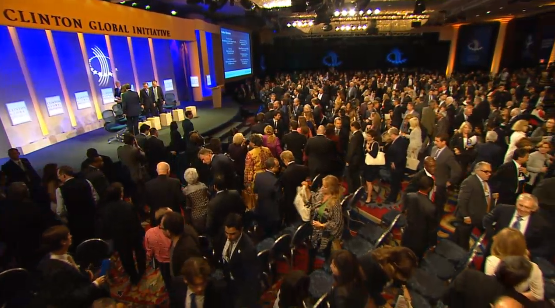
Bill Clinton's eighth annual, star-studded thinkfest on philanthropy, technology, social enterprise and cause advocacy — the Clinton Global Initiative 2012 — kicked off Sunday in Manhattan with a call to delegates to step up their impact on a global scale, to "design your actions in advance to make it more likely they will succeed."

In opening remarks decidedly less optimistic than in previous years, Clinton signaled impatience. "I want to say my standard broken record," he told attendeees, "that cooperation works better than conflict. I say that not for the purpose of avoiding disagreement—there will be a lot of those here—but the point is to act." [At one point during an opening panel with U.N. Secretary-General Ban Ki-moon, Queen Rania of Jordan and World Bank President Jim Yong Kim, Clinton challenged Wal-Mart President and CEO Michael Duke to open a store in Libya and create jobs in some of the world's crisis hotspots. Duke responded that his company already operates in "high-risk areas" but not yet in Tripoli, the Libyan capital.]

"How come we can never seem to take solutions to problems to scale?" Clinton asked delegates and panelists, alike, alluding to the theme of this year's conference, Design for Impact. Since the first CGI conference in 2005, delegates have pledged millions to create new projects to ease hunger, stem environmental damage, and lift thousands of people out of poverty. But Clinton urged delegates to now act more collaboratively, and quickly, to translate what works in their individual projects into larger, cross-border deployments. "There are all of these places, all over the world, and they're all so different. How can we take what we know to work, and scale it quicker?" Clinton asked. "...How can countries come together amid all these cuts in foreign assistance? How can we plan and execute our way out of the current economic crisis (globally) without backsliding on all of these humanitarian goals?"

"If we do not deeply understand the communities we are trying to serve, we cannot design causes for impact." -- IDEA CEO Tim Brown

This is the fifth consecutive CGI that Cause Global has attended; the crowd at the New York Sheraton Hotel in the heart of midtown Manhattan is, once again, a testament to Clinton's continuing clout on the world stage, with appearances scheduled for Tuesday by both Governor Mitt Romney and President Barack Obama, the new leaders of Egypt and Libya (attending amid the opening of this year's United Nations' General Assembly across town], and a blue-chip roster of bold-faced names from the worlds of media, business, policy think tanks and entertainment, including wellbeing guru Deepak Chopra, Actors Michael Douglas, Forrest Whitaker and Geena Davis, Newsweek/Daily Beast Editor-in-Chief Tina Brown, fashion designer Donna Karan, Council on Foreign Relations Co-chair and former Clinton Treasury Secretary Robert Rubin, Barbra Streisand, Loew's Hotels CEO Jonathan Tisch, and philanthropist Eli Broad.

Much of the program will be unfolding during simultaneous break-out sessions and delegate design-for-impact workshops taking place on Monday and Tuesday. Some of the sessions will be livestreamed over the Web. Cause Global will be tweeting from the floor and during some of the breakout sessions. You can follow our CGI tweets @CauseGlobal throughout.

[The 2012 Social Good Summit, a separate conference occuring simultaneously across town, also is exploring impact, but mostly through the use of social media for cross-community action. Cause Global also is covering that conference, sponsored by the United Nations Foundation, Mashable, the 92Y, Ericcson and the Gates Foundation. Watch this space for separate posts.]

To view Sunday's opening plenary session of CGI, a conversation between Bill Clinton and global heads of state, click HERE. In that conversation, United Nations Secretary General Ban Ki-moon , alluding indirectly to the civil war in Syria, issued a "call for alarm" by world leaders and, alluding indirectly to Syria's civil war, urged more collaborative political leadership across the world. His remarks are excerpted, below:

"I'm going to sound the alarm to all leaders for more leadership. We are living in an era of insecurity, injustice, inequality, and intolerance. I want to emphasize that political leadership is needed. This is a collective responsibility of all of our leaders at this time in our history.  I was just in Srebrenica, a place that may be the most difficult place to visit for any Secretary General of the United Nations. It was most humbling, sad, and troubling to realize the international community failed to protect the lives of many in the civilian popultion. We could have done that. We could have done it if there was a very clear, strong political will. More than 8,000 boys and men were murdered in just three days (in July 1995). Why and for what? In Rwanda, hundreds of thousands were killed in the span of a year. Why? Because we lacked the political will to protect the civilian population. We must respect human dignity ... and we have to set this world right, put this world on the right track for humanity. That is what the UN will continue to try to do but we need all of you to get engaged, as we can't do it alone." 

Among other first-day highlights:

* World Bank President Jim Yong Kim acknowledged that multilateral institutions, including his own, "are not very good nor effective at capturing knowledge of what works and spreading it to others."  Within the multilateral system, he said, "there are so many good examples of what works, yet we don't capture them, codify them, or duplicate them." He also said that global institutions have been "very bad at pulling fragile states out of instability. We do know that one way to do that is to create jobs. What do we know about creating jobs in fragile environments? Well, the folks in Mozambique and Rwanda have done pretty well at it. What are the lessons? The World Bank is filled with master practioners but we haven't been systematic about capturing that knowledge and spreading it effectively." He said his precedessor, James Wolfensohn, often talked about transforming the World Bank into a 'knowledge bank.' "But what does that mean?" Kim asked. "Does it mean that we send everyone our studies and our reports? Instead, we need to turn the World Bank into a solutions bank, and develop a science of delivery and execution around social goals. Solutions in one place may not work in another, but if you have a commitment to continously learn from what people are doing, there is a possibility we can contribute to stability everywhere."

* IDEO CEO Tim Brown spoke with Fast Company editor Linda Tischler, telling her that global changemakers need to learn about local culture and local markets before they can be effective scaling their designs for change, whether for new products or new social problem-solving. "If we do not deeply understand the communities we are trying to serve, we cannot design causes for impact," he said. "You need to be on the ground and to understand the local cultures. You have to be able to connect to the people for whom your designs are meant to serve."

* During a private dinner panel hosted by 10,000 Women, the Goldman Sachs-backed women's empowerment initiative, Liberian business owner Kabeh Sumbo told invitees that "if you train one woman like the 10,000 Women trained me, you train a nation." The panel, moderated by Newsweek and The Daily Beast Editor-in-Chief Tina Brown, was joined by Liberian President Ellen Johnson Sirleaf, U.S. Ambassador-at-Large Melanne Verveer, Nobel Peace Prize winner Leymah Gbowee and New York Times columnist Nicholas Kristof. Kristof said there is mounting evidence that small businesses run by women can dramatically influence local communities and "lift nations" over time. But Sirleaf acknowledged that not every woman who wants to start a company will be a success. "Kabeh is an exception," Sirleaf acknowledged. Her administration has given Sumbo 100 acres of farmland to help her grow her palm-oil business, which Sumbo began with one container of olive oil and a microfinance loan. Sirleaf told Sumbo Sunday night, "Kabeh, your 100 acres of land awaits you. I have chosen to put it in my own county so I will be able to monitor you first-hand."

The conference continues through Tuesday. Secretary of State Hillary Clinton is to address CGI Monday morning.

Watch this space for continuing highlights.

-- Marcia Stepanek

[Photographs courtesy CGI and CauseGlobal staff]


Labels: , , , , , , , ,