Thursday, September 26, 2013

#CGI2013: Bill Gates on 'Rich Dogs' and Risk


The philanthropist Bill Gates, speaking on a panel at the Clinton Global Initiative, which ends today, urged nonprofit leaders to work harder and better at collaborating with business on social good projects. "It's interesting that nonprofits think the for-profit guys are evil," Gates told some of the world's most influential philanthropists and CEOs, NGO executives and government delegates to Bill Clinton's annual confab. "That attitude has blocked cooperation in many areas of the global food and drug sectors." And, Gates said, that attitude is blocking aid to the many of the world's hungry and dying.

The Microsoft co-founder and former CEO, in a candid assessment of philanthropy's role in global social innovation, also urged fellow philanthropists to start funding riskier projects "that nobody else wants to touch." Said Gates: "If you're a philanthropist, you don't want to go into an area that is already well-covered." Philanthropy, he said, "has more leeway to experiment. It should fund the higher-risk projects and let businesses and governments do the easier stuff."

What follows is an edited transcript of an interview with Gates that The Economist's Matthew Bishop moderated from the CGI stage this past week. Bishop is author of the book, Philanthrocapitalism, about the rise of for-profit/nonprofit partnerships for collaborative social impact.

Q/ BISHOP:  The world is having a discussion right now about what follows the Millennium Development Goals for 2015. How do we set targets (for global social good) for the next 15 years that are big bets—that are achievable bets but not too hard or too easy to achieve?

GATES: The Millennium Development goals are a phenomenal thing. They are the eight priorities that were adopted by the (UN) General Assembly (in 2000) as a report card for the world. They're very focused on  inequity—in health, in education, and in economics. It's quite amazing that several of them will be fully achieved, even though they were set quite ambitiously. The poverty goal [to halve the rate of extreme poverty by 2015] was achieved. And in fact, in the next round—the goals for 2030—we could get to extremely low levels of poverty around the world. In the health area, we had 12 million children dying every year from a starting point of 1990; we're now down to 6.6 million, so we'll be, by 2015, down to close to a 50 percent reduction. The Millennium Goals have been wonderful because they allow us to look at the countries that are doing it the best, and to go in and talk to the leaders of the countries that aren't and make it a priority. I think the world has come around to the idea that you really need amazing partnerships to make these big things happen. For child mortality, you have to break it down and say, okay there's malaria.  What can the drug companies do? What can UNICEF/World Health Organization do? What can the local governments do? There's diarrhea, there's pneumonia, there's the first 30 days. And so it's all become really quite concrete. And even philanthropy, which is a smaller percentage of the dollars here compared with, say, the private sector, rich world donations, and local governments, it can get involved in some of the riskier things. For example, the actual vaccine development teams (are funded) mostly by philanthropy. Philanthropy is the major player in that part of it. So it's amazing to see how all of that has come together.

Q: But when you think of the next set of goals, the next 15 years, how far should we stretch to accomplish even more?

GATES: The inequity today, that a child under 5 has 30 times chance of dying than a child in a middle income country, gives us a chance in the next 15 years to to largely eliminate inequity. We won't get it down to zero. There will still be a differential there.  But  we can make a very dramatic change. So the fact that these Millennium goals are unfinished goals, and that if we keep them as unique as they've been—and keep up these (for-profit/nonprofit) partnerships—we will be largely complete by 2030. To me, that says that these goals should be the centerpiece of what gets adopted as the world's next report card. Now, because Millennial Development Goals have been successful and every cause in the world would like to have an MDG, there will need to be some tough choices made in terms of measurability and prioritization.

Q: As you think about how to put your money and Warren Buffett's money to work to achieve social good, how do you determine how to get maximum bang for the buck?

GATES: Well, obviously, you don't want to go into an area that is already well covered. And because philanthropy is small, even compared to aid budgets, you have to pick something that is probably risky and therefore not likely to be taken up by aid budgets. Take inventing new vaccines. Governments other than U.S. really don't get into that kind of upstream R&D.  And that's a global public good. As Africa develops, it's not going to get organized to finance the malaria vaccine for itself any time soon. So philanthropy can be very complimentary. I totally agree with the private sector that we need those roads and electricity in a big way in Africa, but we need to realize that five or six magical new vaccines are needed, too, so that's a great place (for philanthropy) to specialize. Now, that kind of philanthropy is very risky. You need to have to have a lot of oars in the water. And you're going to need partnerships, working with universities and the NIH and the pharmaceutical companies, where there's a lot of expertise that only exists with them, so crafting exactly how you work with them is important. We do a report card called the Access to Medicine Index, that rates all the pharma companies on how much they do to help poor people. And it's been great because every year, the bar has gone up. The drug companies at the top want to do more and stay at the top; the ones on the bottom definitely see that, their employees see that, and so they push forward on it.

And further on risky philanthropy, consider polio eradication. It can only work if every country in the world manages to get  those polio drops out to over 90 percent of the kids that need them, around the world. And so now, we're down to northern Nigeria, northern Pakistan, and there's been a big outbreak in Somalia recently. In these places, getting access to those kids is very tough because of rumors that these are people from the West coming in with vaccines, they're from the U.S. and the rumors that the U.S. uses vaccination campaigns for bad things. And that has really overwhelmed the trust and knowledge you want to have on the ground to allow those vaccines to come in. We could fail.  We raised a little over $4 billion at a (polio) summit earlier this year and everyone endorsed a plan (for polio eradication) that runs through 2018. It's the kind of thing the world should take on because if you take it on, it will save millions of lives. But it's not an easy thing. It's not like building a wing of a museum, where probably it will get done. This one? Polio? It should get done.

"Polio eradication? It's not an easy thing. It's not like building a wing of a museum, where it probably will get done."

Q: Is it really worth the effort, to take the last few steps that could mean complete eradication?

GATES: That's sort of a math test. The only reason we have so few cases now is because we are spending so much money. If you stop spending the money before (the death rate from polio) gets to zero, then it goes back and hundreds of thousands of kids get sick or die every year, and the problem gets worse. But if you wait to stop spending the money until after you get to zero, it gets kind of nice because then, you can spend the money on other things—pneumonia, diarrhea, neo-natal, and whatever those other causes are. So you really have to judge, can it be done? The whole credibility of the global endeavor is very much tied up in this (the fight to eradicate polio). Will those hold-out countries allow us access to those kids? That's what this whole thing rests on. There are days I worry we won't get it. But overall, I'm quite optimistic.

Q:  Let's consider, for a moment, the "f word" of failure. In the business world, failures can often be taken as a badge of honor: you tried something, and you learned from it. But in the philanthropic world, failure really is a swear word. People don't talk about it and there is a sense that people don't take enough risks.

GATES: Well, people don't take enough risk, that's fair. And they try to do too many things. If you really want to take on big risk, you really have to be willing and able to develop deep technocratic understanding of the science, the tools, and the social science factors that weigh into the delivery (of the aid you're giving). Philanthropy should be taking much bigger risks than business. If these are easy problems, business and government can come in and solve them. Probably the most risky thing (the Bill&Melinda Gates Foundation) is doing involves the money we spend in the United States, where our top priority is changing the teacher personnel system in K-12 eduction so that teachers get feedback, so we learn from teachers who teach extremely well, and so we have a professional assessment system to really understand how to do things better and get the average teachers into the top quartile. But that has become subjected to all sorts of controversies—with the school board system, with some people who love the status quo and amid controversy over just how it would get done. This project has a very high high chance of failure, whereas our malaria work is just a question of when. I'll be disappointed if it takes too long. Malaria deaths will come down. We will discover drugs and vaccines and we'll get more bed nets out. Malaria is just (a matter of) impatience and cleverness. There is no mode of total and utter failure on that path, whereas K-12? All the money we spend on that could end up being wasted.

"Malaria deaths will come down. We will discover drugs and vaccines and we'll get more bed nets out. Malaria is just (a matter of) impatience and cleverness. There is no mode of total and utter failure on that path, whereas K-12 education? All the money we spend on that in the U.S. could end up being wasted."

Q: Throughout your philanthropy, you've been partnering with business. You just announced a partnership with JP Morgan on health innovation. Do you think the business world is finally escaping the Milton Freidman narrow view of a company's role in society and is now more willing to engage in some of these big bets to improve the world? 

GATES: The private sector is the biggest force in terms of dollars and innovation and often, that takes a form of trickle down, where, for example, a medicine will be invented for rich customers and then it's made available over time, as the patent expires and as manufacturing becomes more efficient. Now, that  has done an amazing amount of good. Unfortunately, that model doesn't work for everything because rich people don't get malaria. One truly ironic thing is that a drug was developed for rich dogs. These dogs had a real problem. They had worms and people wanted to pay to get rid of their dogs' worms, and so there was a great market for it. Ivermectin was developed for that. And then somebody said let's try it on humans in Africa. They have worms, too. And in fact it worked very well and the companies were extremely generous in donating all of that. But that's a strange form of trickle-down from rich dogs to poor people. A lot of things we can't do that way. I will say that in terms of some of these for-profit/nonprofit partnerships, it's sometimes interesting that the nonprofit guys think the for-profit guys are evil...and that's blocked cooperation between some of food companies and some of nonprofit actors in (various countries). ...Bridging the gap between the way the private sector thinks about things and what's reasonable to ask them to do—and the nonprofit people, who know how to deliver aid and are devoting their lives to it—trying to get the best of both worlds out of that often takes a middleman listening to both points.

 "It's sometimes interesting that the nonprofit guys think the for-profit guys are evil..."

Q: What could the private sector do better in these partnerships?

GATES: The most classic example is the Clinton Foundation. We went from suing the South African government for off-patent use of drugs to now getting all the poor countries to get their AIDs drugs at the lowest possible price and there's no intellectual property involved in that at all. That model has been very successful.

Q: We need to measure progress carefully, but when is measurement taken too far?

GATES: You need to do things that are hard to measure but there are some things you really can't measure very well. Consider the child mortality area. We are trying to ensure that kids survive malnutrition but many are damaged mentally by malnutrition, and there's a danger that if we don't understand that, we won't focus on the right interventions. There's a huge hidden cost in health care that goes beyond death. They do IQ studies in Africa, and the numbers in some parts are unbelievably low because kids that have gone through early malnutrition are never developed fully mentally. Anything you can measure is great but you want to make sure you're measuring the right things.

Q: And then there is, in much philanthropy today, a push for social innovation. You, for example, have decided to innovate the toilet. Why have you done that, how is your project going and are there similar, less-trodden areas where philanthropists might bring innovation?

GATES: It's a fantastic example where trickle-down doesn't work. (laughter). The rich world toilets are built on a Rube Goldberg kind of scheme, where you bring all sorts of water in, you make it dirty, you send it to very complex plant to clean it up. Just the piping system alone, if you were going to do this in the slums of India, you could never afford it. And so we need something with the smell- and disease-prevention characteristics that are as good as the gold standard, which is the flush toilet, but do not require a completely unaffordable infrastructure. And so you have to get the best people in smell, and in taking the disease out of the waste and getting rid of it. We had a big contest recently at Caltech, and gave out prizes, and now we're working on what does the engineering for those ideas look like.

It's easier at the community level to create a low-cost toilet. You want to go into the individual households so women don't have to go out at night, facing some insecurity or harassment. But that would not have happened without philanthropy coming in. Scientists will say, 'Oh, we know how to do smell, but nobody ever asked us to solve this problem with toilets.' So it's taking high IQ scientists who were not thinking much about toilets in the developing world, and drawing them into the partnership to try and help solve these very real and pervasive global challenges.

There are a lot of universities that have programs to come up with tools for poor countries, and you have crowd-sourcing, where someone will put out something and get back amazing results. There was this one thing, a call for a power light that someone suggested be made by pulling up a weight on a pulley to generate the power needed, and that got funded in, like, 10 days. So there's lot of neat things out there.

So, in you're a philanthropist, fund innovation. Pick what you're passionate about and think about what are the innovative tools. It will probably be risky. Are you willing to wait 5-10 years (for results)? Are you willing to figure which universities have the science to connect that area you want to fund? What you want to fund is often not something government does well, like education or even health. government can often miss some great opportunities. But philanthropy can help where others can't, and it's needed and a very important piece in these partnerships to make the world a better place.


-- Marcia Stepanek

[Photograph: Bill Gates on stage at CGI on Tuesday, September 24th]

Labels: , , , , , , , ,

Wednesday, September 25, 2013

#CGI2013: Girl Power


Former Secretary of State Hillary Clinton, the subject of endless speculation over whether she will or won't run for the White House in 2016, made it very clear today how she plans to focus much of her time for the next two years. Speaking from the main stage of her family's power-philanthropy conference, the once and possibly future presidential hopeful said she will lead an international effort to evaluate progress made in empowering women and girls worldwide. "Whether we are talking about empowering and connecting women in economics or health care or education or politics, it all comes back to a question of the full and equal participation of women versus their marginalization," Clinton said.

Referring specifically to the 1995 United Nations summit of 189 countries on women in Beijing, where she led the U.S. delegation as First Lady, Clinton said there is much work yet to be done. The Beijing summit, she said, had been "a call to action for the global community to insure that women and girls everywhere finally have the opportunities they deserve to live up to their god-given potentials and contribute fully to the progress and prosperity of their societies." But while more girls are now in school and more women hold jobs and serve in public office, Clinton said, "it is still not enough. ...Women and girls still comprise the majority of the world's unhealthy, unfed and unpaid, marginalized in so many ways."

The year 2015 will mark 20 years since that conference in Beijing, officially known as the Fourth World Conference on Women. "It's time for a full and clear-eyed look at how far we have come and how far we still have to go, and what we plan to do together about the unfinished business of the 21st century: the full and equal participation of women," Clinton said. Since the Beijing summit, she said, "we've built an international architecture of laws and norms to protect women but it remains a bare scaffold without the bricks and mortar needed to make those laws effective in people's lives and turn our rhetoric into reality."

Clinton said her Beijing+20 initiative will work through the Clinton Foundation and leverage the convening power of CGI to bring together partner organizations, NGOs, international institutions, governments, businesses and others to evaluate global progress towards gender equity in time for the September 20, 2015 anniversary of the Beijing summit. She said Beijing+20 will also tap new online feminist networks and social media to encourage broad and global input and participation.

The move was generally lauded by political pundits in Washington, who said that throwing herself into the work of her foundation will give Clinton the ability to add to an already formidable network of donors and keep herself current in the national conversation. According to a report by NPR correspondent Mara Liasson, the Ready for Hillary superPAC announced today that it has reached 1 million Facebook supporters.

Clinton isn't the first women's rights advocate to push for a formal assessment of how far UN member states and other stakeholders have come in implementing the commitments made at the Beijing summit 20 years ago. In July, the United Nations Economic and Social Council (ECOSOC) adopted a resolution proposed by the Commission on the Status of Women to begin its own review.


-- Marcia Stepanek

[Photograph: Hillary Clinton, announcing her Beijing+20 initiative at #CGI2013]

Labels: , , , , , , ,

Tuesday, September 25, 2012

Chelsea's Charity

Chelsea Clinton, in a rare interview, discussed everything from her parents to her own advocacy work to the crisis-mapping social media enterprise, Ushahidi, in this interview today with talk show host Charlie Rose at the Clinton Global Initiative. Clinton said she is "optimistic about politics" and hopes that more young people will ultimately go to the ballot box and vote for candidates "who will write the laws and scale the solutions for the change they want to see." It's easier to raise money than ever before, Clinton said, partly through SMS technology but also because there is a growing sense among people across sectors "that we are all in this together and that is good to see."

The full video is below:


-- Marcia Stepanek

Labels: , , , , ,

Heat 3


President Barack Obama, less than an hour after delivering a stirring defense of free speech and democracy at the United Nations, told CGI delegates today that he has signed a new Executive Order to boost protections against human trafficking in federal contracts, to help eradicate what he called "modern slavery"in the United States and around the world.

"[Human trafficking] is a debasement of our common humanity," Obama told delegates attending the third and final day of Bill Clinton's annual Clinton Global Initiative conference of global changemakers. "...Now, I do not use that word, slavery, lightly. It evokes, obviously, one of the most painful chapters in our nation's history."

"But around the world," Obama continued, "when a man desperate for work finds himself in a factory, or on a fishing boat or in a field, working and toiling for little or no pay and beaten if he tries to escape, that is slavery. When a woman is locked in sweatshop or trapped in a home as a domestic servant, alone and abused and incapable of leaving, that is slavery. When a little boy is kidnapped, turned into a child soldier and forced to kill or be killed, that is slavery. When a little girl is sold by her impoverished family, runs away from home or is lured by the false promise of a better life — and then is imprisoned in a brothel and tortured if she resists — that is slavery. It is barbaric and it is evil and it has no place in a civilized world."

Obama evoked the stories of three women who were victims of human trafficking, including one from the DR Congo and one from Indonesia who had come to CGI to share their stories with delegates. "In the darkest hours of your lives, you may have felt utterly alone," Obama said, addressing them and other victims around the world. "It may seem in those moments like nobody cares but ... we see you. We hear you. We insist on your dignity."

Less than three hours earlier, GOP Presidential nominee Mitt Romney took the CGI stage, and took aim at the U.S. aid system in remarks also made yesterday by Secretary of State Hillary Clinton.  Romney lauded the "power of free enterprise" and urged more public-private aid ventures in the developing world, just as Clinton had.

But Romney also used his CGI speech to take aim at Obama, suggesting that he is not adequately handling the tensions in the Middle East. "A lot of Americans feel that America has found itself at the mercy of events rather than shaping events," Romney said. He listed four examples, saying: "Syria has witnessed the killing of tens of thousands of people. The president of Egypt is a member of the Muslim Brotherhood. Our ambassador to Libya was assassinated in a terrorist attack. Iran is moving toward nuclear-weapons capability."

[For more of Romney, see the video of his remarks here. For the video of Obama's speech on human trafficking, see video, below.]


Among other Day 3 highlights:

* The Elders, the Ford Foundation, the NoVo Foundation and Nike — some of the same people behind the successful Girl Effect campaigns of 2008 and 2010 to promote the advancement and protection of women and girls around the world — committed to jointly establish a new initiative called Girls Not Brides, a global partnership to end child marriage. The four organizations committed $3 million to establish a secretariat to identify activities to end child marriage in priority countries and to set up a network of donors to support programs to end child marriage worldwide.

* Mohamed Morsi, in his first U.S. appearance since his June election as Egypt's first democratically elected president following last year's demonstrations in Tahrir Square, said Egypt and the Middle East are "at a critical juncture." He called Egyptians "the ultimate gurantors" of his country's transition to democracy but declared that "we will also turn to our friends and partners beyond our borders." Morsi directly addressed recent violent demonstrations in Egypt and elsewhere that are widely blamed on a U.S-made film denigrating the Prophet Muhammad. Morsi today suggested that unfettered freedom of expression was at fault. "Freedom of expression comes with responsibilities, especially when it comes with serious implications for peace," he said. Morsi also warned Western nations against seeking to dominate his region. "The world is not one culture," Morsi said. A former head of the Muslim Brotherhood, Morsi told CGI delegates that "we must live together rather than than seek to dominate each other. The people of the world cannot accept domination (from the West) anymore."

* In an interview with TV host Charlie Rose, outgoing U.S. Treasury Secretary Timothy Geithner said today's bitter political climate in America is standing squarely in the way of faster economic growth. "If you allow what is politcally comfortable to stand in the way of what is necessary for the economy," he said, "that is what leaves countries weak and burning." Geithner predicted economic growth would rise to 2 percent or higher in the coming year but said "it is still a very tough economy and the challenges ahead are very daunting. When the United States does best, it is because leaders put politics aside and find the responsibility to govern." See the full video of that interview, below:


* Puma CEO Jochan Zeitz and Cornell University Law School Professor Lynn Stout talked about what's keeping social good off the radar of many corporations. Zeitz described launching his sportswear company's controversial "environmental profit and loss account"  last year, which attempts to put a cost on the impact the business is having on the environment, across its entire supply chain. Zeitz said his hope was to acknowledge that "a new business paradigm is needed, and that the current economic model, which originated in the Industrial Revolution some 100 years ago, must be radically changed." Zeitz told CGI delegates that "if every business monetizes its actual impacts on the environment, they can design new ways of sourcing materials and running their supply chains to alleviate that impact" rather than simply guess "and get it wrong" for the company and the communities they serve. Stout, the author of The Shareholder Value Myth, said public companies also need to stop focusing so hard on maximizing shareholder value. Overemphasizing shareholders leads to a focus on short-term earnings, she says, discouraging investment and social innovation. "We have corporations capable of doing enormous amounts of public good," she said, "but the biggest obstacle these companies face is the myth that a corporation is run well when it is run to maximize stock price." First, this is not what the law requires, she said, and secondly, focusing on shareholder value "is not working out well, not for employees, not for companies, and not for investors, either."  Stout said returns to investors who have ownership in public companies have declined significantly in the last 30 years. Further, she said, "public corporations are disappearing. There were 8,823 public corporations in 1997 but by 2008, that number had declined to 5,418. If this were a species of animal and we saw the population decline by 40 percent, we would say it is in danger." But focusing on new community and environmental goals, such as sustainability, won't come "for free," Zeitz cautioned. "We can't just walk around and say sustainability will be great for business. You've got to invest in it. I'm not sure a lot of companies are ready for that yet."

* Former British Prime Minister Tony Blair told interviewer Charlie Rose that "certain things that were unclear and unresolved in the 20th century now are clear. Government is necessary but it is better at empowering and setting strategic frameworks than doing everything itself." He added: "Civic society, including NGOs, have a creativity and dynamism that can hugely augment the actions of government. And the private sector now understands it can't just be in places without some sense of responsibility to community. So the 21st century is very much about partnership, and the boundaries between government, civic society, and business should be broken down as far as possible."

* CGI closed with over 150 new commitments made by delegates to projects aimed at making the world a better place, valued at more than $2 billion and expected to impact 22 million people. Since the start of CGI in 2005, members have made nearly 2,300 commitments to improve the lives of more than 400 million people in more than 180 countries.


-- Marcia Stepanek

[Illustration, top, by Brooklyn illustrator Sophie Blackall, from her Congo series for the Measles and Rubella Initiative,  featured at this week's Social Good Summit 2012. Photos courtesy CGI.] 

Labels: , , , , , , , , ,

Monday, September 24, 2012

Heat 2


The Arab world "did not set out to trade the tyranny of a dictator for the tyranny of a mob," Secretary of State Hillary Clinton told global heads of state, philanthropists, CEOs and celebrities attending Day 2 of this year's Clinton Global Initiative. In a 30-minute speech, Clinton offered a clear rebuke to Muslim extremists behind the September 11th attack on the U.S. Embassy in Benghazi that killed U.S. Libyan Ambassador Chris Stevens and his colleagues Glen Doherty, Tyrone Woods and Sean Smith. 

"Human dignity doesn't come from avenging insults, especially with violence that can never be justified," Clinton said, referring to the anti-Muslim video that has sparked recent riots around the world, including the one that preceded the attack in Benghazi. "...Countries focused more on fostering growth than fomenting grievances are racing ahead, building schools instead of burning them; investing in their peoples' creativity, not inciting their rage; opening their economies and societies to have more connections with the wider world, not shutting off the Internet or attacking embassies," Clinton said.


Many leaders from around the world — including the foreign minister of Tunisia, where the Arab Spring originated — have expressed their stance against violence in the wake of the attacks, she told CGI delegates. "All of us need to stand together to resist these forces of violence and oppression to support democratic transitions underway across Africa and around the world. Unity on this throughout the international community is crucial because extremists around the world are working hard to drive us apart."

Clinton also spoke broadly about global development and her agency's work to overhaul the U.S. foreign aid system, saying that "we need to move from development aid to investments." She took dead aim at what she called "the elites in every country" who, Clinton said, do not pay their fair share of taxes to support government investment in their local communities. "I'm out of American politics," she said, "but it is a fact that around the world, the elites of every country are making money. There are rich people everywhere, and yet they do not contribute to the growth of their own countries. They do not invest in public schools and public hospitals and other kinds of development internally." She called on government and advocacy leaders around the world "to start telling powerful people things they don't want to hear" about the need to create transparency in governmental budgets and revenues, to work toward political reforms, to bring corruption to light, and create fair taxation models that mobilize resources and establish regulations designed to attract and protect investment.


"There are rich people everywhere, and yet they do not contribute to the growth of their own countries." - Secretary of State Hillary Clinton at CGI2012


"My goal is to put us out of the aid business," Clinton said, and to expand strategic aid partnerships beyond NGOs, to include businesses, other governments and innovative nonprofits and social entrepreneurs. As an example of this new collaboration, Clinton cited the development of Haiti's first business development park and a recent shipment of sewing machines to that country that is creating thousands of jobs there for women who had not worked previously. "You cannot have development in today's world without partnering with the private sector," Clinton said. She further cited a program in Sierra Leone in which more than 1,700 women serve as health monitors, checking up on clinics and reporting problems to the government so they can be resolved.

Clinton said her agency will continue working to encourage developing countries to pay for more of their own development, and to create impact measurements to ensure greater accountability and efficiency for their efforts to improve conditions on the ground.  "I hear from leaders all over the world that ultimately, it must be their responsibility to provide economic opportunity, health care, and good schools to their people. They don't want to turn to other nations forever for assistance. I look forward to the day when our assistance is no longer needed," Clinton said.

In other Day 2 highlights:

* In a panel moderated by New York Times columnist Nicholas Kristof, participants discussed the need to give women around the world the rights to more land so that more buildings and initiatives needed to help them rise out of poverty can —literally—get off the ground. "Only 1 percent of the land titles on earth is owned by women," said Joan Clos, the Under-Secretary General and Executive Director of UN-HABITAT, "and only about 18 to 20 percent of the land on Earth is titled. People want to build but there is no way to register the land, or to use much of it, he said. "There are ancestral ways to register the land that does not end up in the legal system and we need to create institutions for proper land registration that gives more access to women and to everyone," he said. Jonathan Reckford, the CEO of Habitat for Humanity International, said that in the aftermath of the Indian Ocean tsunami, Habitat built 10,000 homes on the southeast Indian coast and titled all of them in women's names, then worked with local government to change local landholding policy, which has had the effect of involving women in local policy decisions that previously did not include their input. "Worldwide, currently, only 1-2 percent of titled land is in the hands of women," Kristof said. "This needs to change."

* Former Secretary of State Madeleine Albright, Chair of the Albright Stonebridge Group, hosted a panel of three social innovators who have used the power of partnerships to make change around the world — Yemeni journalist Tawakkol Karman, co-founder of Women Journalists Without Chains and a 2011 Nobel Peace Prize winner, who is using new media to document human rights violations; Paul Farmer, chair of Global Health and Social Medicine at Harvard and Founding Director of Partners in Health, and Jimmy Wales, the founder of Wikipedia. Karman said her group's goal for Yemen is to "build our countries up from what revolution has destroyed" to include sustainable development and the rule of law, so as to keep new dictators from taking charge. "We have to work with each other, with the international community, to help people in the Arab region, as there is no peace without development and no development without peace." Farmer, whose public health work in Haiti was profiled in the 2003 book, Mountains Beyond Mountains, acknowledged that the last two post-earthquake years in Haiti "have been difficult; Haitians tend to be resistant to change." But Farmer urged tenacity and improved outputs within the development community. "We need to stick with it for some decades to come" but change the way aid advocates engage in Haiti and involve more Haitians in rebuilding for themsleves.  

CGI continues through Tuesday. Watch this space for updates.

—Marcia Stepanek

[Photograph of a segment of the Berlin Wall by Knud Nielsen for istock.com]

Labels: , , , , , , , , , , , ,

Heat


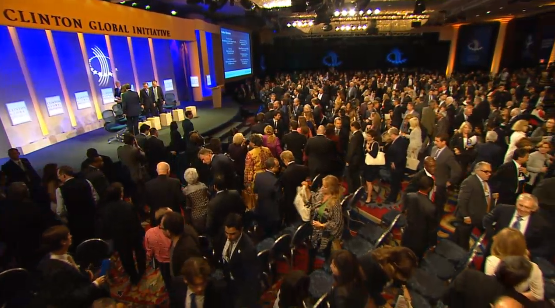
Bill Clinton's eighth annual, star-studded thinkfest on philanthropy, technology, social enterprise and cause advocacy — the Clinton Global Initiative 2012 — kicked off Sunday in Manhattan with a call to delegates to step up their impact on a global scale, to "design your actions in advance to make it more likely they will succeed."

In opening remarks decidedly less optimistic than in previous years, Clinton signaled impatience. "I want to say my standard broken record," he told attendeees, "that cooperation works better than conflict. I say that not for the purpose of avoiding disagreement—there will be a lot of those here—but the point is to act." [At one point during an opening panel with U.N. Secretary-General Ban Ki-moon, Queen Rania of Jordan and World Bank President Jim Yong Kim, Clinton challenged Wal-Mart President and CEO Michael Duke to open a store in Libya and create jobs in some of the world's crisis hotspots. Duke responded that his company already operates in "high-risk areas" but not yet in Tripoli, the Libyan capital.]

"How come we can never seem to take solutions to problems to scale?" Clinton asked delegates and panelists, alike, alluding to the theme of this year's conference, Design for Impact. Since the first CGI conference in 2005, delegates have pledged millions to create new projects to ease hunger, stem environmental damage, and lift thousands of people out of poverty. But Clinton urged delegates to now act more collaboratively, and quickly, to translate what works in their individual projects into larger, cross-border deployments. "There are all of these places, all over the world, and they're all so different. How can we take what we know to work, and scale it quicker?" Clinton asked. "...How can countries come together amid all these cuts in foreign assistance? How can we plan and execute our way out of the current economic crisis (globally) without backsliding on all of these humanitarian goals?"

"If we do not deeply understand the communities we are trying to serve, we cannot design causes for impact." -- IDEA CEO Tim Brown

This is the fifth consecutive CGI that Cause Global has attended; the crowd at the New York Sheraton Hotel in the heart of midtown Manhattan is, once again, a testament to Clinton's continuing clout on the world stage, with appearances scheduled for Tuesday by both Governor Mitt Romney and President Barack Obama, the new leaders of Egypt and Libya (attending amid the opening of this year's United Nations' General Assembly across town], and a blue-chip roster of bold-faced names from the worlds of media, business, policy think tanks and entertainment, including wellbeing guru Deepak Chopra, Actors Michael Douglas, Forrest Whitaker and Geena Davis, Newsweek/Daily Beast Editor-in-Chief Tina Brown, fashion designer Donna Karan, Council on Foreign Relations Co-chair and former Clinton Treasury Secretary Robert Rubin, Barbra Streisand, Loew's Hotels CEO Jonathan Tisch, and philanthropist Eli Broad.

Much of the program will be unfolding during simultaneous break-out sessions and delegate design-for-impact workshops taking place on Monday and Tuesday. Some of the sessions will be livestreamed over the Web. Cause Global will be tweeting from the floor and during some of the breakout sessions. You can follow our CGI tweets @CauseGlobal throughout.

[The 2012 Social Good Summit, a separate conference occuring simultaneously across town, also is exploring impact, but mostly through the use of social media for cross-community action. Cause Global also is covering that conference, sponsored by the United Nations Foundation, Mashable, the 92Y, Ericcson and the Gates Foundation. Watch this space for separate posts.]

To view Sunday's opening plenary session of CGI, a conversation between Bill Clinton and global heads of state, click HERE. In that conversation, United Nations Secretary General Ban Ki-moon , alluding indirectly to the civil war in Syria, issued a "call for alarm" by world leaders and, alluding indirectly to Syria's civil war, urged more collaborative political leadership across the world. His remarks are excerpted, below:

"I'm going to sound the alarm to all leaders for more leadership. We are living in an era of insecurity, injustice, inequality, and intolerance. I want to emphasize that political leadership is needed. This is a collective responsibility of all of our leaders at this time in our history.  I was just in Srebrenica, a place that may be the most difficult place to visit for any Secretary General of the United Nations. It was most humbling, sad, and troubling to realize the international community failed to protect the lives of many in the civilian popultion. We could have done that. We could have done it if there was a very clear, strong political will. More than 8,000 boys and men were murdered in just three days (in July 1995). Why and for what? In Rwanda, hundreds of thousands were killed in the span of a year. Why? Because we lacked the political will to protect the civilian population. We must respect human dignity ... and we have to set this world right, put this world on the right track for humanity. That is what the UN will continue to try to do but we need all of you to get engaged, as we can't do it alone." 

Among other first-day highlights:

* World Bank President Jim Yong Kim acknowledged that multilateral institutions, including his own, "are not very good nor effective at capturing knowledge of what works and spreading it to others."  Within the multilateral system, he said, "there are so many good examples of what works, yet we don't capture them, codify them, or duplicate them." He also said that global institutions have been "very bad at pulling fragile states out of instability. We do know that one way to do that is to create jobs. What do we know about creating jobs in fragile environments? Well, the folks in Mozambique and Rwanda have done pretty well at it. What are the lessons? The World Bank is filled with master practioners but we haven't been systematic about capturing that knowledge and spreading it effectively." He said his precedessor, James Wolfensohn, often talked about transforming the World Bank into a 'knowledge bank.' "But what does that mean?" Kim asked. "Does it mean that we send everyone our studies and our reports? Instead, we need to turn the World Bank into a solutions bank, and develop a science of delivery and execution around social goals. Solutions in one place may not work in another, but if you have a commitment to continously learn from what people are doing, there is a possibility we can contribute to stability everywhere."

* IDEO CEO Tim Brown spoke with Fast Company editor Linda Tischler, telling her that global changemakers need to learn about local culture and local markets before they can be effective scaling their designs for change, whether for new products or new social problem-solving. "If we do not deeply understand the communities we are trying to serve, we cannot design causes for impact," he said. "You need to be on the ground and to understand the local cultures. You have to be able to connect to the people for whom your designs are meant to serve."

* During a private dinner panel hosted by 10,000 Women, the Goldman Sachs-backed women's empowerment initiative, Liberian business owner Kabeh Sumbo told invitees that "if you train one woman like the 10,000 Women trained me, you train a nation." The panel, moderated by Newsweek and The Daily Beast Editor-in-Chief Tina Brown, was joined by Liberian President Ellen Johnson Sirleaf, U.S. Ambassador-at-Large Melanne Verveer, Nobel Peace Prize winner Leymah Gbowee and New York Times columnist Nicholas Kristof. Kristof said there is mounting evidence that small businesses run by women can dramatically influence local communities and "lift nations" over time. But Sirleaf acknowledged that not every woman who wants to start a company will be a success. "Kabeh is an exception," Sirleaf acknowledged. Her administration has given Sumbo 100 acres of farmland to help her grow her palm-oil business, which Sumbo began with one container of olive oil and a microfinance loan. Sirleaf told Sumbo Sunday night, "Kabeh, your 100 acres of land awaits you. I have chosen to put it in my own county so I will be able to monitor you first-hand."

The conference continues through Tuesday. Secretary of State Hillary Clinton is to address CGI Monday morning.

Watch this space for continuing highlights.

-- Marcia Stepanek

[Photographs courtesy CGI and CauseGlobal staff]


Labels: , , , , , , , ,

Friday, September 26, 2008

Heat Wave 3


The Clinton Global Initiative ended today, unbowed by the U.S. economic crisis. Top attendees — which included some 45 global CEOs, 60 heads of state, scores of advocacy leaders, and even a few Hollywood entertainers—ended up pledging close to $8 billion for new projects that would improve the lives of some 158 million people around the world.

Some final highlights:

* British Prime Minister Gordon Brown spoke for a full 25 minutes (extemporaneously, without a teleprompter or cue cards), urging the construction of a "global civic society" and the increased use of the Internet and social media to fight for human rights. He also called on those assembled to innovate their 20th-century institutions such as the World Bank and the United Nations to better tackle modern-day challenges of climate change, poverty, and global health and education gaps. Click here to see Clinton's introduction of Brown, followed by Brown's full remarks.

* Social media for social change got another nod at CGI when CGAP (Consultative Group to Assist the Poorest, an initiative of the World Bank Group) pledged $10 million to create a mobile banking system for some 25 million people in 20 countries. CGAP CEO Elizabeth Littlefield called it a "mobile banking call to action." She said: "Millions of poor have been left out of the formal financial system; the brick-and-mortar branch bank system can only go so far." With cellphone service and a local shop handling the cash, she said, "mobile banking can reach every village and barrio in the developing world." Target countries include: Afghanistan, Bangladesh, Brazil, Ecuador, Egypt, Ghana, India, Kenya, Mexico, South Africa, and Uganda.

*Rene Preval, President of the Republic of Haiti, issued a moving, eloquent appeal for fast help rebuilding his flooded nation, ravaged in late August by Hurricane Gustav. "It's sad to say that if there are no dead bodies on the [TV/computer] screen, public opinion becomes disinterested very quickly," he said. "Important work remains to be done." Haiti's infrastructure needs to be completely rebuilt—but not, he said, so it resembles what it was before. "We need to build back better," he said—to better withstand what is certain to be more hurricane activity in the region in coming years due to the affects of global warming. "More than 90 percent of the crops in Haiti have disappeared in this recent string of hurricanes," Preval told a panel on poverty, "and in six months, we will not have any food to give to the population." Fellow CGI attendees Matt Damon and former Canadian Ambassador Frank McKenna (chairman of the nonprofit ONEXONE.org); Wyclef Jean of Yele Haiti, and past CGI attendees Angelina Jolie and Brad Pitt were among those who pledged more aid to Haiti today. More is needed, Bill Clinton said.

"There is a misperception of assets and opportunities in the world and a misalignment of how we invest our time and money and (build) the kind of future we all say we want," Clinton said in closing remarks. "We need to close the gaps between what we feel and what we see, and between what we say and what we do." The first CGI-Asia meeting will be held in Hong Kong December 2-3 and a "youth CGI" will be held at the University of Texas at Austin in February.

(Photograph, Graffiti in Sydney, courtesy istock.com)

Labels: , , , , , , , , , , , ,

Wednesday, September 24, 2008

Heat Wave


Bill Clinton's fourth annual, star-studded thinkfest on philanthropy, technology, and cause advocacy—the Clinton Global Initiative—kicked off today in Manhattan with a bang of urgency. It's the third CGI I've attended; this year's conference is rife with references to global climate change, the U.S. financial meltdown, and the need for the next president, whoever he will be, to restore some of America's standing in the world.

Here are some highlights from today's sessions:

*Bono blasted the failure of the developing world to make progress meeting United Nations Millennium Goals. He also blasted the Wall Street bail-out, saying: "It's extraordinary to me that you can find $700 billion to save Wall Street and the entire G-8 can't find $25 billion to save the 25,000 children who die from preventable diseases and hunger." Bono, flanked on an opening session stage by Al Gore, Lance Armstrong, Bill Clinton, Queen Rania of Jordan, and Liberia President Ellen Johnson-Sirleaf, said: "Bankruptcy is bad enough but this is moral bankruptcy." The lead singer for U-2 and cofounder of Product (RED) also said the next U.S. president should lead a global effort to tackle climate change, poverty, and other global social ills. This, he said, would "help America to re-describe itself to the rest of the world."

*Al Gore urged young people to engage in "civil disobedience" to stop the creation of new coal-burning power plants. The Nobel Peace Prize winner and environmental crusader said that since last year's Clinton summit, "the world has lost ground to the climate crisis. This is a rout. We are losing badly." Gore called on young people to step up and take action. "If you're a young person looking at what is being done right now, and not done, I believe we have reached the stage where it is time for civil disobedience to prevent the construction of new coal plants that do not have carbon capture and sequestration." Gore said there are about 28 coal plants under construction in the United States, with another 20 projects near the start of construction. Gore also called on people to stop "buying the lie, the notion" that burning coal is still an acceptable energy alternative. "There is no such thing as clean coal," he said. "Clean coal is like healthy cigarettes. It doesn't exist."

*Bill Gates, in an on-stage, one-on-one with Bill Clinton, said that amid the financial crisis and economic slowdown, "we have to show [the wealthy] that [philanthropy] is fun, that it has impact, that there are great success stories." When asked what advice he'd give to wealthy philanthropists now taking a beating on the value of their investments, Gates said: "I think there a lot of rich people. The percentage [of their wealth] that is being given to these great causes and inequity relative to that wealth is very small, and so a fairly modest increase in the amount [of giving] going [to philanthropy] can certainly offset the gyrations in terms of stock market valuation."

Click here for the video of the "two Bills" conversing at CGI.

*Bill Clinton told a small group of bloggers that he thinks there is, at least, "a 50 percent chance" that people will give more to those in need during the evolving U.S. financial crisis. He said the meltdown "will make the work of putting philanthropists and organizations together more significant over the next couple of years."

*Former U.S. Treasury Secretary Robert Rubin, a panelist on an anti-poverty panel, called the current U.S. financial crisis "a really extraordinary situation—by far the most extraordinary situation the capital markets have faced since the 1930s." Rubin, currently the director and chairman of the executive committee of Citigroup, said the first priority for the country is to "deal with the crisis of confidence that we're facing." He recommended quick passage of "some version" of the bailout plan now before Congress, saying that "there are no guarantees in life, but what is being proposed could help significantly, and if it's not passed, then it will exacerbate" the crisis.

*Former President George Bush (41st) made a surprise appearance to talk about the need for Americans to join him and Clinton to raise money for families displaced by natural disasters in the American South. "People are without homes and without jobs as a result of forces beyond their control," Bush said. "Just as we Americans gave to the victims of the tsunami four eyars ago, we must give to those in the Gulf suffering from sudden displacement."

The conference continues through Friday.

(Photo of Bono and Al Gore courtesy Jason DeCrow)

Labels: , , , , , , , , , , , ,