#CGI2013: Brokering for Good


Once again this year, Bill Clinton is hosting his annual power-philanthropy conference in New York. His annual Clinton Global Initiative this week marks its ninth year of channeling mega-wealth to social innovation projects around the world. Cool, exclusive, wonky and celebrity-studded, this year's gathering, like others, is also ferreting out new strains of global injustice and dousing them with nonpartisan outpourings of media, money, PowerPoints, and hard work from truly committed people on the ground.
But it is Bill Clinton’s social capital – his remarkable, ongoing ability to forge
unlikely alliances among corporate executives, NGO leaders, celebrities, and government
officials -- that distinguishes CGI as a game-changer in its own right. "The world's problems are so big, philanthropy cannot do it alone," Clinton said again this year in opening remarks. "We need everyone at the table." Indeed, CGI has done much over the past decade to help erode some of the traditional cultural barriers to business collaboration within the American philanthropy establishment, and has helped to focus it more acutely on social impact. Before CGI, there were no other high-profile, independent forums devoted to channeling philanthropic resources into specific, cross-sector giving projects tied
to measurable results. Today? According to the Clinton Foundation's website, CGI members have so far made more than 2,300
philanthropic commitments which have improved the lives
of over 400 million people in more than 180 countries. When fully funded and
implemented, Clinton says, these commitments will be valued at more than $73.1
billion.
To be sure, not all of the projects spawned at CGI have succeeded; not
everyone gets invited back. [CGI rules require philanthropic commitments that can prove impact from one year to the next.] "Solutions are only effective if they are implemented," Clinton told Time this week. And not everyone thinks CGI is inclusive enough, saying it's still mostly centered around the 1% and not the 99% who are innovating the Internet and digital social networks to create mass philanthropy models capable of channeling more funds directly (and more quickly) to those in need.
Still, more than 1,000 large companies, celebrities, governments and big NGOs are represented here, roaming the halls and small ballrooms of the Midtown Sheraton with an enthusiasm for proving the nonprofit/for-profit collaboration model can work to more efficiently and quickly get money to those in need. During opening day talks, Bono talked about how, when he took his fight against AIDS in Africa to American and European consumers with his One (RED) campaign, he was able to raise $200 million for the cause, while Sheryl Sandberg of Facebook touted the recent launch of Internet.org, a Facebook-led initiative to bring
connectivity to billions of women in poverty living without it.
["U.S. lawmakers would tell us we're not feeling the (AIDs) issue at home," Bono told CGI attendees, sharing that his Global Fund to fight AIDS was flagging until he harnessed it to consumer market forces. "So we went straight to the people, to the shopping malls and Gap stores, and through the marketplace, RED started to turn up the heat on the issue. The marketplace is where the real money lies. Do you want a blue iPod or a red one? Kids started choosing red because they knew that purchase would count."]
Philanthropist Bill Gates, meanwhile, named again by Forbes last week as the wealthiest man in America, urged the nonprofit community to work even harder at nonprofit/for-profit collaboration. "It's interesting that nonprofits think the for-profit guys are evil," Gates told attendees. "That attitude has blocked cooperation in the global food and drug-health sectors" and it's slowing aid to the world's hungry and dying. On the other hand, Gates said, philanthropy has a unique role in the social good sector because it is more easily able to fund the smaller, risker projects, the kind "nobody else wants to touch," Gates said. "You don't want (as a philanthropist) to go into an area that is already well-covered."
["U.S. lawmakers would tell us we're not feeling the (AIDs) issue at home," Bono told CGI attendees, sharing that his Global Fund to fight AIDS was flagging until he harnessed it to consumer market forces. "So we went straight to the people, to the shopping malls and Gap stores, and through the marketplace, RED started to turn up the heat on the issue. The marketplace is where the real money lies. Do you want a blue iPod or a red one? Kids started choosing red because they knew that purchase would count."]
Philanthropist Bill Gates, meanwhile, named again by Forbes last week as the wealthiest man in America, urged the nonprofit community to work even harder at nonprofit/for-profit collaboration. "It's interesting that nonprofits think the for-profit guys are evil," Gates told attendees. "That attitude has blocked cooperation in the global food and drug-health sectors" and it's slowing aid to the world's hungry and dying. On the other hand, Gates said, philanthropy has a unique role in the social good sector because it is more easily able to fund the smaller, risker projects, the kind "nobody else wants to touch," Gates said. "You don't want (as a philanthropist) to go into an area that is already well-covered."
Cause Global has
attended seven out of the nine CGI meetings in New York. This year, attendees have started to refer to themselves as being in "the social commons." As the designer, Eileen Fisher, told Cause Global today: "These are exciting
times for philanthropy because the tent is expanding, big-time, and now, it seems, everyone can play."
Among other first-day highlights:
*Bono did a good impression of Bill
Clinton, to help fill time for the former President when he
ducked back stage to get his glasses prior to starting a morning panel. The video of Bono’s impression got more than 6,000 hits by day's end. Clinton, returning to the stage with his notes, quipped that “it must be real easy to make
fun of me; anybody can make fun of me.”
* Sheryl Sandberg joined the International Monetary Fund’s Christine Lagarde and 24-year-old Khalida Brohi, founder of Sughar Women Program in Pakistan, to talk about the need to do more to empower the world’s women in poverty. “We’re going to invest in women and recognize that women need to lead,” Sandberg said of Facebook, her employer. Brohi, whose organization aims to mobilize a million women in the next 10 years, shared a phrase her father would tell her to encourage her to translate her tears into action. “Don’t cry, strategize,” Brohi said. Sandberg, meanwhile, gave a nod to Hillary Clinton, saying few have done as much for women’s empowerment as she has, stressing the double standard women face around the world with a quick poll of how many female leaders in the audience have been called “bossy.” “We teach ourselves from very young age that men should lead and women shouldn’t,” Sandberg said. “When this changes, we will have a society more productive, more peaceful and families will be happier.” Lagarde encouraged women to get into politics, citing countries like Rwanda, with a Parliament composed of two-thirds women. “In every crisis you see women rising,” Lagarde said. “When it’s messy you get the women in but when the mess is sorted, you need to keep the women in.”
* Mo Ibrahim, the Sudanese-British mobile communications billionaire and founder of the Mo Ibrahim Foundation, blasted the West for neglecting investment in Africa, chiding Google for investing only relatively small sums and criticizing U.S.-based Internet giants for being “totally absent” from the push to provide broadband data access to some 3 billion in Africa who still don’t have it. He also rebuked stereotypes about Africa on corruption, saying that “for every corrupt leader, there are 50 corrupt business people, half of them sitting here.”
* Sheryl Sandberg joined the International Monetary Fund’s Christine Lagarde and 24-year-old Khalida Brohi, founder of Sughar Women Program in Pakistan, to talk about the need to do more to empower the world’s women in poverty. “We’re going to invest in women and recognize that women need to lead,” Sandberg said of Facebook, her employer. Brohi, whose organization aims to mobilize a million women in the next 10 years, shared a phrase her father would tell her to encourage her to translate her tears into action. “Don’t cry, strategize,” Brohi said. Sandberg, meanwhile, gave a nod to Hillary Clinton, saying few have done as much for women’s empowerment as she has, stressing the double standard women face around the world with a quick poll of how many female leaders in the audience have been called “bossy.” “We teach ourselves from very young age that men should lead and women shouldn’t,” Sandberg said. “When this changes, we will have a society more productive, more peaceful and families will be happier.” Lagarde encouraged women to get into politics, citing countries like Rwanda, with a Parliament composed of two-thirds women. “In every crisis you see women rising,” Lagarde said. “When it’s messy you get the women in but when the mess is sorted, you need to keep the women in.”
* Mo Ibrahim, the Sudanese-British mobile communications billionaire and founder of the Mo Ibrahim Foundation, blasted the West for neglecting investment in Africa, chiding Google for investing only relatively small sums and criticizing U.S.-based Internet giants for being “totally absent” from the push to provide broadband data access to some 3 billion in Africa who still don’t have it. He also rebuked stereotypes about Africa on corruption, saying that “for every corrupt leader, there are 50 corrupt business people, half of them sitting here.”
* Barack Obama joined Bill Clinton on stage
to promote Obamacare as part of the Administration's two-week blitz to build public support for the new health insurance law. The GOP Congress is waging an effort to defund the law ahead of October 1, when new health-care
exchanges will begin to enroll people for health insurance coverage that will take effect in
January. “Let's face it," Obama quipped, "It's been a little political, this Obama-care thing." But Clinton was far more pointed. “What you’ve had is an
unprecedented effort that you’ve seen ramp up over the last month or so in
which those who have opposed the idea of universal health care in the first
place have fought this thing tooth and nail through Congress and through the
courts and so forth," he said. "They’re trying to scare and discourage people from getting
a good deal.” Obama said those who need health insurance should tune out the
naysayers. “Make your own decision about whether it’s good for you,” Obama
said. “What we are confident about is that when people look and see they can
get high quality, affordable health care for less than their cell phone bill,
they’re going to sign up.”
* Cherie Blair, the wife of former British Prime Minister Tony Blair and founder of the Cherie Blair Foundation of Women, conferees worked on ways to get more smartphones into people’s hands to create new opportunities for women. “Without access to mobile, so many poor have been cut out of the global economy,” Blair said. According to statistics, she said, countries that boost mobile phone access by 10 percent experience a 1.2 percent economic bump. But even the $20 needed to buy a phone is too much for the billions earning less than $2 a day, Blair said, and for women living in extreme poverty, there are often cultural barriers, too. Women in Africa and the Middle East are 23 percent less likely than men to have mobile access, she said. All told, Blair said, some 300 million women across the world could have access to mobile phones but don’t, due to cost, cultural attitudes that give men first preferences, fear of technology and environmental limitations such as a lack of electricity. Literacy creates another barrier, Blair said.
* Cherie Blair, the wife of former British Prime Minister Tony Blair and founder of the Cherie Blair Foundation of Women, conferees worked on ways to get more smartphones into people’s hands to create new opportunities for women. “Without access to mobile, so many poor have been cut out of the global economy,” Blair said. According to statistics, she said, countries that boost mobile phone access by 10 percent experience a 1.2 percent economic bump. But even the $20 needed to buy a phone is too much for the billions earning less than $2 a day, Blair said, and for women living in extreme poverty, there are often cultural barriers, too. Women in Africa and the Middle East are 23 percent less likely than men to have mobile access, she said. All told, Blair said, some 300 million women across the world could have access to mobile phones but don’t, due to cost, cultural attitudes that give men first preferences, fear of technology and environmental limitations such as a lack of electricity. Literacy creates another barrier, Blair said.
CGI runs through Thursday. Watch this space for further highlights.
-- Marcia Stepanek
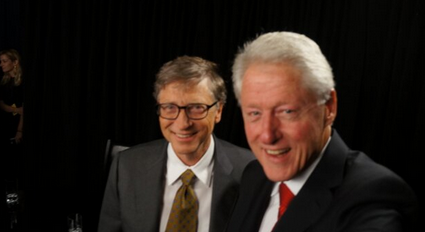
[Photography: courtesy CGI; Bill Gates and Bill Clinton, top; Bill Clinton on the CGI stage with Barack Obama, middle, and Sheryl Sandberg of Facebook, bottom]
Labels: Bill Clinton, Bill Gates, Bono, CGI2013, Cherie Blair, marcia stepanek, philanthropy, Sheryl Sandberg, social capital, social enterprise, women's philanthropy
posted by Marcia Stepanek at
11:22 AM
0 Comments