Tuesday, August 19, 2014

The Ice Bucket Challenge


Unless you've been living under a rock this summer, you've probably heard about the Ice Bucket Challenge by now—and how thousands of celebrities and ordinary people across the country are challenging each other via social media to make a video of themselves dumping ice water on their heads to raise money for research into ALS, better known as Lou Gehrig's disease.

You've probably also heard the criticism of this novel fundraising campaign—that it's silly, that it's narcissistic, and that it's slacktivism. Not suprisingly, perhaps, many social good sector veterans worry that big, viral social media campaigns like this one, which require the participation of others online, are a terrible substitute for real, long-term involvement in a cause. But that's not all. Some drought-weary residents of California have been especially critical of the campaign, blasting organizers for wasting good water.

Vice News reporter Arielle Pardes put it this way: "There are a lot of things wrong with the Ice Bucket Challenge, but most annoying is that it's basically narcissism masked as altruism."

Whoa! Before you think that everyone is throwing cold water on this blockbuster social media campaign (sorry)—or should—listen up.

1. The campaign is working. More than a million challenge videos have been posted on Facebook, the challenge has raised well over $6 million and counting to fight the disease, according to the ALS Association. Last year, says the association, they were happy to get a fraction of those donations.

2. This is philanthropy by the 99%.  Before social media, philanthropy was mostly played offline and by the 1 percent, the high net-worth crowd. Now? Social media have brought everyone to the donor table, and online campaigns that can raise $5, $10, or $20 each from thousands (if not millions) of cause-wired do-gooders should be applauded. Five dollars here, 10 dollars there—pretty soon, it's enough money to make an impact.

3. Narcissistic? Maybe. But have you ever been to a philanthropy charity gala? Showing off for charity is hardly new—and not only online. Making a video selfie of yourself participating in a good cause, and having fun doing it, is not much different than elbowing your way into a charity gala and getting your photo taken for the society pages (or, for most of us, the nonprofit's Flickr pages). When people give money for good, they want a pat on the back for it. Showing off is something that big-money philanthropists have done for decades, and selfies are hard for anyone to resist. Why wouldn't Millennials do the same thing? Look at it this way: Bill Gates put his name on the Stanford University computer school building that his philanthropy enabled. My friend Lisa Sennis? Like thousands of Millennials over the past few days, she made a YouTube "selfie" of her getting ice-water poured over her head. She put her name on it, and shared it digitally. She also donated $100 to the ALS Association online and noted that, too—on her tweets and on Facebook. Granted, a YouTube video isn't the same as having your name on a building somewhere. But it's very definitely the same idea—a digital twist on philanthropy's centuries-old naming traditions. Give, get. Showing off is universal. [And Bill Gates also had a video made of himself getting soaked, which was viewed on YouTube more than 10 million times.]

4. And one more thing? The Ice Bucket Challenge is fun. It's been a long, dicey summer, pepper-sprayed with racial tension in Ferguson, Mo., a new terrorist group called ISIS, the outbreak of Ebola in West Africa, more creepy data security leaks, and a weird-and-getting-weirder climate. Nothing wrong with chilling out for charity on a summer afternoon, right? Since the early 2000s, Millennials have been staging experience-based, group giving activities—from grow-a-beard contests for charity to shopping cart races that spectators place bets on for social good. Being surprised that something like the Ice Bucket Challenge can go viral means you haven't been paying attention. Young people, and all other socially-networked 99 percenters, are reshaping philanthropy and advocacy. They've been doing that for a while now. Embrace it. Be thrilled more people want to do something.

But just in case you're still wondering where we stand on this social media phenomenon, here's what we told NPR-Los Angeles earlier today, when they asked. Have a listen, and tell us what you think.

--Marcia Stepanek

[Photograph: From the Bill Gates's YouTube video for the Ice Bucket Challenge]

Labels: , ,

Thursday, September 26, 2013

#CGI2013: Bill Gates on 'Rich Dogs' and Risk


The philanthropist Bill Gates, speaking on a panel at the Clinton Global Initiative, which ends today, urged nonprofit leaders to work harder and better at collaborating with business on social good projects. "It's interesting that nonprofits think the for-profit guys are evil," Gates told some of the world's most influential philanthropists and CEOs, NGO executives and government delegates to Bill Clinton's annual confab. "That attitude has blocked cooperation in many areas of the global food and drug sectors." And, Gates said, that attitude is blocking aid to the many of the world's hungry and dying.

The Microsoft co-founder and former CEO, in a candid assessment of philanthropy's role in global social innovation, also urged fellow philanthropists to start funding riskier projects "that nobody else wants to touch." Said Gates: "If you're a philanthropist, you don't want to go into an area that is already well-covered." Philanthropy, he said, "has more leeway to experiment. It should fund the higher-risk projects and let businesses and governments do the easier stuff."

What follows is an edited transcript of an interview with Gates that The Economist's Matthew Bishop moderated from the CGI stage this past week. Bishop is author of the book, Philanthrocapitalism, about the rise of for-profit/nonprofit partnerships for collaborative social impact.

Q/ BISHOP:  The world is having a discussion right now about what follows the Millennium Development Goals for 2015. How do we set targets (for global social good) for the next 15 years that are big bets—that are achievable bets but not too hard or too easy to achieve?

GATES: The Millennium Development goals are a phenomenal thing. They are the eight priorities that were adopted by the (UN) General Assembly (in 2000) as a report card for the world. They're very focused on  inequity—in health, in education, and in economics. It's quite amazing that several of them will be fully achieved, even though they were set quite ambitiously. The poverty goal [to halve the rate of extreme poverty by 2015] was achieved. And in fact, in the next round—the goals for 2030—we could get to extremely low levels of poverty around the world. In the health area, we had 12 million children dying every year from a starting point of 1990; we're now down to 6.6 million, so we'll be, by 2015, down to close to a 50 percent reduction. The Millennium Goals have been wonderful because they allow us to look at the countries that are doing it the best, and to go in and talk to the leaders of the countries that aren't and make it a priority. I think the world has come around to the idea that you really need amazing partnerships to make these big things happen. For child mortality, you have to break it down and say, okay there's malaria.  What can the drug companies do? What can UNICEF/World Health Organization do? What can the local governments do? There's diarrhea, there's pneumonia, there's the first 30 days. And so it's all become really quite concrete. And even philanthropy, which is a smaller percentage of the dollars here compared with, say, the private sector, rich world donations, and local governments, it can get involved in some of the riskier things. For example, the actual vaccine development teams (are funded) mostly by philanthropy. Philanthropy is the major player in that part of it. So it's amazing to see how all of that has come together.

Q: But when you think of the next set of goals, the next 15 years, how far should we stretch to accomplish even more?

GATES: The inequity today, that a child under 5 has 30 times chance of dying than a child in a middle income country, gives us a chance in the next 15 years to to largely eliminate inequity. We won't get it down to zero. There will still be a differential there.  But  we can make a very dramatic change. So the fact that these Millennium goals are unfinished goals, and that if we keep them as unique as they've been—and keep up these (for-profit/nonprofit) partnerships—we will be largely complete by 2030. To me, that says that these goals should be the centerpiece of what gets adopted as the world's next report card. Now, because Millennial Development Goals have been successful and every cause in the world would like to have an MDG, there will need to be some tough choices made in terms of measurability and prioritization.

Q: As you think about how to put your money and Warren Buffett's money to work to achieve social good, how do you determine how to get maximum bang for the buck?

GATES: Well, obviously, you don't want to go into an area that is already well covered. And because philanthropy is small, even compared to aid budgets, you have to pick something that is probably risky and therefore not likely to be taken up by aid budgets. Take inventing new vaccines. Governments other than U.S. really don't get into that kind of upstream R&D.  And that's a global public good. As Africa develops, it's not going to get organized to finance the malaria vaccine for itself any time soon. So philanthropy can be very complimentary. I totally agree with the private sector that we need those roads and electricity in a big way in Africa, but we need to realize that five or six magical new vaccines are needed, too, so that's a great place (for philanthropy) to specialize. Now, that kind of philanthropy is very risky. You need to have to have a lot of oars in the water. And you're going to need partnerships, working with universities and the NIH and the pharmaceutical companies, where there's a lot of expertise that only exists with them, so crafting exactly how you work with them is important. We do a report card called the Access to Medicine Index, that rates all the pharma companies on how much they do to help poor people. And it's been great because every year, the bar has gone up. The drug companies at the top want to do more and stay at the top; the ones on the bottom definitely see that, their employees see that, and so they push forward on it.

And further on risky philanthropy, consider polio eradication. It can only work if every country in the world manages to get  those polio drops out to over 90 percent of the kids that need them, around the world. And so now, we're down to northern Nigeria, northern Pakistan, and there's been a big outbreak in Somalia recently. In these places, getting access to those kids is very tough because of rumors that these are people from the West coming in with vaccines, they're from the U.S. and the rumors that the U.S. uses vaccination campaigns for bad things. And that has really overwhelmed the trust and knowledge you want to have on the ground to allow those vaccines to come in. We could fail.  We raised a little over $4 billion at a (polio) summit earlier this year and everyone endorsed a plan (for polio eradication) that runs through 2018. It's the kind of thing the world should take on because if you take it on, it will save millions of lives. But it's not an easy thing. It's not like building a wing of a museum, where probably it will get done. This one? Polio? It should get done.

"Polio eradication? It's not an easy thing. It's not like building a wing of a museum, where it probably will get done."

Q: Is it really worth the effort, to take the last few steps that could mean complete eradication?

GATES: That's sort of a math test. The only reason we have so few cases now is because we are spending so much money. If you stop spending the money before (the death rate from polio) gets to zero, then it goes back and hundreds of thousands of kids get sick or die every year, and the problem gets worse. But if you wait to stop spending the money until after you get to zero, it gets kind of nice because then, you can spend the money on other things—pneumonia, diarrhea, neo-natal, and whatever those other causes are. So you really have to judge, can it be done? The whole credibility of the global endeavor is very much tied up in this (the fight to eradicate polio). Will those hold-out countries allow us access to those kids? That's what this whole thing rests on. There are days I worry we won't get it. But overall, I'm quite optimistic.

Q:  Let's consider, for a moment, the "f word" of failure. In the business world, failures can often be taken as a badge of honor: you tried something, and you learned from it. But in the philanthropic world, failure really is a swear word. People don't talk about it and there is a sense that people don't take enough risks.

GATES: Well, people don't take enough risk, that's fair. And they try to do too many things. If you really want to take on big risk, you really have to be willing and able to develop deep technocratic understanding of the science, the tools, and the social science factors that weigh into the delivery (of the aid you're giving). Philanthropy should be taking much bigger risks than business. If these are easy problems, business and government can come in and solve them. Probably the most risky thing (the Bill&Melinda Gates Foundation) is doing involves the money we spend in the United States, where our top priority is changing the teacher personnel system in K-12 eduction so that teachers get feedback, so we learn from teachers who teach extremely well, and so we have a professional assessment system to really understand how to do things better and get the average teachers into the top quartile. But that has become subjected to all sorts of controversies—with the school board system, with some people who love the status quo and amid controversy over just how it would get done. This project has a very high high chance of failure, whereas our malaria work is just a question of when. I'll be disappointed if it takes too long. Malaria deaths will come down. We will discover drugs and vaccines and we'll get more bed nets out. Malaria is just (a matter of) impatience and cleverness. There is no mode of total and utter failure on that path, whereas K-12? All the money we spend on that could end up being wasted.

"Malaria deaths will come down. We will discover drugs and vaccines and we'll get more bed nets out. Malaria is just (a matter of) impatience and cleverness. There is no mode of total and utter failure on that path, whereas K-12 education? All the money we spend on that in the U.S. could end up being wasted."

Q: Throughout your philanthropy, you've been partnering with business. You just announced a partnership with JP Morgan on health innovation. Do you think the business world is finally escaping the Milton Freidman narrow view of a company's role in society and is now more willing to engage in some of these big bets to improve the world? 

GATES: The private sector is the biggest force in terms of dollars and innovation and often, that takes a form of trickle down, where, for example, a medicine will be invented for rich customers and then it's made available over time, as the patent expires and as manufacturing becomes more efficient. Now, that  has done an amazing amount of good. Unfortunately, that model doesn't work for everything because rich people don't get malaria. One truly ironic thing is that a drug was developed for rich dogs. These dogs had a real problem. They had worms and people wanted to pay to get rid of their dogs' worms, and so there was a great market for it. Ivermectin was developed for that. And then somebody said let's try it on humans in Africa. They have worms, too. And in fact it worked very well and the companies were extremely generous in donating all of that. But that's a strange form of trickle-down from rich dogs to poor people. A lot of things we can't do that way. I will say that in terms of some of these for-profit/nonprofit partnerships, it's sometimes interesting that the nonprofit guys think the for-profit guys are evil...and that's blocked cooperation between some of food companies and some of nonprofit actors in (various countries). ...Bridging the gap between the way the private sector thinks about things and what's reasonable to ask them to do—and the nonprofit people, who know how to deliver aid and are devoting their lives to it—trying to get the best of both worlds out of that often takes a middleman listening to both points.

 "It's sometimes interesting that the nonprofit guys think the for-profit guys are evil..."

Q: What could the private sector do better in these partnerships?

GATES: The most classic example is the Clinton Foundation. We went from suing the South African government for off-patent use of drugs to now getting all the poor countries to get their AIDs drugs at the lowest possible price and there's no intellectual property involved in that at all. That model has been very successful.

Q: We need to measure progress carefully, but when is measurement taken too far?

GATES: You need to do things that are hard to measure but there are some things you really can't measure very well. Consider the child mortality area. We are trying to ensure that kids survive malnutrition but many are damaged mentally by malnutrition, and there's a danger that if we don't understand that, we won't focus on the right interventions. There's a huge hidden cost in health care that goes beyond death. They do IQ studies in Africa, and the numbers in some parts are unbelievably low because kids that have gone through early malnutrition are never developed fully mentally. Anything you can measure is great but you want to make sure you're measuring the right things.

Q: And then there is, in much philanthropy today, a push for social innovation. You, for example, have decided to innovate the toilet. Why have you done that, how is your project going and are there similar, less-trodden areas where philanthropists might bring innovation?

GATES: It's a fantastic example where trickle-down doesn't work. (laughter). The rich world toilets are built on a Rube Goldberg kind of scheme, where you bring all sorts of water in, you make it dirty, you send it to very complex plant to clean it up. Just the piping system alone, if you were going to do this in the slums of India, you could never afford it. And so we need something with the smell- and disease-prevention characteristics that are as good as the gold standard, which is the flush toilet, but do not require a completely unaffordable infrastructure. And so you have to get the best people in smell, and in taking the disease out of the waste and getting rid of it. We had a big contest recently at Caltech, and gave out prizes, and now we're working on what does the engineering for those ideas look like.

It's easier at the community level to create a low-cost toilet. You want to go into the individual households so women don't have to go out at night, facing some insecurity or harassment. But that would not have happened without philanthropy coming in. Scientists will say, 'Oh, we know how to do smell, but nobody ever asked us to solve this problem with toilets.' So it's taking high IQ scientists who were not thinking much about toilets in the developing world, and drawing them into the partnership to try and help solve these very real and pervasive global challenges.

There are a lot of universities that have programs to come up with tools for poor countries, and you have crowd-sourcing, where someone will put out something and get back amazing results. There was this one thing, a call for a power light that someone suggested be made by pulling up a weight on a pulley to generate the power needed, and that got funded in, like, 10 days. So there's lot of neat things out there.

So, in you're a philanthropist, fund innovation. Pick what you're passionate about and think about what are the innovative tools. It will probably be risky. Are you willing to wait 5-10 years (for results)? Are you willing to figure which universities have the science to connect that area you want to fund? What you want to fund is often not something government does well, like education or even health. government can often miss some great opportunities. But philanthropy can help where others can't, and it's needed and a very important piece in these partnerships to make the world a better place.


-- Marcia Stepanek

[Photograph: Bill Gates on stage at CGI on Tuesday, September 24th]

Labels: , , , , , , , ,

Wednesday, September 25, 2013

#CGI2013: Brokering for Good


Once again this year, Bill Clinton is hosting his annual power-philanthropy conference in New York. His annual Clinton Global Initiative this week marks its ninth year of channeling mega-wealth to social innovation projects around the world. Cool, exclusive, wonky and celebrity-studded, this year's gathering, like others, is also ferreting out new strains of global injustice and dousing them with nonpartisan outpourings of media, money, PowerPoints, and hard work from truly committed people on the ground.

But it is Bill Clinton’s social capital – his remarkable, ongoing ability to forge unlikely alliances among corporate executives, NGO leaders, celebrities, and government officials -- that distinguishes CGI as a game-changer in its own right. "The world's problems are so big, philanthropy cannot do it alone," Clinton said again this year in opening remarks. "We need everyone at the table." Indeed, CGI has done much over the past decade to help erode some of the traditional cultural barriers to business collaboration within the American philanthropy establishment, and has helped to focus it more acutely on social impact. Before CGI, there were no other high-profile, independent forums devoted to channeling philanthropic resources into specific, cross-sector giving projects tied to measurable results. Today? According to the Clinton Foundation's website, CGI members have so far made more than 2,300 philanthropic commitments which have improved the lives of over 400 million people in more than 180 countries. When fully funded and implemented, Clinton says, these commitments will be valued at more than $73.1 billion. 

To be sure, not all of the projects spawned at CGI have succeeded; not everyone gets invited back. [CGI rules require philanthropic commitments that can prove impact from one year to the next.] "Solutions are only effective if they are implemented," Clinton told Time this week. And not everyone thinks CGI is inclusive enough, saying it's still mostly centered around the 1% and not the 99% who are innovating the Internet and digital social networks to create mass philanthropy models capable of channeling more funds directly (and more quickly) to those in need.

Still, more than 1,000 large companies, celebrities, governments and big NGOs are represented here, roaming the halls and small ballrooms of the Midtown Sheraton with an enthusiasm for proving the nonprofit/for-profit collaboration model can work to more efficiently and quickly get money to those in need. During opening day talks, Bono talked about how, when he took his fight against AIDS in Africa to American and European consumers with his One (RED) campaign, he was able to raise $200 million for the cause, while Sheryl Sandberg of Facebook touted the recent launch of Internet.org, a Facebook-led initiative to bring connectivity to billions of women in poverty living without it.

["U.S. lawmakers would tell us we're not feeling the (AIDs) issue at home," Bono told CGI attendees, sharing that his Global Fund to fight AIDS was flagging until he harnessed it to consumer market forces. "So we went straight to the people, to the shopping malls and Gap stores, and through the marketplace, RED started to turn up the heat on the issue. The marketplace is where the real money lies. Do you want a blue iPod or a red one? Kids started choosing red because they knew that purchase would count."]

Philanthropist Bill Gates, meanwhile, named again by Forbes last week as the wealthiest man in America, urged the nonprofit community to work even harder at nonprofit/for-profit collaboration. "It's interesting that nonprofits think the for-profit guys are evil," Gates told attendees. "That attitude has blocked cooperation in the global food and drug-health sectors" and it's slowing aid to the world's hungry and dying. On the other hand, Gates said, philanthropy has a unique role in the social good sector because it is more easily able to fund the smaller, risker projects, the kind "nobody else wants to touch," Gates said.  "You don't want (as a philanthropist) to go into an area that is already well-covered." 

Cause Global has attended seven out of the nine CGI meetings in New York. This year, attendees have started to refer to themselves as being in "the social commons." As the designer, Eileen Fisher, told Cause Global today: "These are exciting times for philanthropy because the tent is expanding, big-time, and now, it seems, everyone can play." 

Among other first-day highlights:

     *Bono did a good impression of Bill Clinton, to help fill time for the former President when he ducked back stage to get his glasses prior to starting a morning panel. The video of Bono’s impression got more than 6,000 hits by day's end.  Clinton, returning to the stage with his notes, quipped that “it must be real easy to make fun of me; anybody can make fun of me.”

   Sheryl Sandberg joined the International Monetary Fund’s Christine Lagarde and 24-year-old Khalida Brohi, founder of Sughar Women Program in Pakistan, to talk about the need to do more to empower the world’s women in poverty. “We’re going to invest in women and recognize that women need to lead,” Sandberg said of Facebook, her employer. Brohi, whose organization aims to mobilize a million women in the next 10 years, shared a phrase her father would tell her to encourage her to translate her tears into action. “Don’t cry, strategize,” Brohi said. Sandberg, meanwhile, gave a nod to Hillary Clinton, saying few have done as much for women’s empowerment as she has, stressing the double standard women face around the world with a quick poll of how many female leaders in the audience have been called “bossy.” “We teach ourselves from very young age that men should lead and women shouldn’t,” Sandberg said. “When this changes, we will have a society more productive, more peaceful and families will be happier.” Lagarde encouraged women to get into politics, citing countries like Rwanda, with a Parliament composed of two-thirds women. “In every crisis you see women rising,” Lagarde said. “When it’s messy you get the women in but when the mess is sorted, you need to keep the women in.”

   Mo Ibrahim, the Sudanese-British mobile communications billionaire and founder of the Mo Ibrahim Foundation, blasted the West for neglecting investment in Africa, chiding Google for investing only relatively small sums and criticizing U.S.-based Internet giants for being “totally absent” from the push to provide broadband data access to some 3 billion in Africa who still don’t have it. He also rebuked stereotypes about Africa on corruption, saying that “for every corrupt leader, there are 50 corrupt business people, half of them sitting here.”  

*    Barack Obama joined Bill Clinton on stage to promote Obamacare as part of the Administration's two-week blitz to build public support for the new health insurance law. The GOP Congress is waging an effort to defund the law ahead of October 1, when new health-care exchanges will begin to enroll people for health insurance coverage that will take effect in January. “Let's face it," Obama quipped, "It's been a little political, this Obama-care thing." But Clinton was far more pointed. “What you’ve had is an unprecedented effort that you’ve seen ramp up over the last month or so in which those who have opposed the idea of universal health care in the first place have fought this thing tooth and nail through Congress and through the courts and so forth," he said. "They’re trying to scare and discourage people from getting a good deal.” Obama said those who need health insurance should tune out the naysayers. “Make your own decision about whether it’s good for you,” Obama said. “What we are confident about is that when people look and see they can get high quality, affordable health care for less than their cell phone bill, they’re going to sign up.”

   Cherie Blair, the wife of former British Prime Minister Tony Blair and founder of the Cherie Blair Foundation of Women, conferees worked on ways to get more smartphones into people’s hands to create new opportunities for women. “Without access to mobile, so many poor have been cut out of the global economy,” Blair said. According to statistics, she said, countries that boost mobile phone access by 10 percent experience a 1.2 percent economic bump. But even the $20 needed to buy a phone is too much for the billions earning less than $2 a day, Blair said, and for women living in extreme poverty, there are often cultural barriers, too. Women in Africa and the Middle East are 23 percent less likely than men to have mobile access, she said. All told, Blair said, some 300 million women across the world could have access to mobile phones but don’t, due to cost, cultural attitudes that give men first preferences, fear of technology and environmental limitations such as a lack of electricity. Literacy creates another barrier, Blair said. 

CGI runs through Thursday. Watch this space for further highlights.

-- Marcia Stepanek

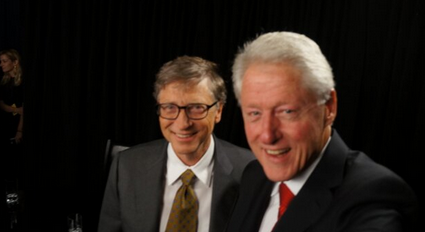
[Photography: courtesy CGI; Bill Gates and Bill Clinton, top; Bill Clinton on the CGI stage with Barack Obama, middle, and Sheryl Sandberg of Facebook, bottom]

Labels: , , , , , , , , , ,

Saturday, February 20, 2010

Gates Goes Green

At this year's TED2010 conference in Long Beach, Calif., Microsoft Founder and Philanthropist Bill Gates took on a new topic: energy and climate change—in part to explain his position amid a surge in requests for his foundation to fund green projects.

In this Feb. 12 talk, released today by TED organizers, Gates unveils his vision for the world's energy future, describing the need for "miracles" to avoid global catastrophe and explaining why he's backing a dramatically different type of nuclear reactor. The goal, he says: zero carbon emissions by 2050.

Labels: , , , , ,

Monday, January 25, 2010

Gates 3.0


Bill Gates released—no, make that tweeted—his second annual letter from the Bill & Melinda Gates Foundation earlier today. [That's right. Bill Gates, starting his second year of life post-Microsoft, now has an account on Twitter. Finally. It's @BillGates, he opened it on January 19th, and as of today—after 19 tweets—he's already got 343,218 followers. His Twitter bio: "Sharing cool things I'm learning through my foundation work and other interests..."]

So far, the billionaire philanthropist is following 42 people, including Vinod Khosla, the venture capitalist, celebrity Ryan Seacrest, commentator George Stephanopoulos, New York Times columnist Nicholas Kristof, President Barack Obama, and dynamic data whiz and public health professor Hans Rosling, for starters.

Gates also just opened a Facebook page [60,000-plus followers so far] and launched a personal Web site, called "The Gates Notes: An Inside Look at Global Matters." (He returns to Facebook after quitting the site last year, saying he was getting too many friend requests and had trouble determining who were his friends and who were strangers.) The Gates Notes, meanwhile, devotes sections to "What I'm thinking about" and "What I am learning" along with "My Travels", "Conversations" and "Curious classroom"—a page he devotes to answering questions from students around the world. [One question, from a high school student in Mexico, prompts Gates to sympathize with the sentiment that people don't always take very young entrepreneurs seriously, explaining that he got his start "young"—at the age of 19.] A sixth page, called "Infrequently Asked Questions" features one of the more frequently-asked of Gates in public forums, "Why not focus on global warming?" (Gates answers the question by saying energy issues are perfect for the marketplace to address but not something any foundation should try to do, and elaborates elsewhere on the site.)

Gates's move to social media, like Microsoft's move to the Web, comes late in the game. But Gates-watchers are taking a better-late-than-never stand, saying his conversion will undoubtedly lend his foundation more of a "cool factor" as well as help to further soften Gates's anti-social image.

Oh yeah, and Gates's 2010 annual letter? This year's note to the social innovation world, as last year's (both inspired by mentor and fellow billionaire Warren Buffett's annual letter to shareholders) is nearly 20 pages long, looks at the state of his $34 billion foundation and pledges to continue to give out record amounts of money this year, even though the global economy has hurt its endowment. Here are just a few highlights, below:

* Gates restated that he sees his foundation's key role as investing in innovations that would not otherwise be funded, and cited the need for new uses of technology, to measure impact more effectiveley so that what works can be replicated globally. (He said the foundation is backing about 30 innovations currently, including vaccines for malaria, AIDS, and tuberculosis.)

* Gates cited the San Francisco startup, Academic Earth, as among new education sites that will "revolutionize education" by offering students personalized learning experiences. Academic Earth, called by TechCrunch a "sort of Hulu for education videos," provides a user-friendly platform for educational video that offers courses and lectures from Yale, MIT, Harvard, Stanford, UC Berkeley, Princeton and others. Gates says his foundation will be investing in online courses that are able to provide interactive applications for children; he says he's also working to ensure that all libraries have computers with Internet access.

* Endorsed President Obama's push to double foreign aid giving, to make sure "the United States will get up into a very respectable range" of giving compared with other wealthy nations. He admonished Italy, specifically, for lowering its foreign-aid budget, saying that in June, he met personally with Prime Minister Berlusconi to make the case for more support, "but I was unsuccessful," Gates wrote. "This is a huge disappointment since I still think the Italian public wants to be as generous as people in other countries."

* Praised the new documentary film about education now airing at Sundance called Waiting for Superman, the story of a several kids trying to get into schools with high-quality teaching. [For more on Gates and his trip to Sundance to support the film, see Bill Gates: Party Animal, in the New York Times blogs today.]

(Photo: From Bill Gates' Facebook page)

Labels: , , , , ,

Saturday, October 11, 2008

Mind-share

I just finished skimming a proof of Michael Kinsley's new book, Creative Capitalism: A Conversation, due out December 2. Kinsley asked Warren Buffett, Oxfam's Elizabeth Stuart, Matthew Bishop and a few dozen others how to retool the global economy to ease poverty.

Say what you will about its timing; the book is intriguing—especially for the way Kinsley got it written. Remember how Mark Twain's Tom Sawyer talked his friends into painting his Aunt Polly's fence (so that he wouldn't have to paint it, himself)? Right after Bill Gates delivered his now famous speech on "creative capitalism" at the 2008 World Economic Forum, Kinsley—the founding editor of Slate—set up creativecapitalismblog.com, a place where people in his network could debate Gates' concept.

Kinsley made their postings into a book. It's 310 pages and 75 very short chapters long and roughly resembles a comment string at the end of a blog entry. Kinsley makes no apologies:

"We can debate the quality of Internet prose: the suspension of grammar, the cutesy acronyms (not to mention emoticons!), the casual spelling, the half-finished sentences, but it is the language of our time. And people do read it. And write it. So the idea for this book was to find a collection of smart people, entice them into a Web-based discussion of creative capitalism, and by this means trick them into producing a book. The book would have the quality of a blog or a "chat" or one of Slate's email dialogues. The prose would be casual, the organization perhaps a bit chaotic. The experience of 'reading' it would be somewhat like surfing the Web—except without the hyperlinks. Plenty of books have grown out of Web sites. But have there been Web sites started with the specific intention of using them to produce a book? Maybe so, but not many. This may remind you of the way Tom Sawyer got Aunt Polly's fence whitewashed. But rest assured that contributors will be compensated."

Most impressive is the brevity of some of the commentary, considering the sources. Kinsley may be on to something (again). Look for more "fast" books to be created this way, via the mass participation of a social network. It's just another way that social media are reshaping the conversation.

(Bending Globe, above, by Laurie Simmons for Project Globe 2008)

Labels: , , , , , , , , , , ,

Wednesday, September 24, 2008

Heat Wave


Bill Clinton's fourth annual, star-studded thinkfest on philanthropy, technology, and cause advocacy—the Clinton Global Initiative—kicked off today in Manhattan with a bang of urgency. It's the third CGI I've attended; this year's conference is rife with references to global climate change, the U.S. financial meltdown, and the need for the next president, whoever he will be, to restore some of America's standing in the world.

Here are some highlights from today's sessions:

*Bono blasted the failure of the developing world to make progress meeting United Nations Millennium Goals. He also blasted the Wall Street bail-out, saying: "It's extraordinary to me that you can find $700 billion to save Wall Street and the entire G-8 can't find $25 billion to save the 25,000 children who die from preventable diseases and hunger." Bono, flanked on an opening session stage by Al Gore, Lance Armstrong, Bill Clinton, Queen Rania of Jordan, and Liberia President Ellen Johnson-Sirleaf, said: "Bankruptcy is bad enough but this is moral bankruptcy." The lead singer for U-2 and cofounder of Product (RED) also said the next U.S. president should lead a global effort to tackle climate change, poverty, and other global social ills. This, he said, would "help America to re-describe itself to the rest of the world."

*Al Gore urged young people to engage in "civil disobedience" to stop the creation of new coal-burning power plants. The Nobel Peace Prize winner and environmental crusader said that since last year's Clinton summit, "the world has lost ground to the climate crisis. This is a rout. We are losing badly." Gore called on young people to step up and take action. "If you're a young person looking at what is being done right now, and not done, I believe we have reached the stage where it is time for civil disobedience to prevent the construction of new coal plants that do not have carbon capture and sequestration." Gore said there are about 28 coal plants under construction in the United States, with another 20 projects near the start of construction. Gore also called on people to stop "buying the lie, the notion" that burning coal is still an acceptable energy alternative. "There is no such thing as clean coal," he said. "Clean coal is like healthy cigarettes. It doesn't exist."

*Bill Gates, in an on-stage, one-on-one with Bill Clinton, said that amid the financial crisis and economic slowdown, "we have to show [the wealthy] that [philanthropy] is fun, that it has impact, that there are great success stories." When asked what advice he'd give to wealthy philanthropists now taking a beating on the value of their investments, Gates said: "I think there a lot of rich people. The percentage [of their wealth] that is being given to these great causes and inequity relative to that wealth is very small, and so a fairly modest increase in the amount [of giving] going [to philanthropy] can certainly offset the gyrations in terms of stock market valuation."

Click here for the video of the "two Bills" conversing at CGI.

*Bill Clinton told a small group of bloggers that he thinks there is, at least, "a 50 percent chance" that people will give more to those in need during the evolving U.S. financial crisis. He said the meltdown "will make the work of putting philanthropists and organizations together more significant over the next couple of years."

*Former U.S. Treasury Secretary Robert Rubin, a panelist on an anti-poverty panel, called the current U.S. financial crisis "a really extraordinary situation—by far the most extraordinary situation the capital markets have faced since the 1930s." Rubin, currently the director and chairman of the executive committee of Citigroup, said the first priority for the country is to "deal with the crisis of confidence that we're facing." He recommended quick passage of "some version" of the bailout plan now before Congress, saying that "there are no guarantees in life, but what is being proposed could help significantly, and if it's not passed, then it will exacerbate" the crisis.

*Former President George Bush (41st) made a surprise appearance to talk about the need for Americans to join him and Clinton to raise money for families displaced by natural disasters in the American South. "People are without homes and without jobs as a result of forces beyond their control," Bush said. "Just as we Americans gave to the victims of the tsunami four eyars ago, we must give to those in the Gulf suffering from sudden displacement."

The conference continues through Friday.

(Photo of Bono and Al Gore courtesy Jason DeCrow)

Labels: , , , , , , , , , , , ,