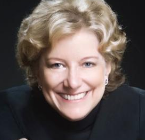
Who is Google's Katie Stanton, the person named today to be White House Director of Citizen Engagement, a new job on Barack Obama's social media team? Here are some bits to add to the emerging picture on the blogosphere: she told attendees at last month's Alliance of Youth Movements Summit at Columbia University, co-sponsored by Google, the U.S. Department of State, Howcast, Facebook, and Access 360 Media that "the Internet is potent fuel for democracy, more than any war or troop surge or invasion." [The summit was organized to respond to the recent, sharp rise in the number of Facebook-organized political protests and mass demonstrations around the world.]
Watch this summit video, below, of Stanton and others discussing how new digital media platforms can be leveraged to affect social change. Stanton [in red] didn't say much, but called the attending youth activists—each of whom had used some form of social media to help bring about social and political reforms in their home countries— "the new United Nations."
(Photograph, Spring 1968 on the Washington Mall, by Max Terkel)
The Alliance of Youth Movements summit at Columbia University ended today with organizers announcing they will turn their six-week-old community of Facebook activists into a permanent anti-violence nonprofit to aid those using social media to work for peace around the world. Attendees included the founders of 17 activist groups that have sprung up independently online in the past year, mostly on Facebook and other social networking sites. Delegates gathered from as far away as Iraq, Egypt, Turkey, Indonesia, the United Kingdom, and Venezuela. Hosted by Howcast, Facebook, MTV, the U.S. Department of State, YouTube, Google, and Access 360 Media, the conference produced a field manual written by attendees that will be used to guide others starting their own Net-powered groups. "The Internet is potent fuel for democracy—more than any war or troop surge or invasion," said Katie Stanton, a group product manager at Google, one of the conference's co-sponsors.
Here are some final conference highlights:
* In Rebooting Politics 2.0, a panel featuring some of the Obama campaign's new media strategists, Sam Graham-Felsen, director of blogging and blog outreach, praised YouTube as a rapid response tool and urged cause activists of all stripes to use the video-sharing site to drum up support and shoot down opponents' attempts to spread misinformation. "During the [Obama] campaign, if the McCain team put out an ad with inaccuracies in it, I'd run over to our deputy economics policy adviser and have him instantaneously rebut the ad, and then we'd put it right on YouTube a few hours later," Graham-Felsen said. He also urged activists to assemble large, online armies to keep supporters engaged. "We had volunteers responding to every Facebook message and Myspace message that came in," he said. "Organizing is the essence of democracy, and the more organizing you do, the more democracy you reap." Added Joe Rospars, Obama's new media director: "At the end of the day, it's all about out-organizing the opposition."
* Luke Russert, MSNBC's 23-year-old youth correspondent and a Summit media panelist, coached conferees to keep their media messages short and targeted to mainstream issues and concerns. "Does a 44-year-old housewife in DesMoines, Iowa, really understand social networking? Probably not," he said. "Keep the cause, itself, the message." Check out Russert's recent interview, here, with Summit co-organizer Jared Cohen, a member of the U.S. Secretary of State's policy planning staff.
* During a panel discussion on how to protect privacy, personal safety, and avoid being shut down in the world's hot spots, Chris Michael of Witness.org warned conferees not to expect technology companies to defend social media-powered activists against censorship or other forms of intimidation. "If a government in a location wants information," he said, "it's very unlikely that a technology corporation will take a stand for an individual human rights activist."
* Sherif Mansour, a program officer at Freedom House, described his group's activist protection program, called the Blue Umbrella, which asks politicians, statesmen, journalists, and others in the West to speak out for those facing jail and torture in Egypt and across the Middle East. Check out this July 2008 video from JourneymanPictures, called Egypt's Facebook Face-Off. It describes how Egyptians are starting to use social media to protest government policies in Cairo:
Here are two "how-to" videos shown to conferees, produced by Howcast, a conference co-sponsor—How to Protest Without Violence and How to Launch a Human Rights Blog:
Inspired by a sharp rise in the number of Facebook-organized political protests and mass demonstrations this year in cities around the world, dozens of youth activists from the U.S. and abroad met today at Columbia University for Day 2 of the Alliance of Youth Movements Summit—a first-time gathering hosted by Howcast, Facebook, MTV, the U.S. Department of State, YouTube, Google, and Access 360 Media.
Selected panel discussions—featuring many of the young people who organized these various mass-scale marches and civic actions in recent months—are being streamed live here. "We noticed a rise of movements all using social networking to fight extremism, so we thought now would be the perfect time to aid and help build momentum for those using online platforms to catalyze social change," said Summit co-organizer Jason Liebman, the CEO and cofounder of Howcast. "All of these groups arose independent of each other. It was time to come together."
Organizers also are using the two-day event to form a new nonprofit to unite global activists and to create a field manual that can be distributed to others about how best to affect Web-driven social change. Updated drafts of the manual can be viewed here.
Among conference highlights so far:
* Oscar Morales, a young engineer and founder of One Million Voices Against FARC, a Facebook group, discussed his use of Facebook to organize what many have described as the largest demonstration in Colombia's history. Morales told conferees his success has proven that social networking can be used to organize citizen campaigns against oppressive forces all over the world. The February 4 protest used word-of-mouth campaigns over Facebook to repudiate FARC guerrillas and turned out more than 1 million people on the streets of Colombia—as well as smaller groups in some 200 other cities across the world, from Berlin to Barcelona, London, Madrid, Toronto, Dubai, Miami, New York, and others. "The Feb. 4 protest was a big slap in the face to FARC, who saw that its ideals were no longer supported by the people, and many members of FARC then started abandoning the group," Morales said. "...Digital platforms are a means to social liberties...We proved that the digitally connected few can connect the masses."
* Juan David Lacouture, the founder of No Mas Chavez, a Venezuelan group that originated on Facebook to oppose Venezuelan President Hugo Chavez’s policies, said his movement "couldn't have started anywhere but on the Internet." The group, which has some 80,000 members on Facebook, staged a mass protest on April 11 that mobilized some 2,000 people to visit Venezuelan embassies in 25 cities around the world to call for an end to terrorism and corruption in that country. The protest also brought thousands of Venezuelans into the streets to call for change. “Facebook lets us stay in contact with friends, relatives, colleagues, and people from our past," Lacouture told conferees, "and it also helps us to express ourselves and carry our messages to thousands and thousands of people.” When asked if extreme left-wing or right-wing groups should have the same access to Facebook to organize, Lacouture said: “I don’t believe anything should be banned online. If an idea is not strong enough and you expose it for what it is, then the idea can be its own biggest enemy. Oppression is sustained by those who would keep bad ideas in the dark.”
* Gemma Olway and Sharon Singh, both 26, organized The People's March Against Knife Crime in London on September 20, which drew 6,000 to a protest rally and gained the attention of British Prime Minister Gordon Brown, other politicians, and the media. The group, formed in July, started as a Facebook group. “We noticed a lot of anti-knife groups already on Facebook but we wanted to unite them to say that enough is enough,” Singh told a Summit panel.
* Elias Kuri, a cofounder of Iluminemos Mexico, organized an anti-violence march on August 30 that was joined by 2 million people in 88 cities across Mexico and in six other countries. Kuri said he organized the march at a time when many Mexicans were horrified by what was then the recent kidnapping and murder of 14-year-old Fernando Martí, the son of a businessman. “Does a march work to make change?” Kuri asked his fellow panelists. “We think yes because when people are angry they want to do something...The important thing was that we didn’t use traditional media to protest. We used the Internet, Facebook, emails, and people just went to the march. The authorities were sure we were going to fail. They didn’t believe the Internet could have so much power.”
* Dustin Moskovitz, cofounder of Facebook, said the 40-and-older crowd is the fastest-growing demographic using the social networking site, a plus for the spread of social activism in the United States and abroad. "We started four years ago as a youth social network and now we are fighting that stigma," Moskovitz told conferees. "In other countries where Facebook is being used, the average age is 45 or 50 years. Our fastest-growing [age] demographics in the United States are 40-plus and we expect that to continue." Moskovitz acknowledged that Facebook groups are still "somewhat limited" in their ability to communicate to very large audiences but said the company is working to expand that capability. He also said Facebook is working hard to discourage al Qaeda and other terrorist groups from using social networks to advance their ideologies. "We work with law enforcement in many countries and we are going to fight people who try to repress free speech all over the world," Moskovitz said. "We already work to expel anyone using Facebook for hate and violence. You can't organize an al Qaeda group on Facebook and expect us to keep it up for very long." Moskovitz did acknowledge, however, that there is a "fine line between harassment and free speech" and told conferees the company is planning to hire more people to help it handle site monitoring.
* James K. Glassman, Undersecretary of State for Public Diplomacy and Public Affairs in the Bush Administration, commended Summit organizers for trying to create what he called "a giant global conversation about how individuals can oppose violence and extremism and stand up for universal values of tolerance, freedom, justice, and social change." He said U.S. government officials have arrived at the notion that the Net is "the locus of civic society" and that governments which don't use the Net to support pro-democracy movements at home and abroad face a greater risk of being ignored by the people they are trying to govern. "What we face today, these threats to liberty and security, cannot be overcome by governments, alone," Glassman said. "Only popular opposition can turn the tide. The forces of oppression and terror have little support but they do intimidate and frighten people into inaction. The Internet is a tool that will help people to overcome." Responding to a question, Glassman said he is confident that the incoming Obama administration will continue the State Department's policies of "Web 2.0 diplomacy." Said Glassman: "I would expect the new administration to take this new approach and expand it, and if they do expand it, I hope they also will provide the resources to do so."
In addition to Howcast videos posted on this site yesterday, see two more, below, released to conferees today—How to Smart Mob and How to Be an Effective Dissident. Watch this space for conference updates.
(Illustration, top, by Miroslaw Pieprzyk for istock.com)
Tomorrow and Friday, an Alliance of Youth Movements Summit convenes at Columbia University Law School to launch a new global youth network to help train people around the world to use social media—from cell phones to digital video to Twitter and other tools—to fight violence and oppression. The Summit was inspired by the recent successes of One Million Voices Against FARC—a Facebook group that used social networking and mobile technologies to organize 12 million people in 190 cities around the world to protest the FARC extremist group in Colombia.
The Alliance of Youth Movements—being organized by Howcast, Facebook, MTV, the U.S. Department of State, YouTube, Google, and Access 360 Media—is crafting a field manual on how to affect social change using the Internet. The first draft can be viewed here.
The alliance also is forming an online "hub" that will include links to community organizing information, a forum for sharing experiences, and instructional videos for creating citizen action groups around the world. The Summit brings together leaders of 17 organizations from 15 countries, including Save Darfur Coalition, One Million Voices Against FARC, Genocide Intervention Network, and Invisible Children. Panels will include talks entitled How to Use New Mobile Technologies and How to Preserve Group Safety and Security. Cause Global will be covering parts of the conference; check this space for updates.
Here are two of the videos being collected by the Alliance as resources for helping cause-wired activists, first posted on Howcast within the last 48 hours:
Ms. Stepanek is a Multimedia Journalist, New Media Strategist, an award-winning news and features editor and author of the forthcoming book, "Swarms: The Rise of the Digital Anti-Establishment." She teaches digital media strategy and cause video at Columbia University, curates a speaker series on disruptive innovation in the advocacy sector and runs a short-form 'micro-documentary' studio in Manhattan. A former Knight Fellow at Stanford and the former Web Strategies Editor at BusinessWeek, Marcia is a frequent speaker on the influence of new media at workshops and conferences worldwide. She was Founding Editor-in-Chief of Contribute magazine, covering the rise of the mass philanthropy movement and the use of social media in advocacy. She blogs for the Stanford Social Innovation Review, Pop!Tech, Videocracy.org and msnbc.com.
This blog covers the influence of new media on popular culture, business innovation, social change advocacy, and the workplace.